
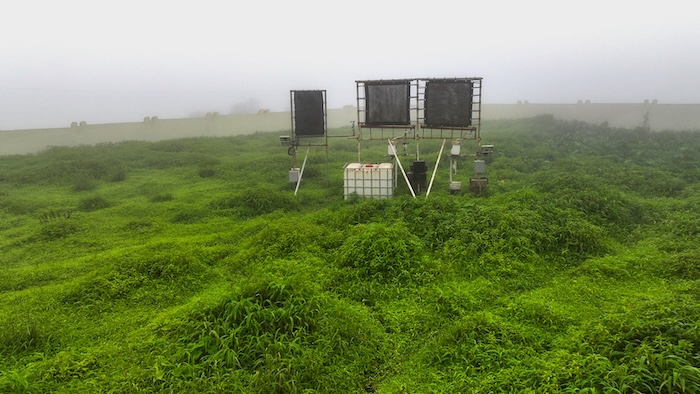
Muscat: The Ministry of Agriculture, Fisheries and Water Resources(MAFWR) is continuing to implement a fog harvesting project in the mountains of Dhofar Governorate to assess the potential of utilising fog associated with the Khareef season as a non-conventional water source. The project aims to enhance scientific knowledge of the quantities of water that can be harvested from this natural phenomenon and identify the most suitable locations for applying the technology in the future.Eng. Khalid bin Salem Al Hooti, Director of the Artificial Rain Enhancement Centre at the Ministry of Agriculture, Fisheries and Water Resources, said the project forms part of the ministry’s efforts to study non-conventional water resources and utilise modern technologies and available natural resources to enhance water sustainability and support the diversification of water sources in Oman.He explained that fog harvesting is a promising technology for utilising atmospheric moisture. It works by capturing water droplets present in fog and converting them into usable water. The technology has relatively low energy requirements, making it worthy of study in areas where fog occurs frequently, including the mountains of Dhofar during the Khareef season.The project includes the establishment of a specialised network to monitor and track fog in the mountains of Dhofar. Twelve fog-collection stations have been installed across nine locations to collect field data during the Khareef season and measure fog condensation rates and the quantities of water that can be collected at different sites.Al Hooti noted that the stations are not limited to collecting water, but also monitor a range of climatic and topographical data associated with fog. This will enable researchers to study the relationship between fog characteristics and the natural and climatic factors affecting the amount of water that can be harvested.The stations are currently operational and being monitored throughout the Dhofar Khareef season, with the aim of building a comprehensive and accurate scientific database that can be used to assess the technical feasibility of fog harvesting and identify locations with the greatest potential for establishing future fog-water harvesting stations.He added that the project uses spatial modelling and statistical analysis techniques to analyse the collected data and develop a predictive model capable of identifying locations with the highest potential for harvesting water from fog. This is expected to enhance the efficiency of future projects and maximise the use of harvested water.Al Hooti stressed that the importance of the project extends beyond the quantity of water that can be harvested, encompassing the development of the scientific knowledge needed to understand the phenomenon and assess its water potential. This, he said, will support future decision-making based on accurate field data.The fog harvesting project is part of the Ministry of Agriculture, Fisheries and Water Resources’ efforts to explore and develop non-conventional water sources and employ innovation and modern technologies in water resource management, in line with Oman’s efforts to improve water-use efficiency, ensure resource sustainability and diversify water sources.
Oman explores fog harvesting in Dhofar to boost non conventional water sources
Full Article
Original Source
Read the full article at Timesofoman →KhanList aggregates and links to publicly available news content. We do not host full articles from third-party sources. Always verify important information with original sources.