
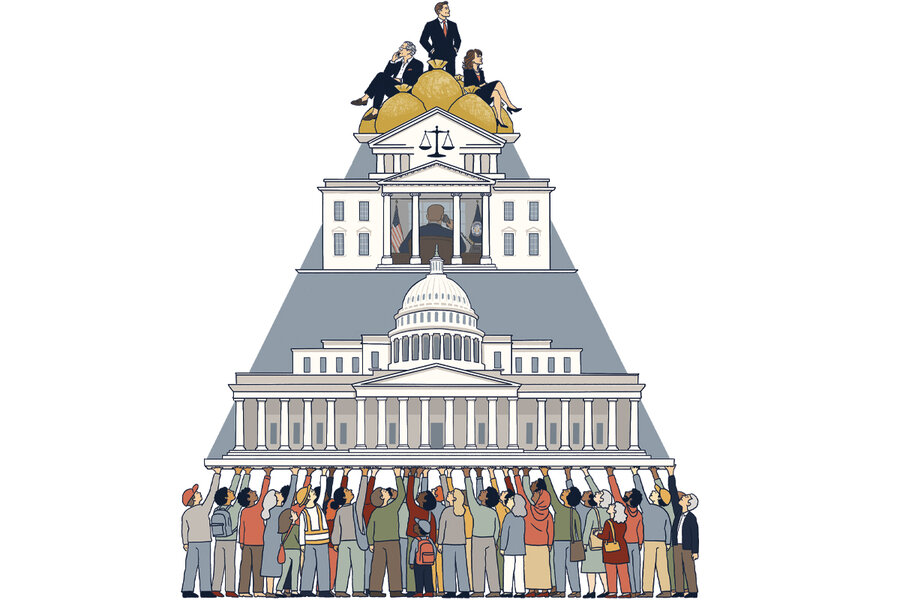
Chicago | Nov. 13, 2026, 1:16 p.m. ET | 9 min read Jeffrey Winters is a professor of political science at Northwestern University and the author of “The Blind Spot: How Oligarchs Dominate Our Democracy.”Over the last 20 years, I’ve witnessed a remarkable transformation in a seminar I teach at Northwestern University called “Oligarchs and Elites.” When the class started in 2006, only one hand went up when I asked if students thought there was oligarchy in the United States. “Russia had oligarchs,” one declared. “The U.S. has rich people.”Today, when I ask the same question, nearly every hand goes up. What’s changed? In 2010, the Supreme Court ruled in Citizens United v. Federal Election Commission that unlimited spending on campaigns was free speech protected under the First Amendment. This opened the floodgates on the use of wealth in elections, establishing that money was a legitimate form of democratic voice. In 2011, the Occupy Wall Street protests focused our attention on the disproportionate power of the 1%. The message resonated not only nationally, but globally. By 2013, the response from the students in my class had started to shift. And this perspective has only hardened as the oligarchs have taken an increasingly visible role in public life, appearing on the same stage with candidates, making speeches, and pouring billions of dollars into campaigns at all levels of government. During the recent midterms, for instance, billionaires made record-breaking investments in campaigns on both sides of the aisle; the top five political investors provided $900 million to the candidates they back. Elon Musk alone accounted for $446 million of this sum. Artificial intelligence companies Anthropic and OpenAI alone funneled $100 million into super PACs supporting both Democrats and Republicans.Today, I find myself struggling to convince my students that there is still a lot that is democratic about our system.Both, I try to teach them, can be true. The U.S. is a democracy. It is also an oligarchy. And we study how the framers intended it to be that way. ■ ■ ■To understand what oligarchy is, we have to start with oligarchs.There are many forms of powerful individuals – those who hold high office; or who command major corporations; or who, like Martin Luther King Jr. or Mahatma Gandhi, mobilize millions. A person who leads a personal militia is powerful. So was Pablo Escobar, who headed a drug cartel in Colombia.Oligarchs’ power comes from massive wealth. Their riches don’t only buy expensive things – if that were the case, the term “oligarch” wouldn’t exist. Wealth in this form also buys political influence. And the troubling thing from an American perspective is that this is just as easy to do in a democracy as it is in a dictatorship.It’s worth pausing on that last point. Oligarchy is not a type of government. It is the use of tremendous wealth to achieve the social, political, and economic goals of the oligarchs. And these goals typically coalesce around one objective: wealth defense. Indeed, the simplest definition of oligarchy might be the politics of wealth defense. This is what unites oligarchs. Those holding great fortunes know that threats to their riches can come from every direction. The nonrich have risen up with pitchforks and torches. Kings tried to grab the landed estates of the nobles. One of the biggest threats oligarchs have faced across the centuries were from other oligarchs using their private armies to enrich themselves. Wealth pyramids are always unstable.So, oligarchs who might otherwise oppose and cancel out each other politically come together on wealth defense.■ ■ ■The rise of the modern state and rule of law solved some problems for oligarchs. With national professional armies and domestic police forces, oligarchs were freed from the trouble and expense of maintaining private armies. Property rights enforced by laws protected their fortunes.But oligarchs became alarmed as the movement for democracy gained momentum in the 1700s. They feared that sharing the powers of voting and voice with the many nonrich was a formula for disaster. How could a wealth pyramid, with only a very few at the apex, remain if the nonrich could use the power of their numbers and the legitimacy of democracy to reduce inequality?Or what if, during a deep economic crisis, the people used democracy to shift more of the financial pain to those most able to bear it?In this country, the collision between the needs of the oligarchy and the ideals of democracy as the will and consent of the governed came to a head as early as the 1780s – and even had a profound impact on the 1787 Constitutional Convention in Philadelphia.There were many problems with the country’s first Constitution, the Articles of Confederation, and there were several calls to hold a convention to fix it. George Washington, Alexander Hamilton, and James Madison were among the most prominent figures urging the states to take action.But every attempt to convene fizzled. Six state legislatures even passed resolutions against holding a convention.Then, oligarchy and democracy collided so frontally in America that the framers believed they had no choice but to take action. They ran to Philadelphia in a panic. The source of the problem was a debt crisis.■ ■ ■Creditor-oligarchs and foreign governments had financed the War of Independence. And in the years following the war, these financiers expected to be repaid – with interest. The burden of repaying that debt fell on America’s small farmers in the form of taxes, which in those days were collected by sheriffs.But a severe economic downturn after the war meant that by the mid-1780s, many of these small farmers could not pay.The U.S. inherited debtors’ prisons from the British. Those unable to pay personal or government debts lost their property and were thrown behind bars, sometimes with their families and often alongside violent criminals.Historical records show that men, women, and children as young as 2 years old were imprisoned by the tens of thousands. These same small farmers were also the only citizens empowered to vote in the new American democracy.In about half of the states, agrarian supporters had captured control of the local legislatures. Farmers asked these representatives for relief so that they and their families could avoid ruin and the prisons. These state legislatures began passing laws that allowed the printing of paper money, which could be used to pay off debts at a steep discount when the paper depreciated against gold and silver.Creditor-oligarchs were shocked. They made loans in specie, but were being repaid at a discount in paper they did not want. Everyone understood that democracy was delivering a majorfinancial haircut to oligarchs.From the perspective of the many, democracy was working in these states. The pain of the depression and debt crisis had become too great for the vast majority of citizens, and the government was stepping in to help.From the perspective of the oligarchs, though, the politics of wealth defense was failing. The new democracy was a threat, just as they had feared.■ ■ ■ The clash was only beginning.In other states, creditor-oligarchs dominated the legislatures. There, the state governments refused to print paper money, even when the farmers begged, pleaded, and petitioned for relief.These farmers saw that their fellow citizens in other states were avoiding debtors’ prisons, while their own legislatures were responding to the wealthy few rather than the many nonrich. The farmers saw this as cruel and undemocratic, and they decided to take matters into their own hands.In hundreds of uprisings in Massachusetts and other states, especially in New England, citizens took up arms and marched into the towns.They did not attack the rich, or fire a single shot. Instead, they freed everyone held in the debtors’ prison. They also blocked judges from holding court, which meant judges could not foreclose on indebted farms or hand those properties to the creditor-oligarchs.The most famous of these direct citizen actions was Shays’ Rebellion, an uprising in central and western Massachusetts.All of this convinced the framers to overcome their reluctance and divisions and finally meet in Philadelphia to address what they saw as alarming trends in American democracy.The state delegations assembled in Philadelphia disagreed about many things. There were big states, small states, states supporting slavery, and states against it. But one thing the delegates agreed on was that, in the words of Elbridge Gerry of Massachusetts, there was an “excess of democracy” in America.The framers genuinely believed in the consent of the governed – as limited as that was in the 1780s – but they also believed in protecting the wealthy few against the nonrich many.During their deliberations, they used words like “democratic licentiousness,” “head-strong democracy,” and “democratical tyranny” to describe the crisis gripping the nation.They worked to find a way to combine oligarchy with democracy. They recognized that extreme economic inequality would lead to political tensions. But they believed those tensions could be managed by the right institutional design of government.Their solution was to restructure American democracy so that it was pyramidal in a way that was parallel to society’s wealth pyramid.■ ■ ■We are taught to think of checks and balances as dividing the legislative, executive, and judicial branches horizontally to ensure that no king or tyrant can get too much power.But the framers also had a very deliberate strategy of vertical checks and balances in mind when they designed the new government to be layered like a great wedding cake, with the power of the people at the base, over which the power of oligarchs was increasingly concentrated upward.The new Constitution they wrote started with a House of Representatives, which was the only part of the government they intended the people to vote on. Above the House, they created a Senate. Its main job was to be a check on the House. They agreed that the Senate would be populated by the rich, and the people would not get to vote on its members. In case threatening policies from below somehow got through the Senate, they gave a veto over the whole legislature to a president, whom they also did not want elected by the people.Finally, in case all of these safeguards failed and an odious democratic action got past the president, they created a Supreme Court that could strike down the democratic actions of the House, Senate, and executive branch.The last decision of the 1787 Convention was to embargo all notes on the framers’ deliberations for at least 30 years. (As it turned out, no one saw them for 53 years.) They did not want an angry backlash against the partial democracy they had designed until it had time to take root and become established.■ ■ ■This structure helps us understand something rather puzzling about our modern political systems. Over the past 250 years, America has become more democratic. The country has abolished slavery, extended the vote to people of all races, and enfranchised women. In 1913, a constitutional amendment gave Americans the right to vote on their senators.And yet, American society has become far more unequal economically. This is because our democracy was deliberately designed in a way that is open to major changes horizontally among the nonrich, but strongly resistant to democratic pressures to redistribute wealth or reduce inequality vertically.The safeguards the framers built into democracy ensured that adopting policies against the interests of oligarchs would be extremely difficult. From the start, wealth poured in from oligarchs to tilt the electoral process in favor of candidates dependent on the rich.What this means is that oligarchy is a feature of our democracy, not a bug. I describe our system as “participatory inequality.”The inequality part is not new. But the participatory part is. Our era is the first time in human history when inequality is maintained and increased through democracy instead of dictatorship.What makes this possible is that oligarchy is woven into our democracy.Writing 2,500 years ago, Aristotle said that the only way an extremely unequal society could be democratic was if the power of the wealthy few was fused with the power of the many. But he added that this would work only if everyone wasn’t quite sure if they were living in an oligarchy or democracy. Confusion is essential to the fusion.That fusion is being tested because oligarchs are far more visible now than at any time since the Gilded Age, when they were called robber barons. Stealth wealth has given way to in-your-face oligarchy, where the ultrarich don’t feel a need to pursue their interests quietly and through politicians. Many have decided to go a step further and dispense with politicians and just use their fortunes to fund their own campaigns. Deepen your worldviewwith Monitor Highlights.Politics with respectGet political stories with respectful analysis.There‘s a world of new ideas in everyBooks newsletter.There‘s more to life, enrich yours withCulture & Learning weekly.Follow humanity‘s discoveries withScience & Nature stories in your inbox.Gain a spiritual perspectivefrom the stories in your inbox.Want to understand the deeper impact of critical events? Learn the Monitor‘s insight.Already a subscriber? Log in to hide ads. This has upended the intentional ambiguity Aristotle said was so important for oligarchy and democracy to coexist. Like my students, the American public has far more clarity about the role oligarchs are playing in their politics.And whether they are Democrats, independents, or Republicans, they don’t like it. ALREADY A SUBSCRIBER? LoginReal news can be honest, hopeful, credible, constructive.The Christian Science Monitor was founded in 1908 to lift the standard of journalism and uplift humanity. We aim to “speak the truth in love.” Our goal is not to tell you what to think, but to give you the essential knowledge and understanding to come to your own intelligent conclusions. Join us in this mission by subscribing.
Oligarchy isn’t a bug of our political system. It’s a feature.
Full Article
Original Source
Read the full article at Csmonitor →KhanList aggregates and links to publicly available news content. We do not host full articles from third-party sources. Always verify important information with original sources.