
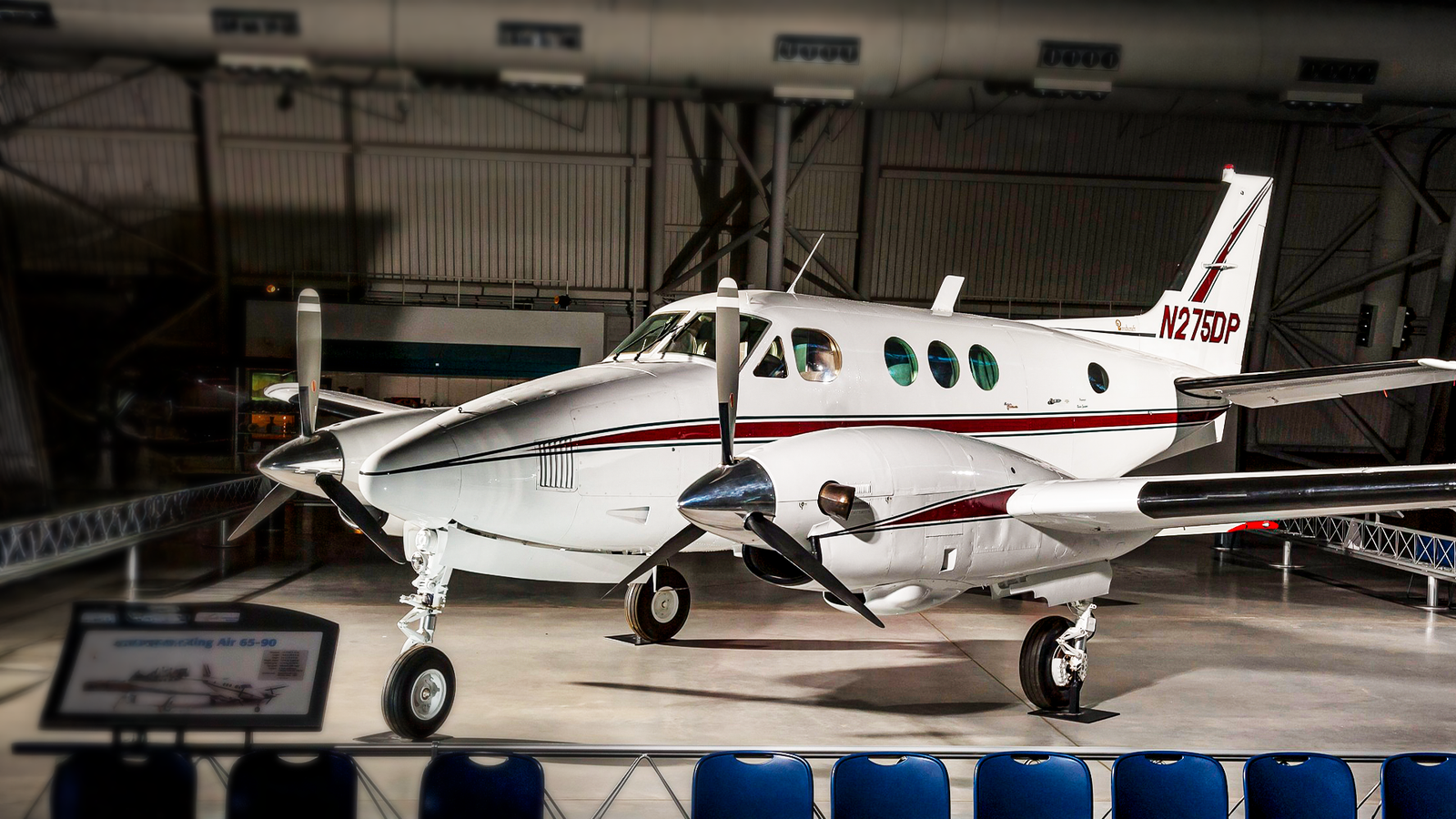
Published Nov 1, 2026, 7:00 AM EST Daniel comes to Simple Flying with a business focused approach to the aviation world. Daniel enjoys analyzing strategy and how companies move against each other to gain a step ahead in the skies. Besides strategy, Daniel also has a passion for aircraft design and the history of aviation. Based in New York Sign in to your Simple Flying account Most cars on the road today were built within the past 30 years, because driving a 1980s or 1970s car is immensely different from driving a modern one. Instead, it's mainly the special vehicles from this era that are still around. Similarly, there are some aging cargo planes and ancient airliners in service, and even some pre-Jet Age relics still fly today, but these are very rare. Instead, airlines keep their planes until they're at most in their 30s. In general aviation, however, not only are 50-year-old planes not unusual, but they're the norm. General aviation refers to everything that isn't airline or military flying, and makes up the vast majority of aviation operations worldwide. While this includes operations such as business jet flying, air ambulances, aerial firefighting, and more, the term is most closely associated with personal operations of small aircraft for recreation or flight training. In these operations, aircraft built in the 1970s, 1960s, or earlier are common, while new planes are comparatively rare. The Age Of GA Aircraft In The US Credit: tuiano I Shutterstock The general aviation fixed-wing fleet numbers just under 220,000 aircraft in the US, according to the Bureau of Transportation. The piston-powered fleet makes up 138,460 aircraft as of 2025, split between 126,915 single-engine piston aircraft and 11,545 twin-engine aircraft. On average, single-engine planes are over 52 years old, while the twin-engine aircraft are slightly younger at over 45 years old. This is significantly older than the average age of the US private jet fleet or the US commercial airliner fleet. Aircraft, of course, can keep flying almost indefinitely so long as they're properly maintained. In commercial and private aviation, what typically prevents aircraft from operating for 40 or 50 years is the economic equation; maintenance costs rise with age, reliability can take a hit, and newer aircraft models are significantly more fuel-efficient. Piston-powered planes, however, are typically bought by owner-operators to be flown for leisure, which changes the equation. Perhaps the figure that most strikingly demonstrates this, however, is the current GA aircraft on sale. Cirrus and Diamond are newer companies that have built GA piston planes for only a few decades, but the Cessna 172, 182, 206, and Piper PA-28 have been in production for over 60 years. The Beechcraft King Air turboprop has been in production for over 50 years. There are several younger aircraft models also on sale, but the legacy products are still selling in high numbers. Production Numbers Of GA Planes Credit: Sandi Smolker I Shutterstock Data from The Air Current show that in 1978, Boeing, McDonnell Douglas, and Airbus collectively delivered 258 aircraft. In 2025, Airbus and Boeing delivered 1,393 aircraft, while adding deliveries from Embraer and ATR brings the number up to 1,658. Meanwhile, 1978 saw general aviation manufacturers such as Cessna, Piper, and Beechcraft deliver nearly 18,000 aircraft, whereas 2025 saw today's manufacturers deliver just over 4,300 aircraft, or about four times fewer than 48 years ago. 1978 was, and remains, the absolute peak of GA production. Production dropped slightly in 1979, but the 1980s saw manufacturers hit by huge waves of expensive lawsuits, while tax code changes and broader economic shifts further pressured the market. Cessna halted production of piston aircraft in 1986, while Piper filed for bankruptcy in 1991. Production of GA planes fell to less than 1,000 aircraft in 1994, while the period following the 'Golden Age of General Aviation' has been called the 'Lost Generation' by some. Production has picked up in recent years, in part spurred by the General Aviation Revitalization Act of 1994, which protected small aircraft and parts manufacturers from certain product liability lawsuits. However, production remains far lower than during the Golden Age, which means there's a relatively large supply of 1970s and 1960s aircraft. Meanwhile, production has been limited for decades, resulting in a smaller supply of newer aircraft and pushing up the average age of America's GA fleet. Prices Of New Versus Old Aircraft Credit: Iv-olga I Shutterstock In 1978, a brand-new Cessna 172 Skyhawk started at roughly $25,000, which is the equivalent of about $127,000 today. Today, however, a new Skyhawk starts at slightly under $500,000, while options can push the price past $700,000. The Piper PA-28 also starts at around $500,000, while well-optioned turbocharged Cessna 182s can near a million. Planes were always expensive, but they were much more accessible during the Golden Age, whereas it requires an entirely different level of wealth to afford a new GA aircraft today. New planes cost significantly more money today than they did 50 years ago, while there is a large supply of new aircraft. As such, it's relatively easy to find early Skyhawks for less than $100,000, while newer, better-equipped examples often cost less than $200,000. The same is true for the Piper PA-28, while 1970s Cessna 182s typically cost less than $350,000. The cost difference further increases once insurance is added in, due to the lower hull value of older airframes. Cessna Piston Aircraft On Sale First Flight Piper Piston Aircraft On Sale First Flight Cessna 172 Skyhawk 1955 Piper PA-28 1960 Cessna 182 Skylane 1955 Piper PA-44 Seminole 1976 Cessna 206 Stationair 1962 Piper PA-46 1979 Maintenance costs can vary widely: older planes are generally simpler but may use scarce parts, and deferred maintenance can make costs shoot up. Generally, however, it's significantly cheaper to buy a used personal aircraft than a new one, and aging examples are quite available. Meanwhile, although these aircraft are hardly modern, they remain perfectly usable, and aftermarket modifications can make used planes as modern as, if not more modern than, new examples coming off the production line. Improvements And Innovations In New Planes Credit: Austin Deppe I Shutterstock Cirrus Aircraft and Diamond Aircraft Industries have become prolific in producing relatively modern, innovative aircraft. As a result, the two companies have become quite successful and are among the largest GA manufacturers in the world, competing effectively against older players with legacy products. Both companies are known for their composite airframes with modern cockpit technology; Cirrus is also famous for its parachute system, while Diamond has been innovating with diesel and Jet-A engines. Innovations in construction, technology, design, performance, and efficiency make newer aircraft platforms desirable, but they remain expensive products. On average, general aviation flights with piston aircraft last fewer than two hours. Plenty of owner-operators use light aircraft for transportation, and features like added speed or improved efficiency can be highly beneficial on these missions. However, many operators also use light aircraft for recreational purposes or flight instruction, where the impact of modern design features is limited. Cirrus Aircraft On Sale First Flight Starting Price Diamond Aircraft On Sale First Flight Starting Price Cirrus SR20 (five-seater) 1995 $694,000+ (G7 standard) Diamond DA20 (two-seater) 1991 $279,000+ (DA20-C1 Eclipse) Cirrus SR22 (five-seater) 2000 $937,000+ (G7 standard) Diamond DA40 (four-seater) 1997 $680,000+ (DA40 NG) Cirrus SF50 (business jet) 2008 $3.1 million (G3 standard) Diamond DA50 (five-seater) 2007 $1.15 million+ (DA50 RG) Diamond DA42 (twin-engine four-seater) 2002 $1.08 million+ (DA42-VI) Diamond DA62 (twin-engine seven-seater) 2015 $1.25 million+ Fundamentally, features like sidestick controls or a glass cockpit are luxuries in GA. They're not necessary for standard flight operations. A commercial airline saves a significant amount of money on fuel costs by acquiring new aircraft, which may also offer new capabilities that older planes don't. However, this isn't the case in general aviation, which makes the massive number of older aircraft much more appealing, especially when you consider the prices of newer-design airframes compared to used examples. The Challenges Of America's Aging GA Fleet Credit: Austin Deppe I Shutterstock GA aircraft production rates remain significantly lower than in the 1970s, creating an interesting market. Although several aircraft types are currently in production, the average age of America's GA fleet continues to rise, while the country's total fixed-wing GA fleet has shrunk over the past several decades. While examples from the 1960s and 1970s are still available, this won't always be the case as aircraft begin to age out. While proper maintenance can keep practically any aircraft airworthy, this becomes harder with age. Maintenance is the largest issue facing today's aging fleet. Original suppliers have discontinued production of parts used by certain vintage aircraft, while full documentation can be difficult to source. Parts shortages can cause maintenance costs to rise, while older planes may also be susceptible to corrosion and fatigue. What's more, a shortage of mechanics qualified to work on older airframes with legacy powerplants and systems is further driving up maintenance costs and making these aircraft harder to own. Within the larger GA industry, there is robust growth in the high-end turbine and business aviation sectors, but the piston market is experiencing a divergence. Manufacturers are generally growing, but the country's piston fleet is gradually shrinking. New planes are extremely expensive, while maintenance costs for vintage planes are rising, gradually pricing some enthusiasts out. Instead, much of the demand for new planes comes from flight schools, which generally prefer the modern features of new airframes.
Older Than Their Owners: How 1970s Aircraft Still Power America’s Private Fleet
Full Article
Original Source
Read the full article at Simpleflying →KhanList aggregates and links to publicly available news content. We do not host full articles from third-party sources. Always verify important information with original sources.