
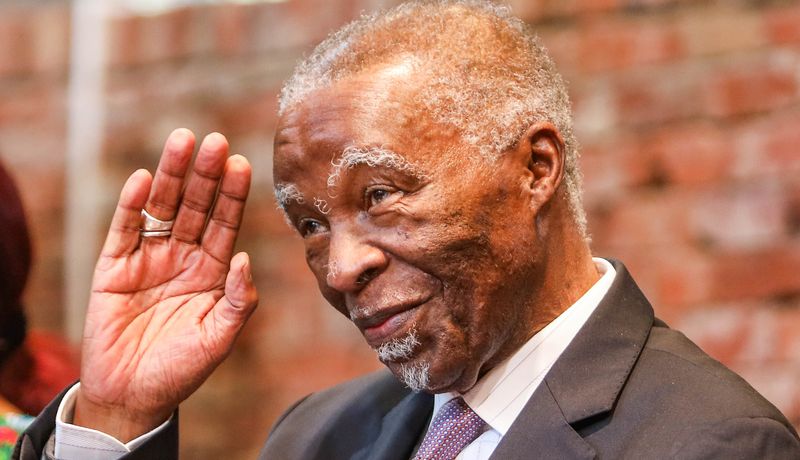
Reflecting on discussions about African infrastructure, development partnerships, Africa-India relations, BRICS, global transformation, maritime gateways and artificial intelligence, Thabo Mbeki asked: “Having discussed those things, what then do we do?” In his valedictory address at the Cape Town Conversation in Cape Town on Tuesday, 24 November, the former president and patron of the Thabo Mbeki Foundation challenged delegates to turn debate into action.Mbeki urged organisers to set aside 45 minutes at next year’s Conversation to review the Sustainable Development Goals (SDGs) and report on progress. By linking the goals to poverty, hunger, inequality and access to energy, he made follow-through a measure of the gathering’s value. He also called for resolutions to be presented to multilateral institutions, including the African Union and the United Nations. Those resolutions, he said, should draw on the “collective brain power” assembled in Cape Town.The fourth Cape Town Conversation, co-hosted by the foundation and India’s Observer Research Foundation, covered geopolitics, BRICS, artificial intelligence, development finance, connectivity and energy. The test is: can the Global South turn strategic importance into power to shape its economic future?Africa is on the map for minerals, shipping routes, its young population, markets and votes in institutions. Attention can resemble power. Agency begins when countries can decide what is built and made, who benefits and how to meet the next shock.When insecurity in the Red Sea or the Strait of Hormuz diverts shipping around the Cape of Good Hope, the route becomes more visible to commerce. But ships do not unload industrial policy with their cargo. A mineral deposit does not automatically become a processing plant, a skilled job or a stronger negotiating position.Samir Saran, president of the Observer Research Foundation, said geography had returned to the centre of global politics. Supply chains are now assessed through security as well as cost; compute, chips, data and minerals help determine who writes the rules. The question is whether new corridors connect African producers or move resources outwards.That depends on integration. Corridors need power, predictable customs, harmonised rules, finance and markets large enough to support production. Fragmented markets and high borrowing costs can turn an impressive route into an expensive road to nowhere. The African Continental Free Trade Area offers a framework, but cannot replace production or infrastructure.African agencyIn the opening address, Nelson Muffuh, the United Nations Resident Coordinator in South Africa, warned that having more partners does not necessarily confer greater agency on Africa if the underlying economic relationships remain unchanged. More partners do not guarantee better terms. Agency depends on infrastructure, energy, skills, institutions, capital and the ability to sustain common positions in negotiations.Muffuh resisted the romance of South-South cooperation. Africa and India’s history of solidarity must produce joint work in food systems, digital infrastructure, renewable energy, research and manufacturing. Partnerships should build local capability, widen opportunity and give countries more room to choose. That standard applies to old allies as much as new ones.The night plenary on US midterms warned against anchoring development plans to Washington’s political cycles. Lisa Singh, director and chief executive of the Australia India Institute, said the results would not restore the US Agency for International Development. Saran warned that a less-constrained president could prove more dangerous. Réka Szemerkényi, former ambassador of Hungary to the US, argued that middle powers could build a steadier agenda through practical cooperation.Democratic supporters at a Democratic Congressional Campaign Committee watch party in Washington, DC, react after the House officially went to Democrats on 3 November 2026, following the midterm elections. (Photo: EPA / Jim lo Scalzo) The return-of-geopolitics panel showed why diversification is costly but necessary. Sergejs Potapkins, former deputy chair of Latvia’s parliamentary Foreign Affairs Committee, said that after Latvia restored independence in 1991, 93% of its foreign trade and 97% of its exports were tied to the Soviet republics. By 2000, trade with Russia had fallen below 10%. The shift was neither instant nor painless. Governments cannot judge diversification only by its immediate price; dependence also carries a bill.South Korea offered a different warning. Kyungjin Song, a senior fellow at Korea University’s Asiatic Research Institute and an adviser to the prime minister of the Republic of Korea, recalled the 2021 urea solution shortage, when more than 90% of South Korea’s supply came from China. The disruption pushed Seoul to diversify its supplier base and strengthen domestic capacity. Yet its semiconductor industry still relies on imported materials and technologies. The aim is resilience with openness, not the fantasy that every input can be made at home.For African states, exposure is compounded by unequal capacity. Liesl Louw-Vaudran, senior adviser to the African Union at the International Crisis Group, pointed to the Democratic Republic of Congo’s efforts to use mineral wealth in security negotiations without securing peace. Somalia’s strategic maritime position has not dissolved fragile state-building or uncertainty over funding for African-led security operations. Geography can attract external powers; it cannot replace stable institutions, regional coordination or peace.Muffuh connected these geopolitical risks to daily life. Conflict destroys infrastructure, displaces people and diverts public resources. Decisions made elsewhere arrive as higher fuel and food prices, disrupted supply chains and tighter budgets. Africa has better data and early warning systems than before, he said, but the weakness is linking that knowledge to timely political action. Vulnerability becomes routine in the gap between knowing and acting.BRICSBRICS was discussed as a route from representation to delivery. Its expanded reach matters, but membership and declarations are not development outcomes. Prabhat Kumar, High Commissioner of India to South Africa, described the New Development Bank’s scope to expand. Ahmed M Darwish, former minister of public administration in Egypt, said it must meet needs such as Africa’s transport bottlenecks. When goods take weeks to cross borders, industry pays the price.The BRICS panel sharpened the question of proof. Victoria Panova, head of Russia’s BRICS Expert Council and deputy director of the Primakov National Research Institute of World Economy and International Relations of the Russian Academy of Sciences, as well as Russia’s W20 sherpa, discussed the links between development banks and the wider finance sector.Mogomme Alpheus Masoga, chairperson of the South African BRICS Think Tank and professor and dean of humanities at the University of the Free State, called for indicators and reporting. Walter Desidera, researcher and coordinator of international relations and integration in the Department of International Studies at Brazil’s Institute for Applied Economic Research, urged joint research. A larger forum is useful if it finances projects, deepens trade and technology links, and reports results.South Africa’s President Cyril Ramaphosa, Brazilian President Luiz Inacio Lula da Silva and Indian Prime Minister Narendra Modi attend a family picture at the BRICS summit in Rio de Janeiro, Brazil, 7 July 2025. EPA/ANTONIO LACERDAThose ambitions meet high borrowing costs, debt-service pressure and gaps in project preparation. Muffuh said reform of the international financial architecture is necessary, but countries must also mobilise existing capital, strengthen domestic markets and develop feasible proposals. A pledge is not a road. Projects need local skills, accountable procurement, maintenance and a route to jobs and value-added. The missing link is often implementation capacity.AI gapsThe AI discussions made the same point. One session on AI and development finance stressed that local priorities, usable data, skilled people, feasible projects and public accountability matter as much as access to a model. Another argued regional AI infrastructure needs public demand, local talent, long-term capital and regulatory capacity. Shared infrastructure can reduce reliance on technology companies, but regional compute and local systems require funding, expertise and sustained public commitment. Sovereignty without capacity to operate a system is only a label on a server.At the development panel, Khalila Mbowe, founder and managing director of Management Unleashed Africa Company Limited, Tanzania, described using AI to connect young women with vetted jobs and preparation support. Her team began with WhatsApp, tested a web app, then returned to WhatsApp before using AI to scale a needed service. In India, Krishnaraju Jampanna, director of solutions at EkStep, designed a voice-based agricultural advisory service around smallholder farmers’ needs, with advice traceable to an accountable institution. These were examples of technology fitted to a defined problem.A person walks past a display during the Bengaluru Tech Summit held at the Bangalore International Exhibition Centre in Bangalore, India, on 17 November 2026. (Photo: EPA / Jagadeesh NV) Other speakers supplied guardrails. Sopiko Beriashvili, research and policy lead at WISE, Qatar Foundation, said teachers should design and test classroom tools; pilots that do not help should stop. Paul McNally, founding director of Develop AI in South Africa, described community-led local-language data collection and journalists checking outputs. Who owns the data, whose language is supported, who corrects errors and who answers when a system fails? If communities supply data while foreign firms own infrastructure and markets, extraction has acquired a digital chapter.The Thabo Mbeki Foundation’s transition aims to connect continental policy with household development. Foundation chief executive Max Boqwana said: “Africa’s plans are written at the level of the continent, but lived at the level of the household. Yet too little connects the two. Our effort is to connect the two.”The foundation has announced its consolidation with the Women’s Development Banking Trust and a name change to the Thabo and Zanele Mbeki Foundation, effective from 2027. The new structure integrates its policy, research, education, leadership and peace-building work with the trust’s experience in women-led development, financial inclusion and community enterprise.Mbeki’s closing intervention put that institutional change to the test. A new name and wider mandate cannot, alone, change the conditions he described. The foundation and its partners must show how convening leads to proposals, which institutions take them forward, what resources they require and who reports progress. Boqwana said participants would meet again in 2027 and account for what they had done with the ideas and plans generated in Cape Town. That is not a ceremonial promise; it is a chance to make the conversation answerable to the people it invokes.The Global South does not lack agendas. It lacks power to make them stick across borders and budget cycles. Africa’s location and resources can open doors, but others may still decide what passes through them. The task is to build the capacity and alliances that let African countries negotiate the route, not merely host the traffic. Mbeki’s question for next year: having discussed these matters, what then do we do? DMBhekisisa Mncube, an award-winning author and columnist, was a guest of the Thabo Mbeki Foundation.
OLD WORLD REORDER OP-ED: Mbeki’s challenge to the Global South — turn debate into action
Full Article
Original Source
Read the full article at Dailymaverick →KhanList aggregates and links to publicly available news content. We do not host full articles from third-party sources. Always verify important information with original sources.