
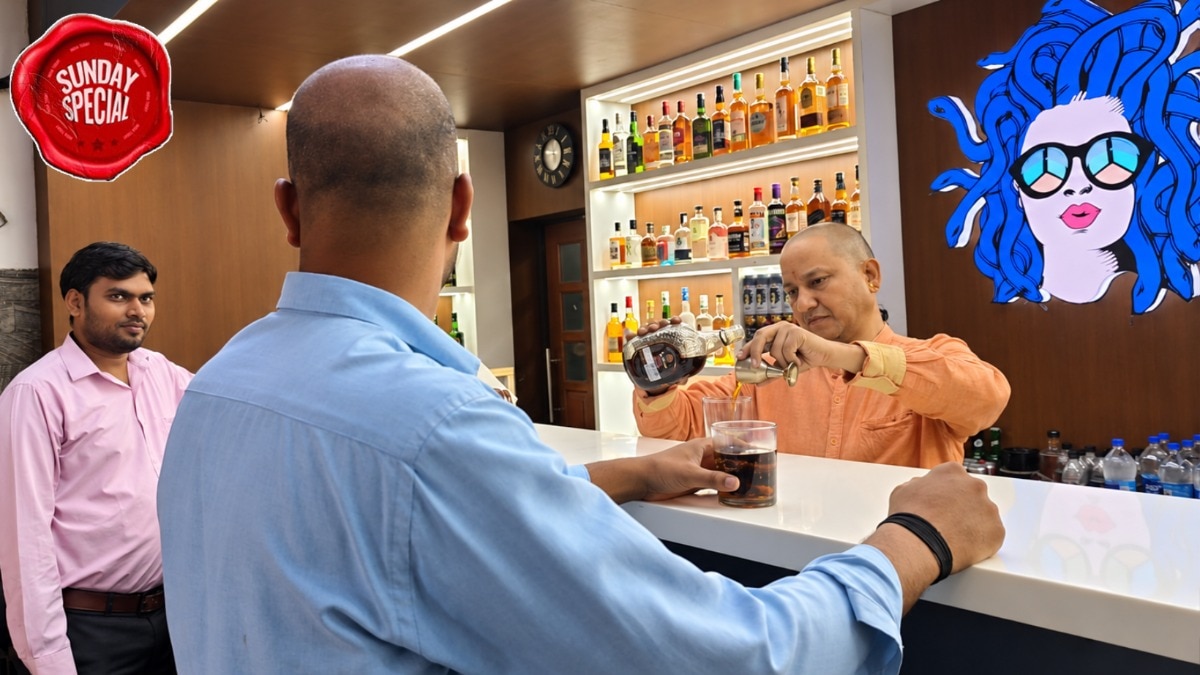
Imagine going to a tea stall for your favourite elaichi chai. Water is boiled, some tea-flavouring agent is added, and the concoction is served to you. You drink it as tea, but you are not told that neither tea leaves nor milk or sugar have been added. What you drank wasn't tea, it was a tea-flavoured drink.That's exactly what Indians are finding out when it comes to their favourite alcoholic beverages, as the Food Safety and Standards Authority of India (FSSAI) enforces labelling norms on Indian-Made Foreign Liquor (IMFL), and a battle is being waged in Bombay High Court. People are finding out that their go-to whisky isn't whisky, and their favourite rum was never a rum.Many are feeling cheated because the legendary Old Monk, venerated across generations, is struggling to call itself a rum. Its sale in Maharashtra has been halted, and it is facing a Rs 1-crore loss in business a day, according to reports. Other brands have capitulated, and are getting their labels redesigned.Old Monk producer Mohan Rocky Springwater Breweries, an affiliate of Mohan Meakin, has also conformed, but the issue has now gone beyond labelling, with the FSSAI saying that it can't be sold as rum. We were told that most whiskies in India were rum, but in this country even rum isn't rum. By the way, the notion that whiskies are rum is false. So, yes, we have an elephant in the Madhushala to address.But the elephant isn't new, it is older than the Indian republic, because that is when the category of IMFL was created and the sale of whisky- and rum-identical alcoholic beverages started in India. Mixologist and author Shatbhi Basu says "the issue has been going on since forever", and this is why Indian spirits were not recognised by the EU, UK and the US.The issue has come to the fore because laws are being amended, and there's stricter enforcement.Across the world, alcohol present in whisky, rum or brandy is generated during the brewing process. Indian mass-market alcobev products are generally extra neutral alcohol (ENA) or grain neutral spirit (GNS) in which flavouring and colouring agents are added to present them as whisky and rum.In fact, India is the largest consumer of whisky in the world. Ironically, the whisky isn't whisky. The question is what is the way going forward? And there are two aspects — consumer rights and billions of dollars of business every year.We will also have a look at the nostalgia associated with Old Monk, the feeling of being cheated, and what loyalists say about the rum-not-a-rum issue.A non-statutory warning first. This Sunday Special is longer than most articles you read on our website. But here is a section-wise guide, which will help you jump some subsections if you are short on time.Read 1 to find out about the FSSAI dispute and the rum question. Subheads 2 and 3 explain why IMFL whisky is closer to desi daaru than any Scotch, but still rules the thekas. You can skip 4 if you don't want to read about the regulations. In 6, we suggest the way forward. Read subheads 5 and 7 for sure, they capture the story's "spirits".1. WHAT IS THE OLD MONK AND THE FSSAI DISPUTE?In early August, the FSSAI barred the sale of certain variants of popular liquor brands, including Old Monk, Antiquity Blue Whisky, Royal Challenge Whisky and Bagpiper Deluxe Whisky over the use of artificial flavours, according to a Reuters report."There is no internationally recognised manufacturing practice whereby rum flavour is added to rum or whisky flavour is added to whisky," the regulator said.What the FSSAI was in effect saying was that the rum wasn't a rum but a rum-flavoured alcoholic drink.On September 3, the FSSAI told the Bombay High Court that Old Monk couldn't be sold as rum, reported Mint.It said the main objection wasn't the labelling of '7 years old blended' and 'very old vatted' but the very nature of the product. "What is not permitted is to sell this product as rum," the FSSAI's counsel said, according to Mint. The lawyer suggested that it could, instead, be described as a "rum-flavoured spirit".The case will be taken up by the high court on September 11. But the FSSAI's assertion shocked generations of Indians."Wow! All along, Old Monk hasn't been a rum at all, but a 'rum flavoured spirit', based not on sugarcane juice or by-products, but a cheap, neutral base spirit, caramel colouring and additives to pass it off as a dark aromatic rum?," wrote celebrated edutainer and content creator Siddhartha Basu on X on September 4.One has to understand the emotions behind the disappointment. Old Monk isn't just any other rum. There are posts and videos on social media that reveal how it has been part of people's journey, the nostalgia value it carries, and its cult status."It does feel wrong though, being cheated about the one thing that you drank when you felt cheated," Joy Bhattacharjya, author and sports producer, wrote on X in August when the dispute over Old Monk's contents first emerged.The story of Old Monk is the story with most IMFL beverages, minus the legacy value. Shatbhi Basu and Rajnish Singh say the government and the alcobev industry will have to work together for regulations that are practical and effective. (Images: Special arrangement/India Today) 2. IS YOUR WHISKY NOTHING BUT DESI DAARU OR COUNTRY LIQUOR?It might sound tipsy talk, but Indian whisky and rum are rather closer to desi daaru or country liquor than what is considered whisky and rum worldwide. That's basically because of how and from what they are made.Whisky is globally made from grain, mainly barley (malt) and corn. Likewise, rum is made from sugarcane juice, and brandy from grape juice. The alcohol is produced during the fermentation process and distillation increases its strength.In India, other than the premium single malts, most whiskies and rums are made from neutral spirits (ENA or GNS), derived mostly from molasses, and these days some grain. Molasses is a byproduct of the sugar-refining process.There is a historical reason why alcohol at a mass scale in India was made from molasses and not grain, like is done in most of the world. "It was simply a commercial enterprise using what was excess of our land — molasses. We needed grain to feed our millions. So grain spirits were never encouraged," explains mixologist Basu.Neutral spirits are nothing but ethanol. Yes, chemically the same ethanol that the government is mixing with petrol."Rum is not rum, but rum-flavored ethanol. Whiskey is not whiskey, but whiskey-flavored ethanol. Life is not a joke, but joke-flavored ethanol," satirist and columnist Kamlesh Singh, the Tau of the popular Teen Tal podcast, wrote on X.The neutral spirits are 96% alcohol by volume (ABV) and demineralised water is added to reduce the alcohol content to 42.8% ABV. Then, depending upon what's desired, specific flavours and colours are added to convert the neutral spirits into whisky or rum. In some cases, some cane spirit is added for rum, and malt spirit for whisky.Across the world, whisky is made by fermenting grains, distilling the liquid, and ageing it in wooden barrels. Where the barley grew, how it was soaked, dried and fermented, what casks were used to age the liquid determine the taste and aroma of the whisky. It is a craft of patience. Tens of millions of casks are sitting in the US and Europe today so that people can enjoy aged whisky several years from now.In India, the neutral spirits get turned into whisky at the blink of an eye. The final product is at best an approximation. It is because of the same ingredients and multi-column distillation process that Indian whiskies and rums are closer to desi daaru than to standard whiskies and rums sold across the world."I think everyone knows that we made our spirits mainly from molasses-neutral spirit and then added colour and flavour of the spirit of choice. Some whiskies were blended with imported scotch malts, but we never knew the proportion as we didn't have specific laws for it," says mixologist Basu. A step-by-step explainer of how whisky is generally produced, from malting to distillation to bottling. 3. WHAT IS IMFL? WHAT ARE THE NEW WHISKIES FROM INDIA?India accounts for nearly half of the world's whisky consumption. In 2023, India overtook France as the world's biggest buyer of Scotch whisky by volume, according to a BBC report.However, that would be a minuscule part of the entire trade. The largest segment of booze in India is sold under the segment of India Made Foreign Liquor (IMFL)."The largest whisky segment in India by volume is the popular or mass-market whisky category, typically priced between Rs 300 and Rs 900. This segment accounts for the vast majority of whisky consumption in the country," says Bishan Kumar, Editor-in-Chief of Spiritz, India's premier alcoholic beverage monthly."While premium whiskies and Indian single malts have been growing at an impressive pace, they still represent a relatively small share of total volumes," he adds.Beyond the mass-market whiskies, a new segment of crafted whiskies is emerging from India. The Indian single malt, Indri, was in 2023 named the world's best whisky. Besides Indri, Amrut, Paul John and Radico Khaitan's Rampur are among the Indian brands giving a tough fight to global alcobev giants for shelf space in India."Our younger entrepreneurs are doing an exceptional job putting India on the global map with world-class spirits — single malts, gin, vodka, agave spirits, liqueurs, even Feni and Mahua," says Basu.However, as Kumar said, the segment forms a small part of the sales as its products are positioned at a much higher price point.The IMFL segment was born because people in India wanted something better than country liquor but couldn't afford the costly imported booze. The industry sensed a big business opportunity, and drinks mimicking whisky and rum started being manufactured. Valued at $60 billion in 2025, India's IMFL market is projected to exceed $101 billion by 2032, according to Associated Alcohols and Breweries Ltd.4. ARE DISTILLERS IN INDIA VIOLATING LAWS?Rajnish Singh from Dhvaen Law Practice, a lawyer and expert shaping India's alcobev industry policies, says there are two sides to the IMFL coin. "On one side, the alcohol companies are legally compliant in what they are doing. The other is of the right of the consumer to know and their trust in the brand," Singh tells India Today Digital.The expert says there are three sets of regulations for India's alcobev industry. The alcoholic beverages regulations of 2018, the additives regulation of 2011, and the labelling regulations of 2020."Having done conjoint reading of the relevant regulations of FSSAI, the rum and whisky products being sold in India are very much in compliance with the regulations," he says.Kumar of Spiritz says the FSSAI might need to revisit the regulations, and that disruptions in business also hit consumers and the exchequer.He, however, suggests standardisation of whisky, rum, gin etc, being made in India, like the Indian Malt Whisky Association has done by bringing all malt whisky makers on the same page.5. WHAT OLD MONK LOYALISTS HAVE TO SAY ABOUT RUM CONTROVERSY"We get it. 'Old Monk isn't rum'. In a gentler world, they could have quietly passed this judgment in stealth mode rather than kill an entire generation's collective nostalgia," posted Parminder Singh, CEO of Reliance Enterprises Intelligence, on X after the FSSAI's submission in the Bombay High Court.Though there is the feeling of being cheated, will Old Monkers give up their favourite poison?I called up an Old Monk loyalist, a journalist for over two decades. Whenever I saw him with a glass at the Press Club of India (PCI), he invariably had Old Monk in it."The debate about whether Old Monk is actually a rum doesn't matter to me. I have been drinking Old Monk for two decades and will continue drinking," the Delhi-based journalist tells me.Does he feel cheated now knowing that his rum wasn't actually a rum?"No, I don't feel cheated at all. I drink Old Monk because it is Old Monk, not because it is rum. I will continue drinking Old Monk even if it isn't branded rum," he says.To understand alcohol preferences, I spoke to Jagdish Singh Rawat, who heads the bar operations at New Delhi's PCI. Now, the bar at PCI must be one of the biggest watering holes in the Capital."IMFL consists of over 90% of all alcohol sold at the Press Club bar. When it comes to rum, Old Monk is about 90% of all rum sales," says Rawat.Rawat, who has worked at the PCI bar for around 22 years, says the "craze" for Old Monk has remained intact over the years. He believes its popularity won't get hit because of the rum debate.The trend is similar in Mumbai, where the sale of Old Monk has been prohibited for now.Gurukripa, a restaurant-bar in Mumbai's Powai suburb, is a mix of a dive bar and a family restaurant. Its clientele consists of students from IIT Bombay, IT employees, and families living in the nearby high-rises."Old Monk has always been a favourite. From students to corporate employees, people from all backgrounds drink it. There is still demand, but since there is no supply, people are mostly going for beer," a management employee at Gurukripa told India Today Digital over the phone.Asked if the rum debate would hit the brand, the staffer said, "I don't think people care whether it's genuine rum or not. It is sold as rum. I only got to know that it isn't real rum when you asked me."While people tend to judge others by the whisky they drink, in the case of Old Monk, it just passes off as the rum they have for old time's sake and because there are "things money can't buy".6. WHAT IS THE WAY FORWARD FOR MASS-MARKET INDIAN WHISKY AND RUM?The Press Club is visited by journalists who are among the most aware people. I think they know what is what, and what goes into most IMFL. They are still asking for their favourite IMFL drinks. So, I don't think the debate is going to change the demand-supply equation," says Rawat.Then he says something that Mohan Meakin needs to listen to carefully. "For most people, Old Monk is rum. Whatever it is made of, it is rum."Because people have put in their trust, it is incumbent upon a brand to tell consumers honestly what is in the bottle.The mass market whiskies and rums fill the big gap between country liquor and imported spirits, and if they exist it is because the demand exists. Therefore, the elephant in the Madhushala will have to be addressed, and a way forward will have to be found."This current fracas may bring about some good changes, but it must come with knowledge and in partnership with the industry and experts in the field," says Basu. "The government must create laws that are realistic and current. Let the distillers take responsibility for their products and label them within the Indian framework. And be honest about the liquid in the bottle."In true sense, rum and whisky should be prepared using cane and malt spirit, respectively, and not be dependent on flavours. That would, however, end up making the final product costlier and beyond the targeted price point, according to experts.Brands will have to come clean and make consumers aware that what they are having is rum-identical, and not real rum. But what about the category and labelling?In 2018, a similar problem cropped up with brandy. While brandy is essentially made from grapes, in India it was being made with neutral spirits and flavouring agents.The FSSAI understood that adding even some amount of grape spirit would create a pricing problem for the distilleries, so, it allowed the creation of a new category — Indian Brandy. Similarly, Indian Rum or Indian Whisky could be a way out."Taking precedence of the definition of Indian Brandy defined under FSSAI rules, the food regulator can consider amending its existing regulations and introducing sub-categories like Indian Rum or Indian Whisky or similar nomenclature, which should effectively portray the true nature of the product being consumed by any consumer," suggests Singh.7. OLD MONK, EMPTY BOTTLES AND MEMORIESLike millions of people, I had Old Monk in the days that I remember because of the struggle. Later, I enjoyed my Old Monk and Coke on winter evenings when I could afford better but felt rum was all I needed. While I switched whisky brands as I matured, the rum was mostly about Old Monk.I have used pyaar and PR with owners of alcohol vends to get hold of Old Monk bottles when they were in short supply in winters. An Old Monk was a must among my bottles of Indian whiskies, single malts and Scotch.Then there was an annual ritual for years. Months ahead of Christmas, I soaked raisins in Old Monk for the Christmas plum cake that my wife would bake. Rum-soaked raisins!!While I liked what was in the bottle, she used the empty bottles as planters. There are several of those bottles with and without plants at my home. The labels on them read, 'Matured XXX Select Rum. Very Old Vatted'.- EndsPublished By: Anand SinghPublished On: Sep 6, 2026 07:00 IST
Old Monk isn't a rum. My whole life was a lie
Full Article
Original Source
Read the full article at Indiatoday →KhanList aggregates and links to publicly available news content. We do not host full articles from third-party sources. Always verify important information with original sources.