
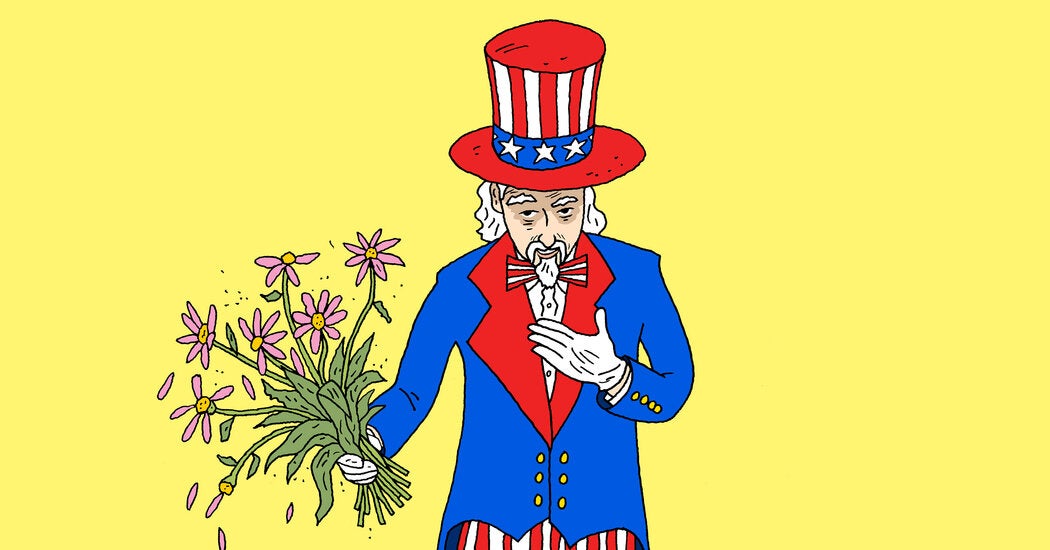
AdvertisementSKIP ADVERTISEMENTGuest EssayNov. 17, 2026, 7:37 a.m. ETCredit...Peter ArkleChrystia FreelandMs. Freeland is a former Canadian deputy prime minister, minister of foreign affairs and minister of finance.Earlier this fall, when I was en route from Toronto to Boston, a security guard running the X-ray machine at Island Airport recognized me with a big smile and a warm greeting.Then he got serious. I was in the wing of the airport reserved for U.S. travel, so he knew where I was headed. He didn’t approve.“Minister, you know we’re not allowed to go there anymore,” he said.I explained that I agreed with Canada’s very unofficial ban on nonessential U.S. trips. Then I assured him I was flying south to make the case for our country, and to visit an institution whose resistance to illegal orders from the White House Canadians generally admire, to boot.He was unconvinced. “Well, Minister,” he told me, “go talk to them if that’s what you need to do. But I hope you tell those sons of bitches that we’ll be better off without them, anyway.”I’ve told this story a few times to U.S. audiences. There is usually a collective intake of breath when I share the first line, about Canada’s de facto national boycott of discretionary U.S. visits.That turns to astonishment, and sometimes outright anger, when I recount the kicker.But my friend at the luggage belt was articulating the national consensus in Canada. And it is not only Canadians who have been getting ready to write off America. For many Europeans, President Trump’s recent betrayal of Ukraine has felt like the last straw, proof that America is on the wrong side in the most serious security threat the continent has faced since World War II.Hans Petter Midttun, a former Norwegian defense attaché to Ukraine, put plainly what many of his colleagues still in government have been saying in meetings with me behind closed doors. “Like China, the U.S. has sided with Russia against Ukraine and Europe,” he argued, going on to say that “the U.S. is no longer an ally, but a strategic adversary.”For a lot of Canadians, and citizens of the other democracies, even this month’s Democratic tsunami in the midterms won’t be enough to immediately change their minds about the reliability of the United States.Mr. Trump knows me, and he doesn’t like me very much: He has called me a “nasty woman” and “toxic” and celebrated my resignation from Justin Trudeau’s cabinet by crowing, “She will not be missed!!!”So my compatriots may be surprised to read my advice here that Canada and the world’s other democracies need to embrace the midterm results as an opportunity to start figuring out how to renew the global democratic alliance — including inviting Washington to rejoin us in a new, more balanced partnership. Crucially, this reimagined relationship needs to be different from what preceded it. Jean Chrétien, the former Canadian prime minister, likes to joke that Mr. Trump should be awarded the Order of Canada, because he prompted our country to do the hard work needed to be stronger and more independent at home. The same is true of the Trump effect in Europe and Asia. Thanks to those efforts, we are all now in a position to create a 21st century partnership, in which responsibilities and authority are more equally shared.But I can’t deny it will be a hard sell.My own, unreliable boyfriend metaphor for America’s fraught relationship with its allies has made it into the popular culture in the Great White North. The Beaverton, Canada’s version of The Onion, pretty accurately summed up the national mood this month with a riff on my conceit: “After a Democratic blue wave swept the U.S. midterms tonight, and Democrats took back both the House and the Senate from the Republican Party, Canada wishes to gently, yet firmly, let all of America know that we will still not be taking you back.”I don’t blame my compatriots for being skeptical. After all, they remember the giddy relief of Joe Biden’s victory in 2020 and how it was followed by the “just when you thought it was safe to get back in the water” nausea of Mr. Trump’s re-election in 2024.The fact that Americans had freely chosen Donald Trump not just once, but twice, made it hard not to conclude that they actually agreed with the self-christened “Tariff Man” and his chest-beating commitment to America first. The great capitulation of corporations, law firms, universities and pretty much the entire Republican Party during Mr. Trump’s first two years in office in this second term seemed to be further proof that the problem wasn’t just Mr. Trump; it was America itself.The seemingly inescapable conclusion was that America — and Americans — simply could no longer be trusted as an ally of the world’s democracies.As Benjamin Haddad, then a member of the French National Assembly, cautioned in early 2024, months before Mr. Trump’s re-election: “We need to ask ourselves if we want to rely on the voters of Montana, Wisconsin and Michigan to keep Europe safe. Basically, Europe’s security would be flipping a coin every four years.”But the break with America was about more than treaties and tariffs, more than reliability and betrayal. The world’s democracies started to give up on America because they thought America was giving up on democracy.Abroad, America’s traditional friends saw Washington siding with dictators and undermining democracies. At home, they saw a MAGA president muzzling universities and the free press, pressuring corporations to kowtow to him, and more, and unleashing masked agents who shot live ammunition at his citizens.That’s why this month’s vote matters so much — and why many of my fellow Canadians are wrong to insist that the rupture with our southern neighbor needs to be irrevocable.America’s democratic allies decided that they needed to permanently break up with the United States because they feared America was permanently slipping into authoritarianism.But two weeks ago, Americans categorically chose democracy. They showed that democracy matters to Americans and that American democracy still actually works.America’s reaffirmation of its own democracy is so critical because the breakdown of the Western alliance is only one act in a larger, global drama. Mr. Trump hasn’t just been trashing American democracy at home. The presidential authoritarian wrecking ball has been deployed around the world, too.This administration has attacked America’s traditional allies, hitting them with tariffs and territorial claims on Canada and Greenland. It has cynically installed a corrupt authoritarian puppet regime in Venezuela, undermining that country’s Nobel Prize-worthy fight for democracy. Most shamefully, it has sided with the Kremlin against democratic Ukraine in Kyiv’s heroic and defining fight for its sovereignty, a struggle in which I am lucky to play a minor role as an economic adviser to President Volodymyr Zelensky.Vladimir Putin, Xi Jinping and Kim Jong-un weren’t on the ballot this month, but they lost just as decisively as Mr. Trump did. The world’s authoritarian regimes have long realized something that the world’s democrats and democracies need to understand: We are in the midst of a global fight between authoritarianism and democracy — and its critical battleground is America.Democracy isn’t doomed without America. But it will be much harder for democracy to survive, and thrive, anywhere in the world without the United States onside.Without America’s money and without its muscle, the democratic alliance will inevitably be weaker. Worse still, without the United States firmly anchored in the democratic camp, the world’s other liberal democracies will be reduced to a fraught balancing act between two authoritarian hegemons — the United States and China.Human rights and the rule of law will be seen as unaffordable fripperies by middle powers struggling to survive in the narrow space between two predatory superpowers. Corruption, as we saw in the first two years of the second Trump administration, will simply become another tool of diplomacy.The sting of America’s betrayal is so sharp for many of America’s traditional allies that it is easy to imagine that America can never again be a true partner — and, indeed, that the best outcome is an alliance of democracies that have moved on from the Pax Americana.That’s because, over the past two years, America has been unreliable at best, abusive at worst. But while America is dangerous as a predator, it is still desirable as a friend.This month, Americans began the hard work of saving their own democracy — and in doing that, they opened the door to rebuilding a relationship with the world’s other democracies.We may be in store for some uncomfortable sessions of relationship therapy over the next couple of years, and there are sure to be painful setbacks, but it is time to start figuring out how we can get back together in a new and better partnership.Even The Beaverton, after its initial dismissive assertion about Canada’s relationship with the United States, conceded that “reconciling our once-great love affair” might one day be possible: “That’s not to say that we can’t be won back, of course! God knows we’re a sucker for second-chance romances.”But America has some work to do if it decides to go back on its self-mutilating decision to break up with its traditional allies. Deep renewal of the democratic alliance will be possible only after the 2028 presidential election in the United States. Only then will the world’s other democracies know if America is really serious about recovering from its slide into authoritarianism.Canadian satirists suggest that one helpful gesture would be to fire the U.S. ambassador to Canada, who, like so many Trump envoys to the world’s democracies, has decided his main job is to amplify his president’s bullying insults.That would be a great start. But Democrats, and Republicans smart and brave enough to break with the president, can and should begin laying the foundations for long-term renewal now. They should begin building back better by focusing on three pillars: tariffs and trade; Ukraine and security; and A.I. and China.First, on tariffs and trade, senior Democrats are already planning to put forward a bill in January that would lift tariffs on America’s allies. Farm state Republicans, who were critical allies for me during Mr. Trump’s first term, would probably support this measure, too.Second, on Ukraine and security, smart Democrats like Gavin Newsom and Mikie Sherrill are taking bold positions on an issue that can connect with Americans who want to rediscover their nation’s moral compass. For their part, Europe and its middle-power allies need to do a Draghi — pledge to provide Ukraine with “whatever it takes” to hold off Russia during what is looking to be a horrific winter. By taking the lead on Ukraine, Europe can show itself to be ready to be an equal partner in a rebalanced and renewed Western alliance.Third, on artificial intelligence and China, America’s democratic allies can help the United States resolve the tension between its technology and its politics. America’s tech lords are globally dominant in A.I. But the American people are deeply suspicious of A.I. and its billionaire proponents. Europe, technologically weaker on A.I. but also facing less public opposition overall to the technology, could be a valuable partner for both the technologists and the populists, and help to bridge the gap between them. Crucially, a trans-Atlantic alliance with a shared A.I. policy could form a common front in handling China, the only other A.I. superpower.This is all important, but what matters just as much is for Europe to rise up out of its defensive crouch when it comes to the White House. The watershed election results offer a clear opportunity to begin building a renewed Western alliance. But that will be possible only if European leaders are prepared to do what the American people did this month and unequivocally stand up to Mr. Trump, including on the unilateral tariffs they were wrong to accept.And then there are the human gestures that, ultimately, are the basis of all enduring relationships.When I landed at Logan, it was a little cold, so I put on my bright red, maple leaf hoodie. As I made my way through the airport, an older couple, speaking with a New England accent, hesitantly approached me.Are you Canadian? they asked. Trust, but verify, I guess.When I said yes, they smiled sadly: We just wanted to say that we are really, really sorry.That is one of the messages Americans sent to the world when they voted this month.It’s a start.Chrystia Freeland, a former Canadian deputy prime minister, minister of foreign affairs and minister of finance, is an unpaid economic adviser to President Volodymyr Zelensky of Ukraine and the author of “Unreliable Boyfriend: An Insider’s View of Dealing With a Chaotic Superpower, Plutocrats and Other Complicated People.”The Times is committed to publishing a diversity of letters to the editor. We’d like to hear what you think about this or any of our articles. Here are some tips. And here’s our email: letters@nytimes.com.Follow the New York Times Opinion section on Facebook, Instagram, TikTok, Bluesky, WhatsApp and Threads.Related ContentAdvertisementSKIP ADVERTISEMENT
OK, America, We Can Still Be Friends
Full Article
Original Source
Read the full article at Nytimes →KhanList aggregates and links to publicly available news content. We do not host full articles from third-party sources. Always verify important information with original sources.