
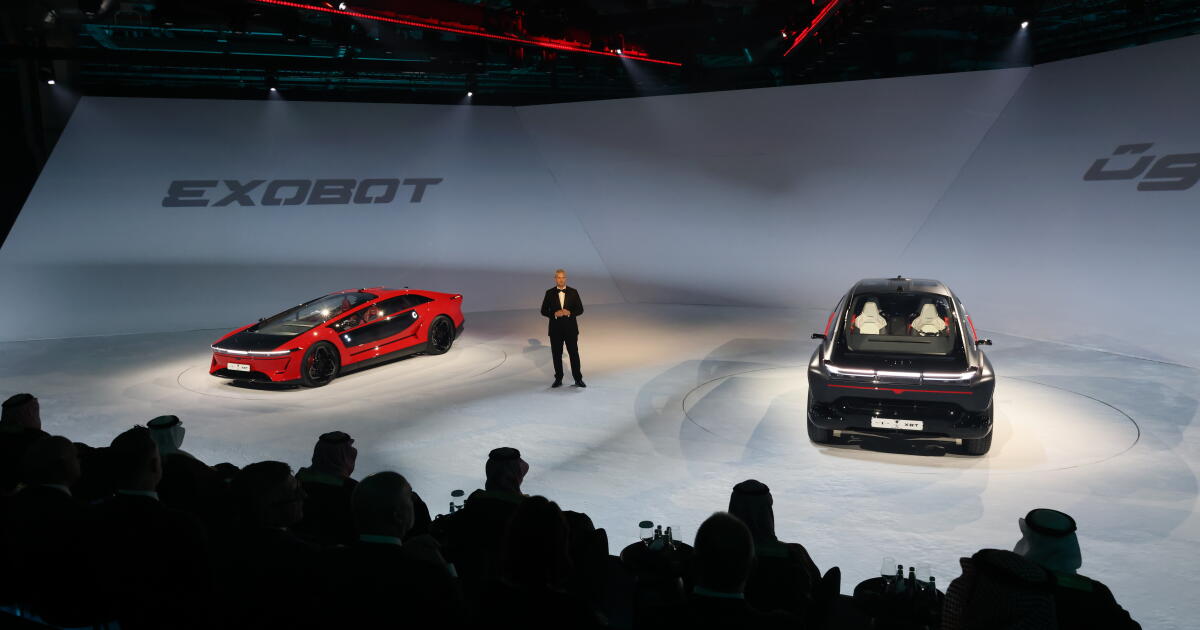
RIYADH, Saudi Arabia — In the quest to become an EV powerhouse, you’d be hard pressed to find a less likely candidate than Saudi Arabia. After all, the country’s lifeblood is oil and combustion engines’ global thirst for it; going electric seems akin to a candy maker switching to fruits.Yet on a pleasantly warm October evening in Diriyah, an enclave that qualifies as Beverly Hills to Riyadh’s L.A., a gaggle of curious Saudi men and women paced around and snapped selfies in front of two futuristic-looking cars — the first in the kingdom’s bid to develop its own homegrown electric vehicle industry.The cars, dubbed Exobot, are the first products of the Saudi automotive startup Ceer, a joint venture launched four years ago between the country’s sovereign Public Investment Fund and Taiwanese electronics manufacturer Foxconn. (BMW is also providing key components.)Beyond the two fully electric cars on display, a sedan and an SUV, the plan is to eventually offer five more vehicles in Ceer’s portfolio by the end of the decade, and branch out into hybrid and combustion engines. The expectation is that Ceer will draw $150 million in foreign direct investment, create up to 30,000 direct and indirect jobs, and contribute $8 billion to Saudi Arabia’s GDP by 2034.That ambition is of a piece with Vision 2030, Crown Prince Mohammed bin Salman’s plan to hedge against a post-fossil-fuel future, and transform Saudi Arabia into a commanding presence in the realms of tech, entertainment, tourism and advanced manufacturing.It’s not the first time Saudi Arabia has forayed into EVs. In 2018, it bought a 5% stake in Tesla before selling it a year later. Also in 2018, the Public Investment Fund plowed money into Lucid Motors, a U.S.-based EV manufacturer, eventually becoming its largest shareholder and opening a factory in the kingdom. But Ceer goes further than those investments, with the aim of becoming the kingdom’s first original equipment manufacturer. It aims to make almost half of its components locally by 2034.“Most countries import EV transition, but Saudi Arabia is manufacturing it and building on the strong financial capabilities that they have,” said Joseph Salem, a senior partner specializing in travel, transport and hospitality at the consulting firm Arthur D. Little Middle East.“The investments today go well beyond selling cars, but also into factories, supplying and charging,” he said.Walt Madeira, a principal analyst for vehicle forecasting at S&P Global Mobility, compared Ceer to other national automotive manufacturers, such as Turkey’s Togg or Malaysia’s Proton, as opposed to countries like Morocco, which convinced foreign carmakers to manufacture in local factories and export to Europe.“Saudi Arabia has very ambitious plans. They’re serious in developing the ecosystem,” Madeira said.The Exobots’ debut arrives at a pivotal moment. Soaring gas prices, spurred by the U.S. and Israeli war against Iran, have energized the global market for EVs and hybrids, with almost a third of cars sold worldwide expected to be electric, according to the International Energy Agency’s Global EV Outlook report this year.That trend holds for the Middle East, where electric car sales in 2025 reached approximately 75,000 units, a 40% expansion compared with the year before, with the United Arab Emirates representing roughly half of regional demand.Saudi Arabia remains a relative minnow: EV sales reached 9.2% in the country, according to a November report from Focus2Move, a Rome-based mobility research firm. And though forecasters say the Iran war and the kingdom’s fight with Yemen’s Houthis are hurting demand, the expectation is it will grow quickly.Though the trends are enticing for any EV aspirant, Ceer enters a market where the bull in the china shop is — ahem — China, with Beijing-backed automakers decimating the bottom lines of storied brands with cheap yet innovative offerings. A worker inspects a high-end bus to be exported to Saudi Arabia at a workshop in Nanchang, China, on Nov. 9, 2026. (Zhou Mi / Xinhua via Getty Images) And because Chinese automakers are building more cars than China’s market can take, they’ve made strong inroads abroad, including in the Middle East.The International Energy Agency reported that BYD, China’s largest automaker, accounted for roughly 60% of Middle Eastern EV sales last year; Tesla by contrast got only 15%. Other Chinese makers include Geely, Avatr and Jetour, and together with BYD sell 1 in every 5 cars in the Emirates.Yet Ceer believes it can compete by emphasizing a theme the crown prince has long focused on throughout his flagship projects: over-the-top luxury, coupled with levels of technology reminiscent of sci-fi movies and games.That ethos could be seen in the cars displayed in Diriyah, which, according to the enthusiastic salesman on hand and employees, were designed with much input from Bin Salman.Both models take the notion of a wedge car — a shape famously popularized by iconic vehicles such as the Lamborghini Countach — and dial it up to a cyberpunk-inspired 11. They also feature gull-wing doors and a 94.5-inch windshield that Ceer says is the largest in the world. Inside, the car has a flight yoke rather than a steering wheel.There are little touches to indicate the cars’ Saudi DNA, from the “Saudi made” badge on the trunk to subtler cues like the shape of the hubcaps, which are supposed to be reminiscent of Saudi architecture; or the 32 LEDs in the car’s front end, a reference to 1932, the year Saudi Arabia was declared a kingdom. Colors, too, are Saudi-inspired, and include options such as “Obaya Black” or “Abha Green.”Performance figures are supposed to match the cars’ aggressive looks. The models have three electric motors from Rimac, a Croatian manufacturer, and Hyundai; collectively they provide 625 kW, the equivalent of about 850 hp, to propel the sedan from 0 to 60 mph in 2.6 seconds, with a range of over 400 miles. Both Exobots sell for almost 400,000 riyal (the equivalent of $107,000), planting Ceer in the premium segment against cars from Porsche, Mercedes and Tesla — a different universe from the sub-$15,000 segment dominated by most Chinese carmakers.“At that price, we’re not looking at the People’s Car,” Madeira said, referencing the Volkswagen Beetle — an example of a car designed to be affordable.“It’s a strategy where they’re getting higher-income consumers to buy this vehicle, then maybe it trickles down where middle-income consumers can see this higher-priced vehicle and aspire to owning the new model.”Yet even here Ceer may not be safe from competition. This year, as Chinese makers face a Darwin-esque winnowing at home, they’re branching out into high-end segments.Geely, for example, has a dedicated premium sub-brand called Zeekr; its newest model, the 9X, comes loaded with gee-whiz tech that only underscores the stodginess of competitors in the U.S. and Europe, including self-parking capabilities and advanced infotainment options.In the UAE, where the 9X is offered at $100,000, Zeekr’s marketing personnel said they had already received 600 pre-orders for the vehicle by September, with a roughly $3,500 nonrefundable down payment.In the meantime, like Lucid before it — which the Public Investment Fund has spent billions propping up, despite losing a billion dollars in 2026 alone — Ceer will benefit from Riyadh’s considerable financial muscle and state planning to ensure success.For example, the government is ramping up investments in charging stations, increasing the few hundred available in the kingdom to 5,000 by 2030 to help encourage EV adoption.Yet with a projected manufacturing capacity of 240,000 cars per year, Ceer will have to look outward. Madeira said the expectation is that Ceer will be able to sell 50,000 to 70,000 cars regionally for it to be considered a win for Riyadh.“First they have to be a success within Saudi Arabia before they start going into neighboring countries,” Madeira said, adding that he expected the Exobots’ price would probably hinder sales performance.“Having said that, I think they’re in it for the long run. They have enough money to sweat it out.” More to Read
Oil-rich Saudi Arabia bets on futuristic luxury cars to build an EV industry
Full Article
Original Source
Read the full article at Latimes →KhanList aggregates and links to publicly available news content. We do not host full articles from third-party sources. Always verify important information with original sources.