
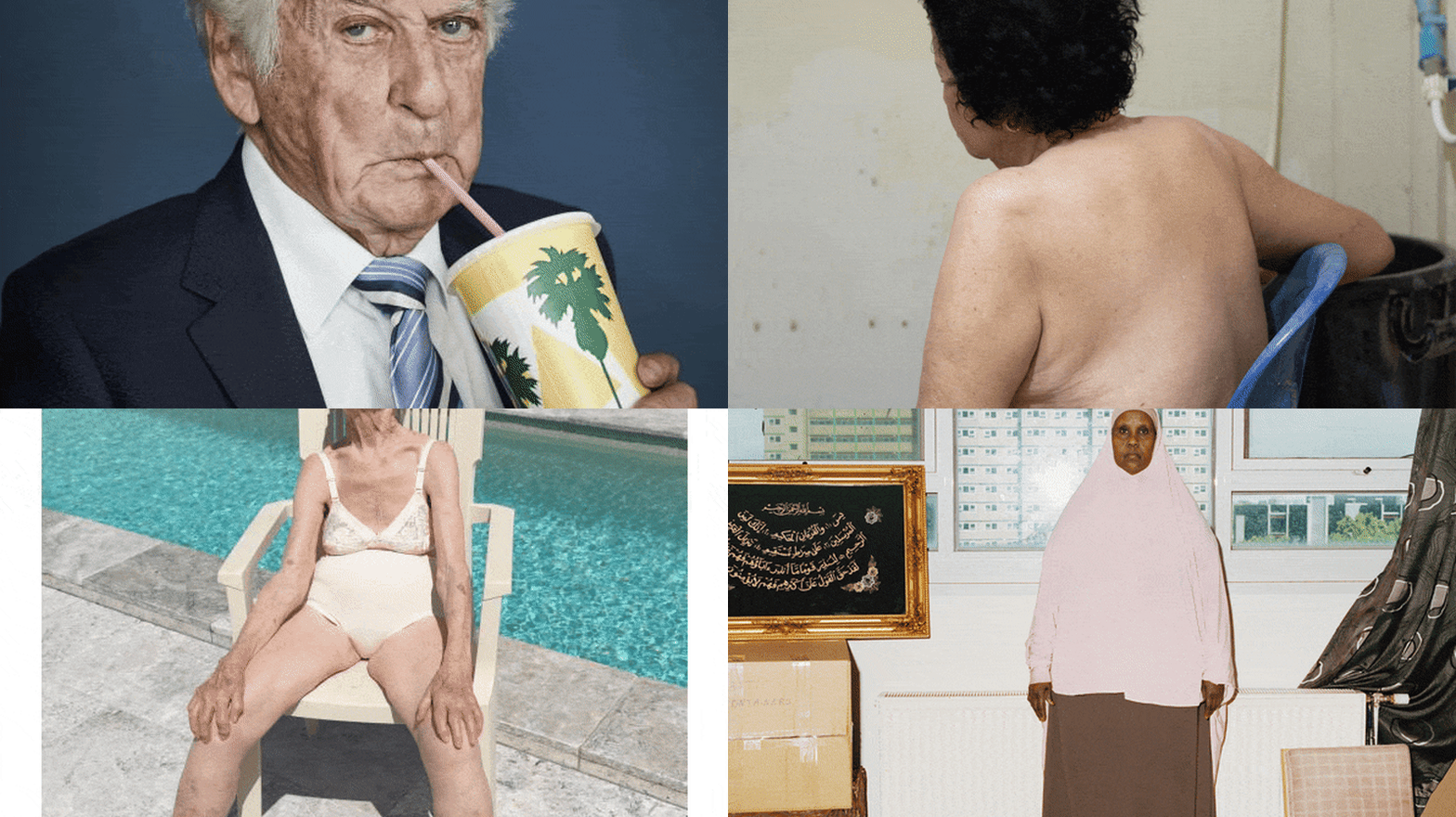
Ray EdgarAugust 27, 2026 — 12:00pmPrime Minister Bob Hawke was a man of lusty appetites. Philanderer, sports fanatic, champion beer-sculler, Cuban cigar lover. And, as Harold David’s surprising 2017 photo reveals, strawberry milkshake enthusiast.David captured the larrikin elder statesman candidly sucking on a tall one during a magazine shoot for the launch of the interview book Wednesdays with Bob.“We were in his house setting up, and he came in drinking that milkshake,” David recalls. “I’m like, ‘Wow, he’s going from chugging beer to drinking milkshakes. I love this.’ I said, ‘I know this isn’t for the magazine, but I need this portrait.’ [Bob] was game and got a real kick out of it. I love that glint in his eye.”The 2017 portrait The Honourable Bob Hawke Savouring a Strawberry Milkshake.Harold DavidYou can almost hear the slurp, as he drains the last drop.David’s unabashed image features in the National Portrait Gallery’s two decade survey of its annual Photographic Portrait Prize. The Hawke portrait is “quite a beloved work, and it won the people’s choice award [in 2018],” says curator Isobel Parker Philip. “It’s playful, mischievous, rewriting our expectations of what a portrait of a politician would look like.”While the survey curators combed through every finalist over the course’s 19-year history, not all previous winners were included. “Winners have had their moment,” Philip says. The idea behind the exhibition is “to give a sense of the works that still feel urgent and show in microcosm the themes, or points of fascination, that have come up in past prizes”.Unlike the Archibald Prize, whose subjects are public figures, the NPG’s “represents the range of Australian experience”, Philip says. “We have a lot of work that’s about community, family, regional life. A lot of work that’s about climate change, migration and displacement – things that showcase what people are thinking through.”Kanjdjihkanjdji Madjinbardi Kukabo (Down by the River at Madjinbardi), by Shannon Nango.Shannon Nango, courtesy National Portrait GalleryWhere Magnum photographer Trent Parke humorously snaps his young son Jem at Christmas soaking under a shower, Allison Marion documents her son escaping the fires of hell. New Year’s Eve 2019 blurs portraiture with dramatic photojournalism. During the devastating summer fires of 2019-20 that swept across Victoria, residents on the Mallacoota coast were forced to flee by boat. Against a backdrop of smoky amber-red skies, Marion’s iconic image records her 11-year-old son Finn, masked and at the tiller, hightailing it with his family and dog.“The prize has never just been about one type of portraiture photography,” Philip says. “All these artists are very attuned to the way that photography is not passive or objective. It has codes and conventions, and they often subvert and play with them, or amplify in different ways.”Petrina Hicks, for example, employs the deadpan tropes of advertising and fashion imagery to create an uncanny and unsettling portrait of a teenage Rosemary. In other beguiling examples, the subject is barely visible. Shelley Xue’s portrait of her mother behind frosted glass symbolises the hidden facets of their relationship and the family secrets slowly being divulged late in life.“[We] trust our audiences to read complex emotional states into these images, even if they don’t disclose the face of their subject,” Philip says. “That can be as much an act of representation.”Indeed, it holds true with the portrait by this year’s winner, Nathan Beard. Because of, or despite, the subject’s head being turned, his depiction of his injured aunty showering herself is intimate, modest and ultimately revealing.Francis Cloake’s portrait Shirley.Francis Cloake. Courtesy The National Portrait GalleryFrancis Cloake’s Shirley (2022), a portrait of a 90-year-old family friend, upends expectations of natural beauty as much as Bob Hawke’s milkshake recalibrates his roguish reputation. As Shirley was getting changed for a swim, Cloake asked if she could take her photo. Cloake meant after she got changed. But Shirley was more than happy to do it right away in her underwear.“I just wanted to see her at her most natural,” Cloake says. “I see her sense of freedom in the sun, in her body, in her old age. She just closed her eyes and put her head back, and I went, ‘Perfect’.”Shirley’s self-confidence inspired Cloake’s series No Filter. All the women are over 70. Some are topless. Alongside each portrait, Cloake asks: How do you feel in your body? Has your body been kind to you? What do you love about your body? Each one has a personal story. “They’re very candid photographs, and they’re very candid stories. All of these women, they’re pretty assertive in their own way.”Shirley’s in a nursing home now. “I think she’s 94,” Cloake says. “I’ve seen her decline, so [the photo’s] a beautiful memory.”If admiration compels many portraits, trust is intrinsic to their success. “That’s what’s so beautiful about portraiture as a genre: you can always feel a lot of trust,” Philip says. “If you’re not feeling comfortable with the photographer, you won’t let that guard down.”Anu Kumar’s portrait Fatima.Anu Kumar. Courtesy The National Portrait GalleryThis is abundantly clear in Anu Kumar’s intimate photograph of her family’s 26-year-old Pakistani cleaner, Fatima Muhammad. She unveils a world of stories. Kumar was at university studying photography, while Muhammad was a single parent with little English escaping domestic violence and living in a Fawkner garage. She had just picked up her two children from aftercare after a long day’s work.“When you look at [the image], there is only one bedsheet,” Muhammad says. “I used to tell my kids: ‘the kid who’s the good kid will get to sleep on the bed with the sheet on’. The mirror at the back is broken. There were no other rooms. The stove was right in front of the bed, and then there was a toilet right next to it with a curtain. The dress that I was wearing was collected from somebody’s hard rubbish. I was a person who couldn’t have any likes or dislikes. I couldn’t afford dislikes.”In the picture, Fatima looks off into the distance, her daughter draped around her shoulders. Her expression is hard to read. “I was just really worried about what’s for dinner because the kids were hungry and I was exhausted,” Muhammad remembers. “And I was just showing Anu, look there’s nothing in the cupboards. My cupboards didn’t have any doors. I was a single parent, barely having money to eat.”Like Cloake’s study of Shirley, Kumar’s portrait provides a poignant time capsule. “It’s a visual representation of how life has changed over the last 10 years,” Muhammad reflects. “It’s an alive thing. It keeps telling me, ‘Oh, this is how it was.’“I couldn’t speak any English when I came to Australia. I started my uni when I was in that place. I have three degrees now. I’ve become a social worker, and I’ve spent the last 10 years of my life doing something that I love. I work in community mental health with migrants or refugees. [That photograph is] a part of me, and I’m damn proud of it.”The National Photographic Portrait Prize 2026 is at the National Portrait Gallery, Canberra until October 11, 2026, and will then tour nationally.Want more Spectrum stories?‘Amazingly upbeat’: Lex Lasry on Van Nguyen’s bravery as he awaited executionWhat happens when your cleaning lady decides she’s entitled to more than just a wage?‘Grief never stops’: Jacki Weaver on love, loss and the antidote to sadnessFrom our partners
Off-guard and on point: Australia’s most unexpected portraits
Full Article
Original Source
Read the full article at Smh →KhanList aggregates and links to publicly available news content. We do not host full articles from third-party sources. Always verify important information with original sources.