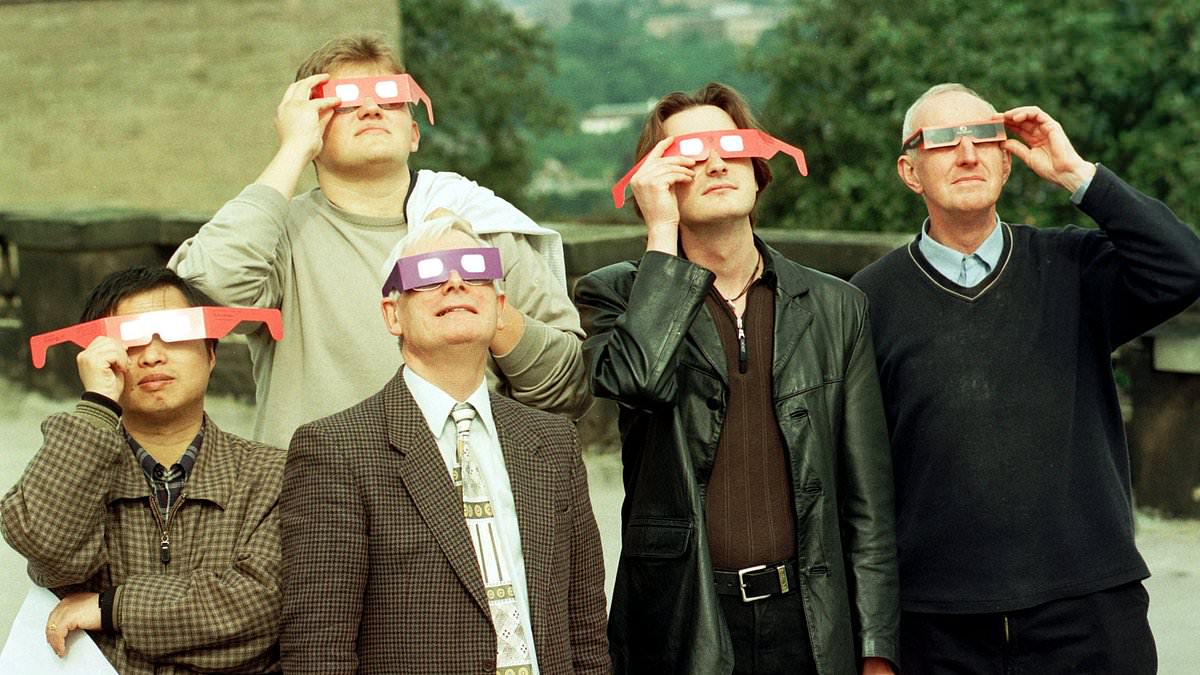
The UK's biggest energy supplier is encouraging Brits to use less electricity during the solar eclipse tomorrow – saying it wants to avoid the country burning more fossil fuels as solar generation plummets.Octopus Energy urged its eight million customers to delay using their washing machines, ovens, dishwashers and other plug-in devices between 6pm and 8pm.Tomorrow's hotly-anticipated eclipse will see solar generation plunge at a crucial time of day when electricity demand rises as millions of people come home from work.The National Energy System Operator, which runs the grid, believes the eclipse could cut supply by up to 1.3 gigawatts tomorrow - enough to power about 500,000 homes.Extra gas power stations may therefore have to be fired up, but Octopus said this need will be reduced if enough households delay using electricity for a short time.The London-based company is therefore asking people to use less energy to avoid putting extra pressure on the grid at that point and increasing carbon emissions.As an incentive, Octopus said those who use less electricity than usual during the two-hour window would get one hour of free daytime electricity this Sunday.Bosses said solar power generated a record 14.4 per cent of Britain's electricity last month, meaning two hours without sunshine will 'leave a gap that has to be filled'.The moon will obscure more than 90 per cent of the sun between 6.17pm and 8.06pm tomorrow, the most it has been blocked above the UK since the 1999 total eclipse. Spectators at Edinburgh's Royal Observatory view the last total solar eclipse in August 1999 Octopus said it will monitor usage during the 'Eclipse Session' from customers' smart meters tomorrow, and will then email successful participants on Saturday with the exact time – which will be at some point 'in the late-morning, early-afternoon'.Its chief customer officer Rebecca Dibb-Simkin said: 'Many of us will be looking up at the sky on Wednesday evening to experience this once-in-a-generation event. But as the sun disappears, so will some of Britain's solar generation, just as demand peaks.'By shifting everyday tasks like the washing machine or dishwasher until later, households can help reduce the need for gas power stations - and earn rewards for doing their bit.'The company added that solar power generated a record 14.4 per cent of Britain's electricity last month, meaning a 'couple of hours without sunshine can leave a gap that has to be filled'.Customers can also enter an Octopus photo competition showing what they did during the eclipse instead of being inside at home, with the chance to win free solar panels and installation or £12,000 in cash instead.Neso said it has been planning for the solar eclipse for more than a year, 'helping keep the electricity system balanced while the nation looks to the skies'.Meanwhile the Met Office revealed Devon, Cornwall and the westernmost parts of Pembrokeshire in Wales are set to see the eclipse at its fullest, with a range of 94 per cent to 96 per cent of the sun obscured by the moon.Plymouth in particular is forecast to see the moon cover 94.66 per cent of the sun at 7.16pm.The rest of Wales, Northern Ireland, parts of the West Midlands and the South West, and the westernmost parts of Scotland can expect to see 92 per cent to 94 per cent solar coverage. The Daily Mail's front page on August 12, 1999 following the last total solar eclipse Another total solar eclipse visible from the UK in 1927 - pictured in Stoneyhurst, LancashireIn Cardiff, the moon is forecast to obscure 93.24 per cent of the sun at 7.13pm while in Belfast it will cover 93.09 per cent of the sun at 7.08pm.Skygazers in the rest of the UK will likely see the moon obscure 90 per cent to 92 per cent of the sun – with 91.79 per cent expected in Birmingham at 7.12pm, 91.41 per cent in London at 7.13pm, 90.74 per cent in Inverness at 7.03pm, 90.71 per cent in Edinburgh at 7.06pm and 90.22 per cent in Newcastle at 7.07pm.Those most keen to catch a sight of the fullest possible solar eclipse should avoid the easternmost parts of the UK, where only 88 per cent to 90 per cent of solar coverage is expected.These include the coasts of Norfolk, Yorkshire and Aberdeenshire, as well as the Orkney and Shetland Islands. When will the eclipse be visible in the UK? When to see the solar eclipse Location Eclipse starts Maximum eclipse Eclipse ends Edinburgh18:0819:0520:00 Glasgow 18:0819:05 20:06 Dublin 18:12 19:10 20:04 Manchester 18:13 19:1020:04 Liverpool 18:1319:10 20:04 Birmingham 18:1519:11 20:04 Bristol 18:1719:12 20:06 London 18:1719:12 20:06 Cardiff 18:1719:12 20:06 Truro 18:1819:16 20:10 Eye doctors urged people to avoid looking directly at the sun, with even brief exposure causing lasting vision damage.Experts have warned that only special solar eclipse glasses that are ISO 12312-2 certified for the safest eye protection should be used to view the eclipse. But they have all but sold out online, or carry hefty delivery fees to arrive in time.The Royal Greenwich Observatory told the public that regular sunglasses are not a safe enough method to view the cosmic phenomenon.So-called eclipse glasses that do not carry the safety standards, or ordinary sunglasses, no matter how dark, should never be worn to view an eclipse, as they reduce glare, making it feel more comfortable to look at the sun for longer, but still allow harmful solar radiation to reach the retina.Following the 1999 eclipse, the Royal College of Ophthalmologists reported around 70 cases of people experiencing vision problems after watching the eclipse. Around 40 per cent had looked at it for less than a minute.The next time the moon obscures as much of the sun will be in 2081 and the next total solar eclipse in the UK will be in 2090.Reykjavik in Iceland and Spanish cities A Coruna, Oviedo, Zaragoza, Bilbao and Valencia will see a total eclipse tomorrow, in which the moon fully obscures the sun.In an added bonus for stargazers, the annual Perseid meteor shower reaches its peak tomorrow night. The shower is produced as Earth ploughs through a stream of dust left behind by Comet Swift–Tuttle.Each tiny grain strikes Earth's atmosphere at about 60km per second (37 miles per second), burning up in a brief flash that takes the appearance of a shooting star.
Octopus Energy tells customers to avoid using electricity during the eclipse as solar power generation plummets
Full Article
Original Source
Read the full article at Dailymail →KhanList aggregates and links to publicly available news content. We do not host full articles from third-party sources. Always verify important information with original sources.