
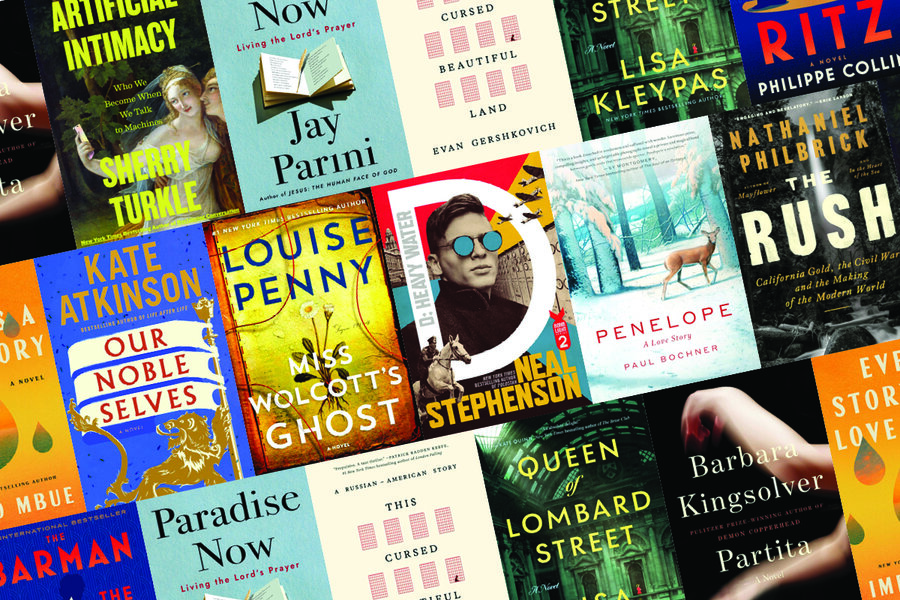
These are the fiction titles our reviewers liked best this month.Partita, by Barbara Kingsolver (Harper Collins)Barbara Kingsolver’s first novel since her 2022 Pulitzer Prize-winning “Demon Copperhead” may divide her loyal fans. Reactions will hinge on whether readers find Livia, a talented music conservatory student, a likable narrator. The story revolves around Livia’s summer romance with a charismatic labor activist named Sigurd when Livia was in her 20s. Now a married woman in midlife, Livia is shaken by a phone call from the long-absent Sigurd. Kingsolver pulls back the curtain on events that changed the trajectory of Livia’s life. It keeps the reader turning the pages but feels overwrought at times. Where Kingsolver shines is in her depiction of Livia’s path from a rural, Southern town to the rarified world of classical music. The novel explores ambition, guilt, passion, and, eventually, a kind of acceptance. – April Austin Queen of Lombard Street, by Lisa Kleypas (Harper Collins)In this delightful Victorian-era novel, genius economist Reina Martin strategizes to become London’s first female banker. She hires a motley domestic staff of paroled prisoners, including a charming Welsh butler who’s actually an undercover investigator, to run her household. They blossom into a found family as their innate worth comes to the fore. With a captivating bank fraud mystery, and two irresistible love stories, Kleypas’ uniquely wise and witty novel is a gem. (Some mature content.) – Stefanie MilliganThe Barman of the Ritz, by Philippe Collin (Simon & Schuster) Weaving fact and fiction into a World War II-era novel, Philippe Collin tells the story of Frank Meier, who worked in Paris’ Ritz Hotel during the Nazi occupation. Meier serves drinks to the enemy, while concealing his Jewish identity. The chilling storyline gathers speed and intensity as he chooses to stay in Paris – hiding in plain sight – to support the Resistance. The novel conveys the moral decency of one man determined to do right. – Stefanie MilliganEvery Story is a Love Story, by Imbolo Mbue (Penguin Random House)In her newest novel, award-winning author Imbolo Mbue takes up the age-old question of how to forgive the unforgivable. Years ago, Wolo’s beloved wife was struck and killed in a freak accident. With the help of family and friends – including his pastor – Wolo believes he has moved on from the worst of the trauma. But then, Victoria, the woman responsible for his wife’s death, sends him a letter. She wants them to meet. What follows in this poignant, deeply felt, and surprisingly buoyant story is a shared, and sometimes difficult, journey toward redemption – and peace. – Deborah JohnsonOur Noble Selves, by Kate Atkinson (Penguin Random House)Set in the summer of 1951, Kate Atkinson’s latest novel follows Harry Flynn who, after enduring wartime captivity, seizes the opportunity of a new start working for the Festival of Britain, a celebration of national pride and creative endeavor. But he finds himself with more to contend with when he is accused of murder. Deft plotting, vivid characterization, and murky shenanigans power this relentlessly entertaining tale. – Malcolm Forbes Miss Wolcott’s Ghost, by Louise Penny (Minotaur)Louise Penny’s latest mystery opens with a jolt: a 3 a.m. call to the home of Armand Gamache, the head of homicide for Quebec’s police force. The panicked caller has found “a body in Lost Nation.” The perplexed inspector has no idea what – or where – that is. Working from his beloved village of Three Pines, Gamache and his team must untangle a thicket of clues involving their artist friend Clara, a lost maritime disaster, a bold 19th-century botanist, and one very ugly plant. Penny, in top form, digs into cowardice, courage, and the importance of remembering, all with wisdom and warmth. – Erin DouglassD: Heavy Water, by Neal Stephenson (Morrow)Must readers have finished “Polostan,” the start of Neal Stephenson’s historical Bomb Light trilogy, before diving into “D”? No. Should they? Yes. While this second installment stands on its own, “D” is enriched by its predecessor. Stephenson’s storytelling finesse – clever reveals, discursive side quests, stealthy plot twists – shines in this robust tale of British journalist Owen and his globe-spanning search for a missing English earl in 1934. There’s history, revolution, spies, plus a desperate dash to keep a dangerous scientific breakthrough – heavy water – out of the hands of the baddies. – Erin DouglassThese are the fiction titles our reviewers liked best this month. Penelope: A Love Story, by Paul Bochner (Penguin Random House)This tender and surprising memoir chronicles the author’s soulful connection to an injured white-tailed deer that he cares for and grows to love. In elegant prose, Bochner charts the progression of their relationship as the deer, which he names Penelope, comes to trust him and demonstrate affection toward him. Penelope’s evident attachment to the author is remarkable. So, too, is Bochner’s steadfast devotion to a wild animal. – Barbara SpindelThe Rush: California Gold, the Civil War, and the Making of the Modern World, by Nathaniel Philbrick (Viking)In January 1848, a workman building a sawmill near Coloma, California, found a “teaspoon” of gold flakes. The discovery launched the California Gold Rush. The territory’s population boomed and quickly turned the distant region into an extraordinarily valuable part of the United States. More importantly, it forced America’s political and business leaders to reckon with the immense geography between the Atlantic and Pacific oceans. Nathaniel Philbrick weaves this complex story into a seamless and compelling narrative of the ways that this unexpected discovery transformed America at the same time that the country hurtled toward the Civil War. – Terry HartleArtificial Intimacy: Who We Become When We Talk to Machines, by Sherry Turkle (Little, Brown and Company)Sherry Turkle’s newest book offers something new to current conversations about AI: a heartfelt warning about forming attachments to chatbots. Through bite-sized interviews and personal anecdotes, Dr. Turkle explores AI’s impacts at every stage of human life – children bonding with AI-powered toys and chatbots, lonely singles falling in love with AI characters, and overwhelmed therapists off-loading their caseloads to artificial intelligence agents. Built on Turkle’s decades of research on technology and human development, “Artificial Intimacy” unpacks human-AI relationships with care and honesty – two things, she argues, that chatbots will never truly provide. – Laina Gustafson Paradise Now: Living the Lord’s Prayer, by Jay Parini (Morehouse Publishing) In this thoughtful book, prolific poet, novelist, and critic Jay Parini walks readers through each line of the Lord’s Prayer as it appears in the 1979 “Book of Common Prayer.” Part spiritual guide, part academic excavation, “Paradise Now” quotes a host of philosophers, theologians, and writers from Augustine, Elaine Pagels, and Joseph Campbell to Mary Oliver, Shakespeare, and Parini’s lifelong mentor, Paul Tillich. “The Lord’s Prayer is an architecture of sorts,” Parini writes, “a way to organize and reveal the deep silence of God within us.” Inspiration abounds. – Erin Douglass Deepen your worldviewwith Monitor Highlights.Politics with respectGet political stories with respectful analysis.There‘s a world of new ideas in everyBooks newsletter.There‘s more to life, enrich yours withCulture & Learning weekly.Follow humanity‘s discoveries withScience & Nature stories in your inbox.Gain a spiritual perspectivefrom the stories in your inbox.Want to understand the deeper impact of critical events? Learn the Monitor‘s insight.Already a subscriber? Log in to hide ads. This Cursed Beautiful Land: A Russian-American Story, by Evan Gershkovich (Crown)In March 2023, Evan Gershkovich, a foreign correspondent for The Wall Street Journal, was arrested by Russian Security forces and charged with espionage. After nearly 500 days in prison, he was released as part of a multicountry prisoner exchange. He describes in vivid detail the emotional ordeal of imprisonment and how the experience altered his views of journalism and the Russian people. Written with a reporter’s sharp eye for detail and a remarkable lack of anger or bitterness, this is a compelling story of courage and grace. – Terry Hartle ALREADY A SUBSCRIBER? LoginReal news can be honest, hopeful, credible, constructive.The Christian Science Monitor was founded in 1908 to lift the standard of journalism and uplift humanity. We aim to “speak the truth in love.” Our goal is not to tell you what to think, but to give you the essential knowledge and understanding to come to your own intelligent conclusions. Join us in this mission by subscribing.
October’s best books boast indelible characters
Full Article
Original Source
Read the full article at Csmonitor →KhanList aggregates and links to publicly available news content. We do not host full articles from third-party sources. Always verify important information with original sources.