
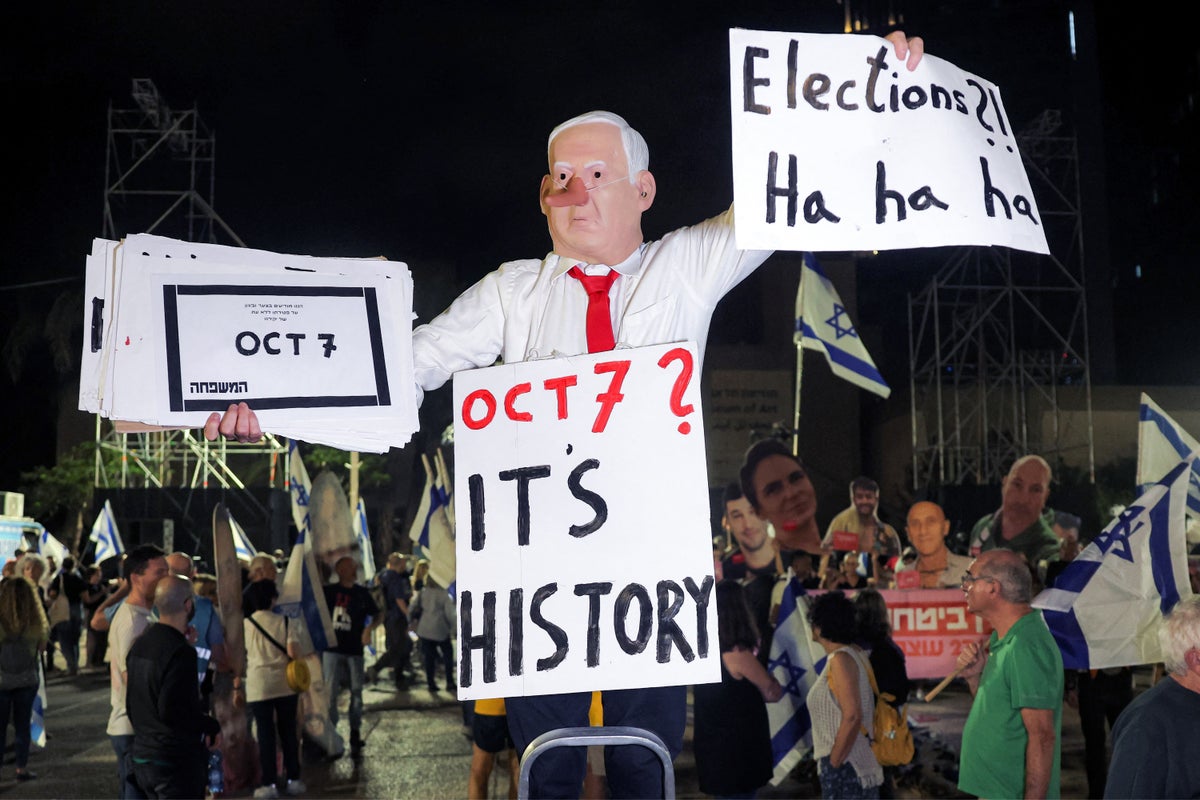
Prime minister Benjamin Netanyahu faces one of the toughest tests of his tumultuous political career to date as Israel prepares to vote in the first national elections since the 7 October terror attacks.With around four million voters expected to cast their ballots on Tuesday, public reckoning over the 2023 Nova massacre remains front and centre. Recent polling by the Israel Democracy Institute found 68 per cent of Jewish Israelis consider October 7 a central factor in deciding which party to vote for.Netanyahu has spent the better part of three decades branding himself Israel’s “Mr Security” but questions remain over his handling of the worst civilian attack in Israel’s history. In spite of having guided his coalition through a full four-year term in the Knesset — a rare feat in Israel’s chronically volatile parliament — he enters polling day hemmed in by compounding legal entanglements and public fury over the events of the last three years. The fallout from the October 7 massacre continue to loom over Benjamin Netanyahu’s political future (Reuters)Earlier this month, former Shin Bet chief Ronen Bar filed a three million shekel (£630,000) defamation lawsuit against Netanyahu, accusing the prime minister of fabricating a "blood libel" to scapegoat the domestic security agency and deflect from his own culpability on 7 October.With persistent, damning reports alleging that the prime minister brushed aside warnings from Egyptian and Emirati intelligence ahead of the attacks, between 60,000 and 400,000 people have crowded Tel Aviv’s streets week after week, demanding an independent state commission of inquiry.Despite the outrage, Netanyahu has consistently stonewalled these calls.Netanyahu’s handling of October 7 has drawn widespread calls for an independent inquiry into the tragedy (AFP/Getty)But the Israeli public’s rage extends beyond the intelligence failures behind October 7, to what many view as an unconscionable betrayal in its aftermath. Bereaved families of hostages, alongside former defence officials, have repeatedly accused Netanyahu of stalling negotiations in the months after October 7, deliberately torpedoing ceasefire agreements whenever a breakthrough threatened to trigger the collapse of his coalition. Some 41 Israeli hostages are believed to have died in captivity. Of these, at least 24 are said to have died as a direct result of Israeli military action in Gaza, according to forensic probes. Combined, these intelligence failures and the fate of the captives have drawn widespread domestic condemnation, where polling conducted last year found that 72 per cent of Israelis believe the prime minister should take responsibility and resign.Some 72% of Israelis believe Netanyahu should take responsibility for the events of October 7 and resign, according to 2025 polling (Getty)But for Netanyahu, the stakes extend far beyond merely remaining in office, as losing power would likely remove the institutional buffer shielding him from imminent criminal accountability, directly exposing him to the prospect of jail time.At present, he remains in the dock across three separate criminal cases— known as Cases 1000, 2000, and 4000 — on charges of bribery, fraud, and breach of trust.The trial, dragging on in the Jerusalem District Court since May 2020, details alleged kickbacks including regulatory favours handed to media moguls in exchange for flattering coverage, balanced out by steady deliveries of luxury cigars and champagne from billionaire patrons.Under Israeli law, a conviction for bribery carries a potential prison sentence of up to 10 years, while fraud and breach of trust carry maximum three-year terms.Netanyahu has decried the entire apparatus of state prosecutors and judges as a left-wing “witch-hunt”. But while his pre-war push to dismantle the judiciary was once sold as constitutional reform, it is now widely seen as an emergency exit from a potential jail sentence. Gadi Eisenkot has fiercely criticised Netanyahu’s handling of October 7, vowing to establish an inquiry if elected (AP)In Israel, a sitting prime minister is legally entitled to remain in post while on trial. A private citizen is not.The resulting institutional backlash has found a potent political vehicle in Netanyahu’s main challenger — Gadi Eisenkot, the former military chief of staff who joined Netanyahu’s emergency war cabinet after October 7 before resigning in protest over what he described as the prime minister’s paralysis, political time-wasting, and lack of an exit strategy.Eisenkot has emerged as one of Netanyahu’s fiercest domestic critics, where he has made the establishment of an independent inquiry into October 7 a major tenet of his electoral campaign. But Eisenkot represents just one of a crowded, fractious opposition camp. Former prime minister Naftali Bennett has resurfaced after years away from the political front line, stitching together an alignment with centrist opposition leader Yair Lapid. All leading candidates in Israel’s elections back the expansion of settler outposts in the West Bank (Reuters)Avigdor Lieberman, Netanyahu’s former defence-minister-turned-rival, belongs to a secular right-wing faction that has capitalised on public fury post-October 7 to claim that Netanyahu is “too soft” on military drafts and action against Hamas.Yet for all the personal animus between Netanyahu and his challengers, the contest offers remarkably little divergence on the reality on the ground.Neither Netanyahu, Eisenkot, Bennett nor Lieberman supports the creation of an independent Palestinian state. All endorse permanent Israeli military control over the West Bank and back settlement expansion across Area C of the occupied West Bank. Recent opinion polls point to a razor-thin contest, where no party commands an obvious route to the 61 seats needed for a parliamentary majority.Should the ballot result in a hung parliament — a familiar outcome in recent Israeli politics — prolonged coalition deadlock could see Netanyahu remain in office as caretaker for months.
October 7 terror attacks loom large over Israel’s elections as Netanyahu fights for his future
Full Article
Original Source
Read the full article at Independent →KhanList aggregates and links to publicly available news content. We do not host full articles from third-party sources. Always verify important information with original sources.