
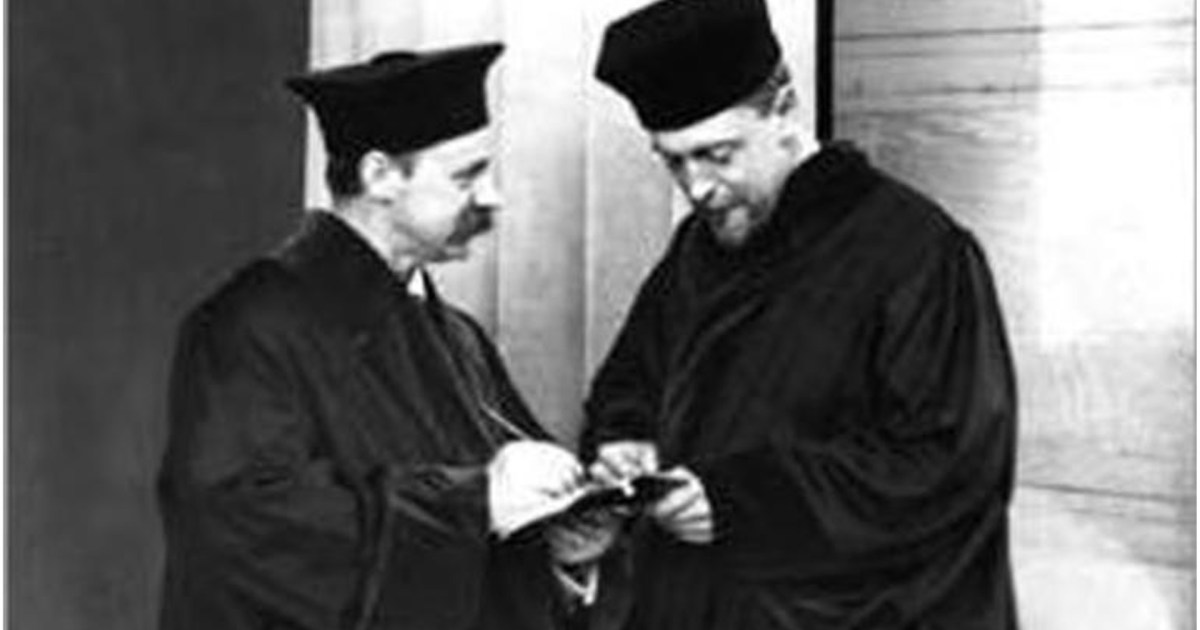
Today in the history of astronomy, a pioneer in star classification is born. | Published: October 8, 2026 Ejnar Hertzsprung (right) worked with German physicist Karl Schwarzschild (left) from 1909 until the latter's death during World War I. Credit: The Göttingen Observatory photo, courtesy Hartmut Grosser/Public domain, via Wikimedia Commons On Oct. 8, 1873, Ejnar Hertzsprung was born near Copenhagen, Denmark. His father had studied astronomy and worked in finance, and Hertzsprung himself showed interest in astronomy and math, but pursued a degree in chemical engineering. After graduating from the Polytechnical Institute in Copenhagen, he worked as a chemist in St. Petersburg, Russia, and went on to study photochemistry in Leipzig, Germany. It was upon Hertzsprung’s return to Copenhagen in 1901 that he began seriously pursuing astronomy, publishing papers in 1905 and 1907 revealing his discovery of the dwarf and giant sequences of stars. By 1909, he began work with German physicist Karl Schwarzschild, first at Gottingen Observatory and then Potsdam Observatory. When World War I meant most of the observatory staff was away for military service – including Schwarzschild – Hertzsprung took charge of nearly all the telescopes. His improvements to the techniques for photographing double stars allowed for extensive measurements and cataloging. After the war and Schwarzschild’s death, Hertzsprung left Germany for Leiden University in the Netherlands; in 1935, he became director there, a position he would hold until his retirement in 1944. A pioneer in classification, Hertzsprung is best known for his part in the development of the Hertzsprung-Russell diagram, which charts stars by their magnitude and color. Elisa Neckar is senior production editor of Astronomy magazine, and the editor of the Today in the History of Astronomy feature on Astronomy.com.
Oct. 8, 1873: The birth of Ejnar Hertzsprung
Full Article
Original Source
Read the full article at Astronomy →KhanList aggregates and links to publicly available news content. We do not host full articles from third-party sources. Always verify important information with original sources.