
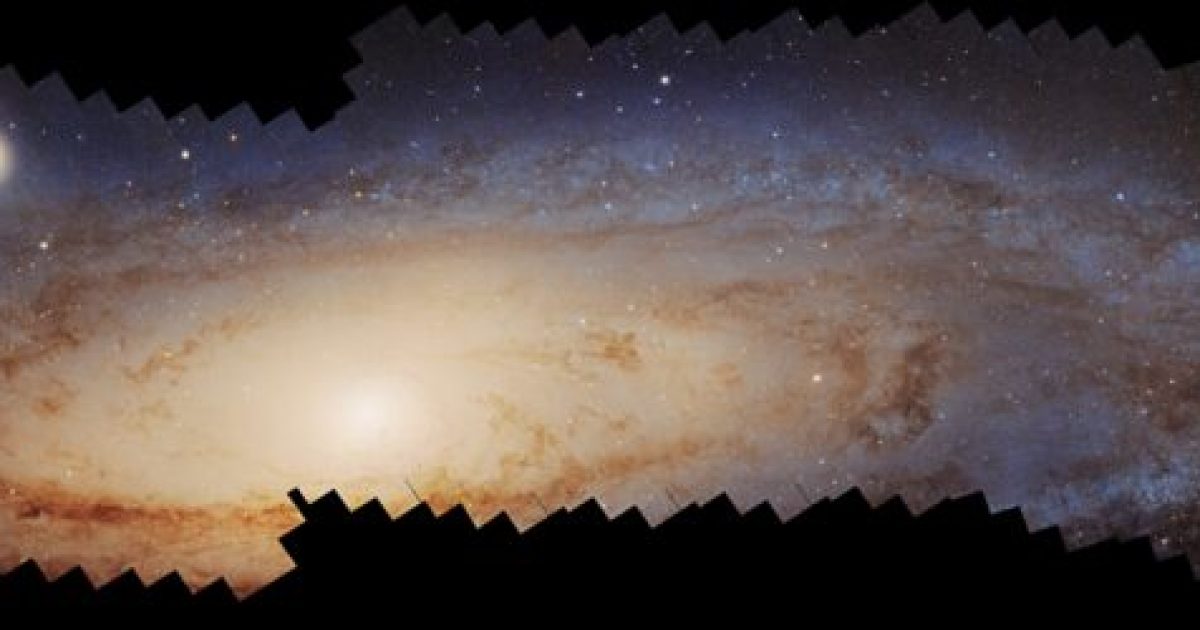
Today in the history of astronomy, Edwin Hubble’s identification of Cepheids in M31 reveals the massive scale of the universe. | Published: October 5, 2026 NASA released this Hubble Space Telescope panorama of the Andromeda Galaxy, our nearest cosmic neighbor, in January 2025. It took over 10 years and 600 shots to create. Credit: NASA, ESA, Benjamin F. Williams (UWashington), Zhuo Chen (UWashington), L. Clifton Johnson (Northwestern); Image Processing: Joseph DePasquale (STScI) On Oct. 4, 1923, Edwin Hubble took a photographic plate of the Andromeda Nebula (as it was known then) using the 100-inch Hooker telescope at Mount Wilson. The next night, Oct. 5th, he took another plate and found that a star that seemed to belong to the nebula had changed in brightness. At first, he thought this was a nova, a type of stellar explosion. But eventually, he realized it was a particular type of variable star — and this meant he could accurately measure the distance to this star. From studying these variable stars — called Cepheids — in our own galaxy, astronomers already knew that the period of time over which they varied was related to their intrinsic luminosity. Henrietta Leavitt, an astronomer at Harvard College Observatory, had worked out in 1912 that the longer Cepheids take to pulsate, the brighter (and presumably larger) they are. So by knowing the star’s true brightness and comparing it to how faint it appeared, Hubble could calculate how far away the star was. His answer: 1 million light-years. Today, we know the Andromeda Galaxy (M31) is actually about 2.5 million light-years away, but the implications of Hubble’s measurement stands. What he found changed our conception of the universe forever and confirmed that Andromeda and its nebulous brethren were in fact entire galaxies separate from the Milky Way — island universes of their own. David J. Eicher is one of the most widely recognized astronomy enthusiasts in the world. He has been with Astronomy magazine since 1982, beginning as an assistant editor and working through associate, senior, and managing positions. He was editor in chief from 2002 to 2025 and is currently the magazine’s Editor Emeritus.
Oct. 5th, 1923: Hubble discovers galaxies beyond the Milky Way
Full Article
Original Source
Read the full article at Astronomy →KhanList aggregates and links to publicly available news content. We do not host full articles from third-party sources. Always verify important information with original sources.