
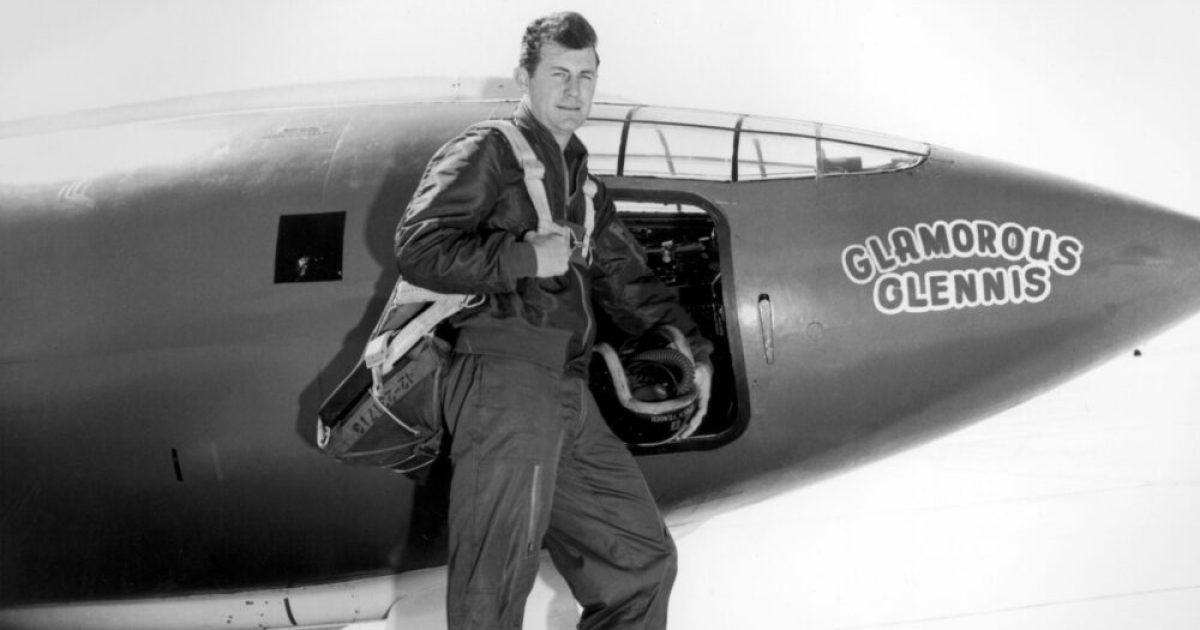
Today in the history of astronomy, Chuck Yeager breaks the sound barrier. | Published: October 14, 2026 Chuck Yeager named his Bell X-1 experimental aircraft "Glamorous Glennis" after his wife. Credit: U.S. Air Force/Public domain, via Wikimedia Commons When Glamorous Glennis, an experimental Bell X-1 aircraft built to mimic the shape of a .50 caliber bullet, shot to 700 mph (1,127 km/h) with Air Force Captain Chuck Yeager inside, it paved the way for Americans to one day travel to space. On Oct. 14, 1947, the X-1 was launched from the bomb bay of a B-29 at 20,000 feet (6,096 meters) for a flight that lasted 14 minutes. Experts had warned that going faster than the speed of sound – Mach 1 – could cause both Yeager and his plane to break up into tiny pieces. But when the X-1 jumped from Mach .965 to Mach 1.06, there were remarkably few effects, other than a boom on the ground. The supersonic flight put to rest this belief in the dangerous “invisible barrier” of sound, brought Yeager hero status, and gathered details about supersonic flight that would be imperative for the future of the space program. Elisa Neckar is senior production editor of Astronomy magazine, and the editor of the Today in the History of Astronomy feature on Astronomy.com.
Oct. 14, 1947: Flying faster than sound
Full Article
Original Source
Read the full article at Astronomy →KhanList aggregates and links to publicly available news content. We do not host full articles from third-party sources. Always verify important information with original sources.