
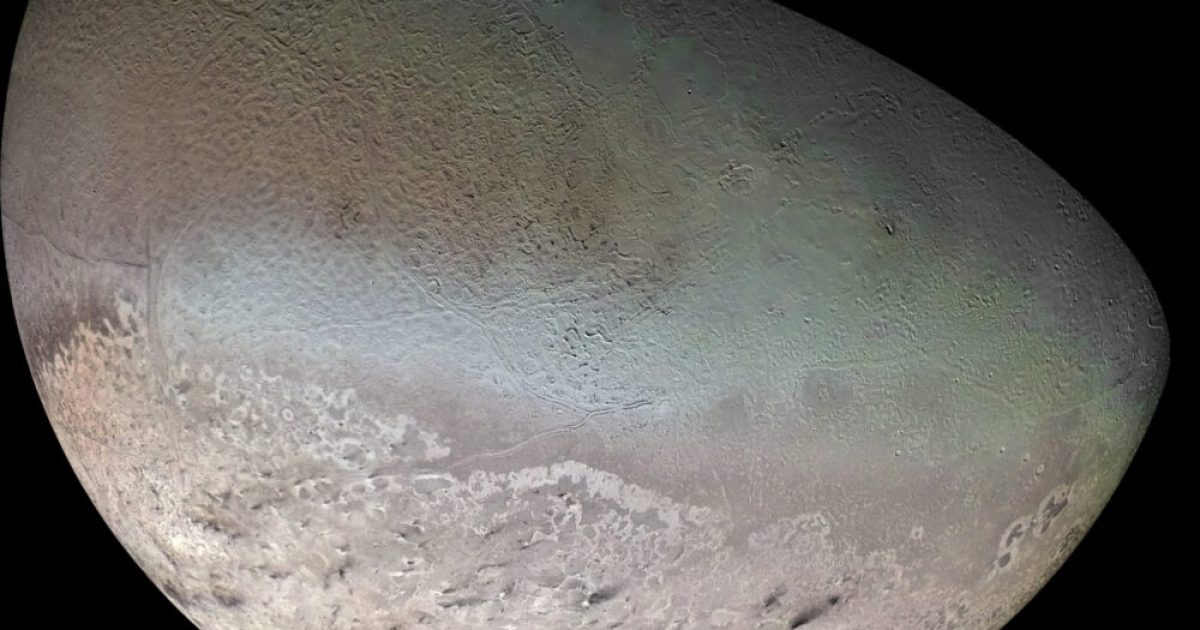
Today in the history of astronomy, William Lassell spots a moon of Neptune – only days after Neptune itself is discovered. | Published: October 10, 2026 Voyager 2's image of Triton shows the weird "cantaloupe" surface. Credit: NASA, NASA-JPL, USGS On Oct. 10, 1846, William Lassell peered through his 20-foot reflector in Liverpool, England. Lassell was a self-funded amateur astronomer who had made a fortune as a brewer, and he’d built his own scope – apparently doing quite a good job of it, since through it, Lassell spotted Triton orbiting Neptune. Neptune itself had been discovered only 17 days earlier, and the moon was less than 1/10th the diameter of the planet. Lassell would go on to discover two moons of Uranus, Ariel and Umbriel, with the same telescope in 1851. Though Triton was far too small for Lassell to see its characteristics when he discovered it, the Voyager 2 flyby would help us understand its uniqueness: It is one of the coldest objects in the solar system, yet is volcanically active and erupting in huge geysers of nitrogen. The moon also sports an unusual dimpled surface, making it appear like a giant cantaloupe. Elisa Neckar is senior production editor of Astronomy magazine, and the editor of the Today in the History of Astronomy feature on Astronomy.com.
Oct. 10, 1846: The discovery of Triton
Full Article
Original Source
Read the full article at Astronomy →KhanList aggregates and links to publicly available news content. We do not host full articles from third-party sources. Always verify important information with original sources.