
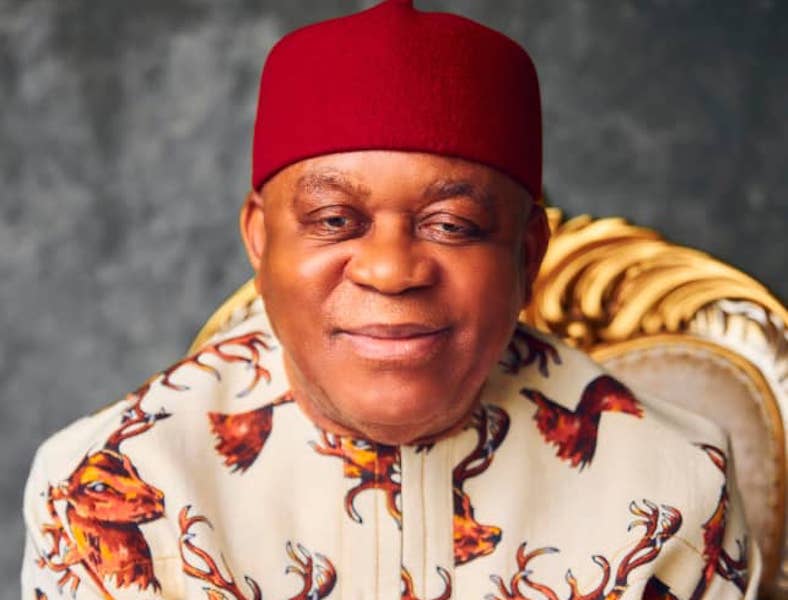
Charles Ajunwa T here are birthdays that come with noise. And there are birthdays that come with quiet reflection. The 76th birthday of Senator Theodore Ahamefule Orji belongs to the second kind. It is not the birthday of a man still chasing office. Or still fighting to be noticed. It is the birthday of a man who has done the work, kept his word, and gone home to rest. In Umuahia, in Ibeku, in every corner of Abia Central, and far beyond Abia State, the name Ochendo still opens doors. People do not say it like a title. They say it like a memory. Ochendo. Papa Ukwu. Ochendo Global. The man who came from a small compound in Amaokwe-Ugba and rose, step by step, without noise, without hurry, to become governor, then senator, and then something rarer in Nigerian politics. A man who retired on his own terms. He was born on November 9, 1950, in Amaokwe-Ugba, Ibeku, in what is now Umuahia North Local Government Area of Abia State. His father, Chief Tom Ikoro Orji, was a warrant chief in the colonial era, a man known in his community for order, discipline, and a certain old-fashioned dignity. His mother, Daa Ifeoma, later Lolo Virginia Orji, was the centre of his early world. Those who knew the family say she wanted him to become a priest. She saw something gentle in him. Something patient. Something that did not belong to the rough world of politics. In a way, she was right about the gentleness. It stayed with him all his life. What she did not see, what nobody could have seen then, was that the same gentleness would become his strength in public life. Theodore, in Greek, means gift of God. Ahamefule, in Igbo, means let my name not be lost. Between those two names, a life was already being shaped. Young Theodore did not grow up with silver spoon in his mouth. He grew up like many children of his time. Walking to school. Listening to elders. Learning early that a name is not given, it is earned. He started at St. Michael’s Primary School, Ugwu-Nchara, in Umuahia North. From there he went to Sancta Crux Secondary School, Olokoro, and later to Holy Ghost College, Owerri, for his higher school certificate. Those schools were not just classrooms. They were places where character was formed, where a boy learned to sit still, to listen, to respect time, to respect other people. When he got to the University of Ibadan, one of the proudest universities in the country, he read English. He graduated in 1977. English may look like a soft course to some people, but for Orji it became a tool. He learned how to speak carefully. How to write clearly. How to listen before answering. Anybody who has sat with him will tell you, he does not rush his words. He weighs them. That habit started long before politics. After his national youth service in Sokoto, he did what many young graduates of his generation did not want to do. He joined the civil service. Not business. Not quick money. Service. He started as an Administrative Officer in the old Imo State, serving under military administrators and later under the civilian government of Dr. Sam Mbakwe. It was hard work. Mostly invisible work. Files, meetings, memos, postings from one place to another. But Orji did not complain. He learned the machine of government from inside. When Abia State was created in 1991, he came home with other Abia civil servants, and his postings took him to Government House, to the Bureau of Budget and Planning, to the Ministry of Agriculture. He rose steadily, not by noise, but by diligence, until he reached the top of the civil service as a Permanent Secretary. He was also seconded to the National Electoral Commission, the body that later became INEC, where he served as Administrative Secretary in Enugu State and helped midwife the 1999 elections there. That is a part of his story people often forget. Before he ever contested an election, he had already helpedIn 1999, when democracy returned, he was appointed Chief of Staff to Governor Orji Uzor Kalu. He held that position for eight years. Eight years is a long time to be beside power without holding it yourself. Many men would have become bitter. Many would have started scheming. Orji did not. He was loyal, steady, and disciplined. He watched. He learned. He kept records in his head. Those who worked in Government House in those years say he was the calm in the middle of many storms.When deputy governors came and went, he remained. When tempers flared, he lowered his voice. It was that steadiness that later made people trust him with the state itself. The road to Government House in 2007 was not smooth. It was, in fact, one of the strangest and most dramatic journeys in Nigerian political history. Orji won the governorship primaries of the Progressive Peoples Alliance in December 2006. He went into the 2007 election as the candidate of the Progressives Peoples Alliance (PPA). And then, in a twist that still sounds like a story from a novel, he won the election while in detention. No other governor in Nigeria’s history had done that. Abians voted for him, not because he was present to campaign in the final days, but because they had already made up their minds about the kind of man he was. Think about it for a moment. While his opponents were on the road shouting through megaphones, he was behind walls, unable to shake a single hand. And yet the people still chose him. That tells you something about trust. It was not trust built in one campaign season. It was trust built over decades, in offices, in villages, in small acts that nobody recorded. His detention in 2007 remains part of his public record. So does the fact that the people voted for him anyway. On May 29, 2007, he was sworn-in as the third democratically elected governor of Abia State, God’s Own State. The crowd that day did not just see a new governor. They saw a man who had passed through fire and come out without bitterness. His eight years as governor, from 2007 to 2015, were years of building, sometimes quietly, sometimes boldly. He did not govern by shouting. He governed by planning. Under his administration, Umuahia began to change its shape. The new Government House, the new Secretariat Complex, the International Conference Centre, the JAC building, these were not just concrete. They were statements that a state capital must look like a capital. He opened up Ogurube Layout, a new city within the city, to ease pressure on the old centre of Umuahia and to give investors, civil servants, and young families a place to grow. He took security seriously at a time when kidnapping and violent crime threatened to swallow Abia. He worked with federal authorities, and Abia became home to the 144 Battalion, Goodluck Jonathan Barracks, in Ohafia, and the Army School of Languages in Ovim, Isuikwuato. Those were not small achievements. They helped restore confidence in the state. He also understood that a governor is not just a builder of roads and houses, but a keeper of fairness. Perhaps his most talked-about political legacy was equity. At the end of his tenure, he did not try to hand power to his own zone or to his own friends. He insisted that power should go South, to Ukwa/Ngwa, a zone that had long felt left out of the governorship. That decision brought Dr. Okezie Ikpeazu to office as governor in 2015. People still call Orji the Father of Equity because of that single act. In a country where many leaders try to keep power close to themselves, he opened the door wide and let others walk through. He also handed back 19 mission schools to their original owners, a decision that showed respect for history, for the church, for communities that had built those schools with their own hands. He paid salaries and leave allowances promptly, and he gave civil servants a one-level promotion, an act that older workers in Abia still remember with gratitude. He did not do these things for applause. He did them because, as a former civil servant himself, he knew what it meant to wait for salary, to wait for promotion, to wait for recognition. In 2011, he was re-elected, this time on the platform of the Peoples Democratic Party. That second term gave him time to consolidate. He was not a governor who abandoned old projects to start new ones for show. He finished what he started. When he handed over on May 29, 2015, he handed over peacefully, with dignity, to his successor. No drama. No fight. Just a handover. That alone, in Nigerian politics, is a legacy. His successor, Dr. Okezie Ikpeazu, later described him as a seasoned administrator and statesman whose contributions and shining example in the public service should be emulated. That was not a line written for a birthday card. It was said by a man who had sat in the same seat and knew how heavy it was. Many thought he would rest after eight years as governor. But the people of Abia Central had other plans. They persuaded him to run for the Senate. They bought his forms. They said, ‘go and represent us in Abuja’. He listened. On April 11, 2015, he won the Abia Central senatorial election. On June 9, 2015, he took his seat in the 8th Senate. For eight years, from 2015 to 2023, he served in the 8th and 9th Senate, and he served with the same quiet effectiveness that had defined his governorship. He was not the loudest senator. He was one of the most productive. In 2016, he was rated the third most productive senator in the country. In the 9th Senate, he was rated highest in legislative productivity in one report card covering June 2019 to May 2020, among former governors in the Senate. He sponsored more than 15 bills and moved more than seven motions. Four of his bills were signed into law by President Muhammadu Buhari. The most famous of them is the bill for the establishment of the Nigeria Centre for Disease Control and Prevention (NCDC), SB 256. When COVID-19 came, when the whole world was shaken, Nigerians suddenly understood what that bill meant. It was not just a law on paper. It was a shield. He also worked on food security, on biodiversity, on constitutional amendment, and on other matters that touched ordinary lives. He chaired the Senate Committee on Privatisation, served as vice chairman of the Committee on Agriculture, and served on the Committee on Health, among others. But his work was not only in Abuja. Back home, his constituency felt his presence. He built classroom blocks, health centres, roads, and rural electrification projects across the six local government areas of Abia Central, Umuahia North, Umuahia South, Ikwuano, Isiala Ngwa North, Isiala Ngwa South, and Osisioma Ngwa. He gave transformers to communities. He built water projects. He ran an annual scholarship scheme that supported hundreds of undergraduates. He supported a free eye surgery initiative that treated hundreds of people, many of them elderly men and women who had lived for years without clear sight. He supported skills training for scores of people in various vocations, in places like Umudike, Isiagu, and Ilorin, and gave them start-up support. These were not promises on a billboard. If you go to Abia Central today and ask, many will point to a classroom, a borehole, a transformer, a health centre, and say, Ochendo did that. The records of those projects are in the constituency. The people who use them are still there. And then, in 2019, while campaigning for re-election to the Senate, he said something that many did not take seriously. He said 2023 would be his last outing. He said he would not contest again. He said it was time to give younger politicians a chance to grow. In Nigeria, where many leaders say they will leave and then change their minds, people laughed gently and waited. They thought he would change his mind. They thought the pressure would make him stay. He did not change his mind. He kept his word. As those close to him explained at the time, political office holders do not need to wait to die on the seat when there are young, vibrant men and women to take over the baton of leadership. He did not seek re-election in 2023. He honourably exited the 9th Senate in June 2023. Supporters describe him as the first senator from Abia State to voluntarily quit the stage while the ovation was still loudest. Other senators had lost elections, or been forced out, or taken appointments. He walked out by himself, with his head high, because he had said he would. That is why his Umuahia home today has become a place many young politicians visit. Not to beg for money. To listen. To learn how to leave with dignity. Retirement has not made him bitter. It has made him calm. He lives quietly in Umuahia, in sound health, with his wife, Mercy Odochi Orji (Osinulo), his partner of many years, by his side. He has kept a low profile since leaving office. Together they have five children, including Chinedum Orji, who himself rose to become Speaker of the Abia State House of Assembly. His family is his first constituency, and he has kept it close. He has received many honours, including the national honour of Commander of the Order of the Niger (CON) and traditional titles like Ochendo Ibeku, Utuagbaigwe of Ngwaland, and Ohazurume of Abia South. But titles have never changed him. He still speaks softly. He still listens more than he talks. He still prefers a gentle lifestyle to a loud one. At 76, what does his life teach us? It teaches that power does not have to be loud to be effective. That loyalty is not weakness. That a man can rise from civil service to Government House to the Senate without losing his soul. That equity is not just a word, it is a decision. And the greatest test of a leader is not how he enters office, but how he leaves it. Orji entered in detention and left in honour. He entered as a civil servant and left as a statesman. He entered as a son of Ibeku and left as a father to Abia. So today, as family, friends, political associates, former colleagues, and ordinary Abians celebrate him, the prayer is simple. May God grant him longer life, good health, peace of mind, and the joy of seeing his children, his grandchildren, and the state he served, flourish. May his name, Ahamefule, truly not be lost. May the tree he planted continue to make a forest. Happy 76th birthday to Chief Theodore Ahamefule Orji, CON, Ochendo Global, Papa Ukwu, the quiet man who served, who kept his word, and who walked away with dignity. Abia remembers. Nigeria remembers. And history, which is kinder than politics, will remember him even more
Ochendo At 76: The Man Who Walked Away While Ovation was Loudest
Full Article
Original Source
Read the full article at Thisdaylive →KhanList aggregates and links to publicly available news content. We do not host full articles from third-party sources. Always verify important information with original sources.