
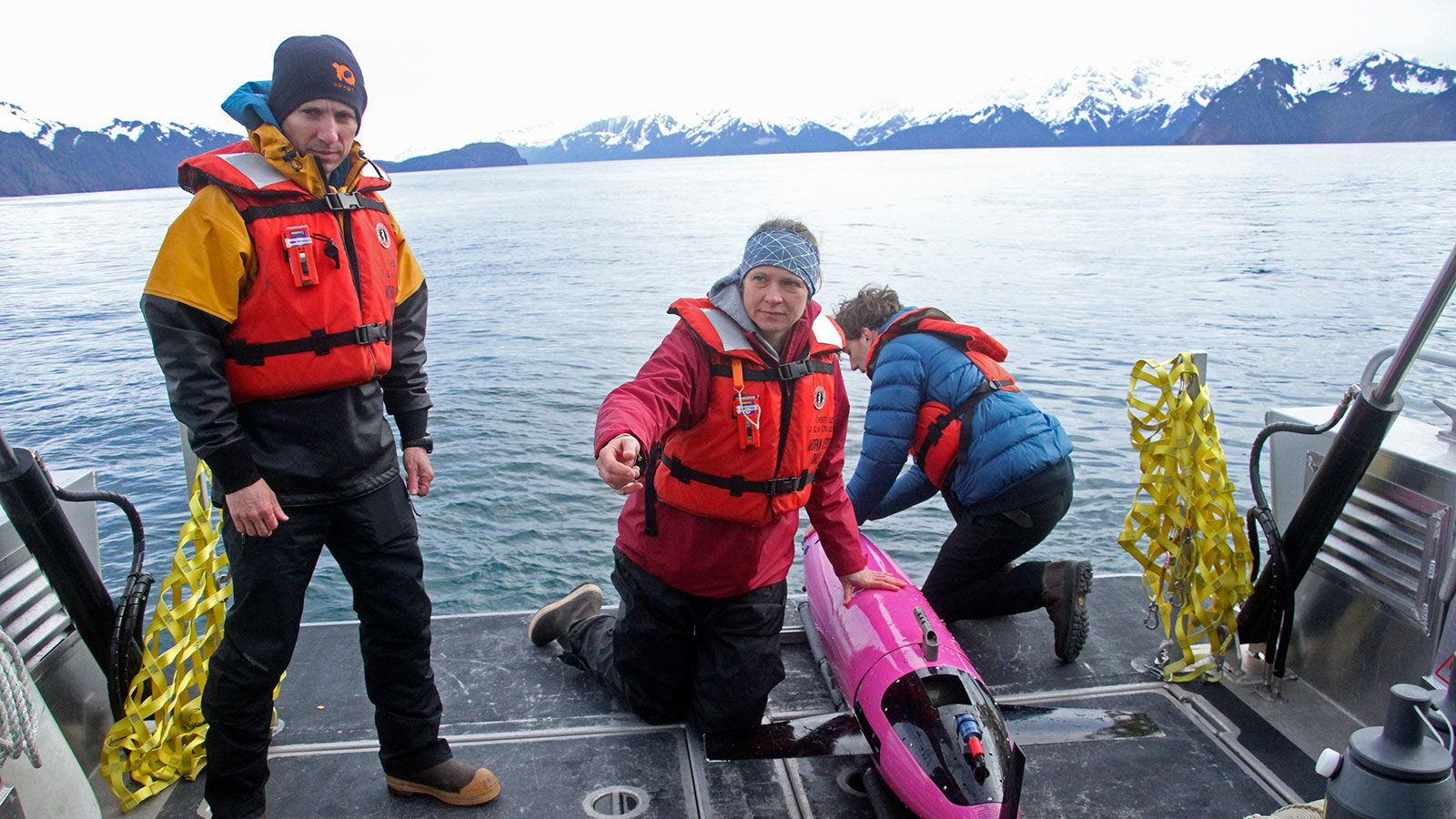
Skip to content Oceanographers Andrew McDonnell, left, and Claudine Hauri, middle, along with engineer Joran Kemme after an underwater glider was pulled from the Gulf of Alaska. The glider was fitted with special sensors to study ocean acidification. (Image credit: AP Photo/Mark Thiessen) Transcript: Oceans cover more than two-thirds of the planet’s surface, and hold enough water to fill the Grand Canyon more than 300,000 times. And all that water is slowly becoming more acidic. When people burn fossil fuels like oil and gas, it releases carbon dioxide to the atmosphere. The ocean then absorbs about a third of that carbon dioxide, where it mixes with water to form carbonic acid. Since preindustrial times, the ocean has grown about 30% more acidic as people have burned fossil fuels. This change would not be noticeable to someone at the beach, but ocean acidification harms some marine life. Coral skeletons and oyster and clam shells are made by combining calcium and carbonate ions into a material called calcium carbonate. But when ocean water gets more acidic, there are fewer carbonate ions floating around. That makes it harder for corals to grow and oysters and clams to form shells. As people continue to add carbon to the atmosphere and acidification gets worse, it could threaten some shellfish populations and the livelihoods of the people who harvest them. So preventing that pollution is vital for protecting marine life – and coastal communities. Reporting credit: Ethan Freedman / ChavoBart Digital Media
Oceans have gotten about 34% more acidic since before the Industrial Revolution
Full Article
Original Source
Read the full article at Yaleclimateconnections →KhanList aggregates and links to publicly available news content. We do not host full articles from third-party sources. Always verify important information with original sources.