
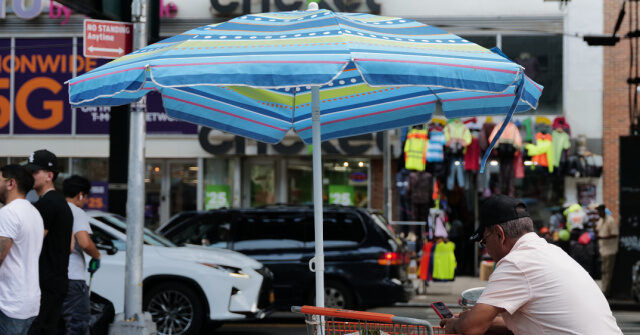
The New York Times is blessing the city’s population of illegal migrant street vendors as noble martyrs, despite the diverse economic damage they impose on ordinary New Yorkers. The article’s headline, “For Senegalese Street Vendors in New York, ‘Work Is Worship,” obscures the reality that the poor illegal migrants survive by selling knockoff products, paying higher rents by crowding into apartments, and by dodging the property and city taxes paid by normal retailers. But all is forgiven, perfumed, and downplayed by author Aimee Ortiz as she trills about the migrants’ diverse lawbreaking: Most days, Khadim Ndiaye wakes up in the apartment he shares with five people in the Bronx and heads down to Canal Street, where he sets up shop on the sidewalk. Cat-eye, oversize and aviator frames bearing familiar logos — Prada, Gucci, Fendi — are among the sunglasses he hawks to passers-by. Nearly all the migrants are men who have left their wives and families behind in Senegal. Ortiz and her editors also wink at the cruel border policies that helped kill thousands of migrants during President Joe Biden’s term: Mr. Ndiaye, 33, is among the thousands of Senegalese migrants who have made their way across the Atlantic from Dakar, Senegal’s capital, followed by a perilous overland trek through South and Central America to New York with one goal: to create a better life for themselves and their families in Senegal. The article’s enthusiasm for diversity extends to praise for Islam, despite its role in suppressing democracy, human rights, and economic development: While Senegalese immigrants have long had a foothold in the city, a recent surge of newcomers, many of them young men seeking asylum, have found themselves struggling to find work and adapt to their new surroundings. The Trump administration’s immigration crackdown has made life even harder for the new arrivals, many of whom are members of the Baye Fall, a subgroup of a Sufi Muslim brotherhood called the Mouride, for whom labor and prayer go hand-in-hand. Unable to find work, many turned to vending. The article included the term “newcomer,” which is the newest euphemism used by progressives to insist that American citizens no longer have any right to exclude diverse migrants from their society. Unfortunately for the Senegalese migrants, the Trump administration’s 2024 deportation mandate includes fast-track asylum enforcement that is rejecting 95 percent of asylum claims. Local police rarely intervene, partly because the city’s Uganda-born, Muslim mayor wants to raise the city’s migrant population. Los Angeles has a similar problem with illegal street vendors crowding out local merchants and legal shops, amid the local government’s hands-off, pro-migrant policies. The newspaper treats the migrants as plaster saints and ignores the crime issue, while it describes the law-breaking economic migants as selfless patriots: Despite the hardships and discrimination he’s faced, Mr. Ndiaye said that he and other newcomers like him just want to support their families and contribute to the building of this nation. President Donald Trump’s ICE agents, however, are trying to reduce the crime problem, NY1.com reported: ICE old NY1: “Ngagne [Gagne Diagne] has multiple arrests for felony trademark counterfeiting and public order crimes. ICE released Ngagne Aug. 19, based on a court order. He will be afforded all due process.” … Diagne said he came to the United States through the U.S.-Mexico border in April 2023. He said he was detained briefly in Texas before being allowed to continue pursuing his asylum case in the United States. The newspaper also ignored the elite-backed economic exploitation of the illegal migrants as it downplayed the migrants’ subservient class in New York’s Democrat-dominated politics: Malamine Bamba, 33, who survived a dangerous trek through South America to reach the United States a little over two years ago, believes he is on a holy mission. Dressed in colorful patchwork clothing that identifies him as a Baye Fall, and with a smile on his face, he walks around Le Petit Sénégal selling small cups of café touba, coffee made from beans ground with djar, a musky black pepper, which he pours from a 10-liter container. On good days, he can make $80 to $90. He uses the money to support himself and his family back in Senegal, and to pay off the $10,000 he owes to the smugglers who helped him get to the United States. Mr. Bamba said he’s paid off about half. The newspaper did not accept comments on the article. The newspaper’s support for migration reflects the political demands of progressives, many of whom spur Americans’ concerns, and instead describe migrants as a refreshing replacement for boring and used-up Americans. “Immigration is essential to New York City’s vitality,” claimed Nancy Foner, a former sociology professor at Hunter College who wants to weaken the power of American citizens over their borders and society. Writing in VitalCityNYC.org, she wrote: The numbers alone are extraordinary. After nearly half a century of huge inflows from abroad, more than 1 out of 3 New Yorkers are now immigrants, or around 3.1 million people in a city of almost 8.5 million, according to 2024 census data. Together with their U.S.-born children, they are an estimated half of the city’s population, the overwhelming majority with origins in Asia, Latin America and the Caribbean. The city now has a foreign-born mayor — born in Uganda to parents of South Asian origin — who made history as the first Muslim to hold the position. “Immigrants are fundamentally changing this country,” said a blurb supporting Foner’s latest book, adding: An astonishing number of immigrants and their children—nearly eighty-six million people—now live in the United States. Together, they have transformed the American experience in profound and far-reaching ways that go to the heart of the country’s identity and institutions. Elsewhere in the New York Times, reporters carefully sideline the damage caused by migration as they describe the economic plight of New Yorkers. On October 25, the newspaper posted an article headlined: “Can’t Afford a Home. Can’t Afford a Baby. Can’t Afford Life. This Is 30.” The article described the economic problems facing Americans in New York, where waves of migrants have provided employers with wage-cutting labor and granted landlords a flood of rent-spiking renters: Many young professionals in their 30s have reached a breaking point in recent years and moved away in droves to raise families — contributing to an enrollment crisis in New York City’s school system. … In Manhattan, a 33-year-old nonprofit lawyer was somewhat embarrassed to admit that his parents are purchasing him a home. But it’s the only way that anyone he knows has managed to buy. A college-educated couple, both 32, in Bay Ridge, Brooklyn, who spoke on the condition of anonymity to avoid reprisal from their employers, were among the many who acknowledged that these pressures have made them reconsider becoming parents. The husband recently learned that, adjusted for inflation, he earns only about $5,000 more than he made in 2020. In contrast, President Donald Trump’s zig-zag migration policies are helping to suppress Americans’ rents and raise their wages. California has also begun to remove some of the state’s many unlicensed street vendors:
NY Times Endorses Migrants' Law-Breaking, Poverty, and Exploitation
Full Article
Original Source
Read the full article at Breitbart →KhanList aggregates and links to publicly available news content. We do not host full articles from third-party sources. Always verify important information with original sources.