
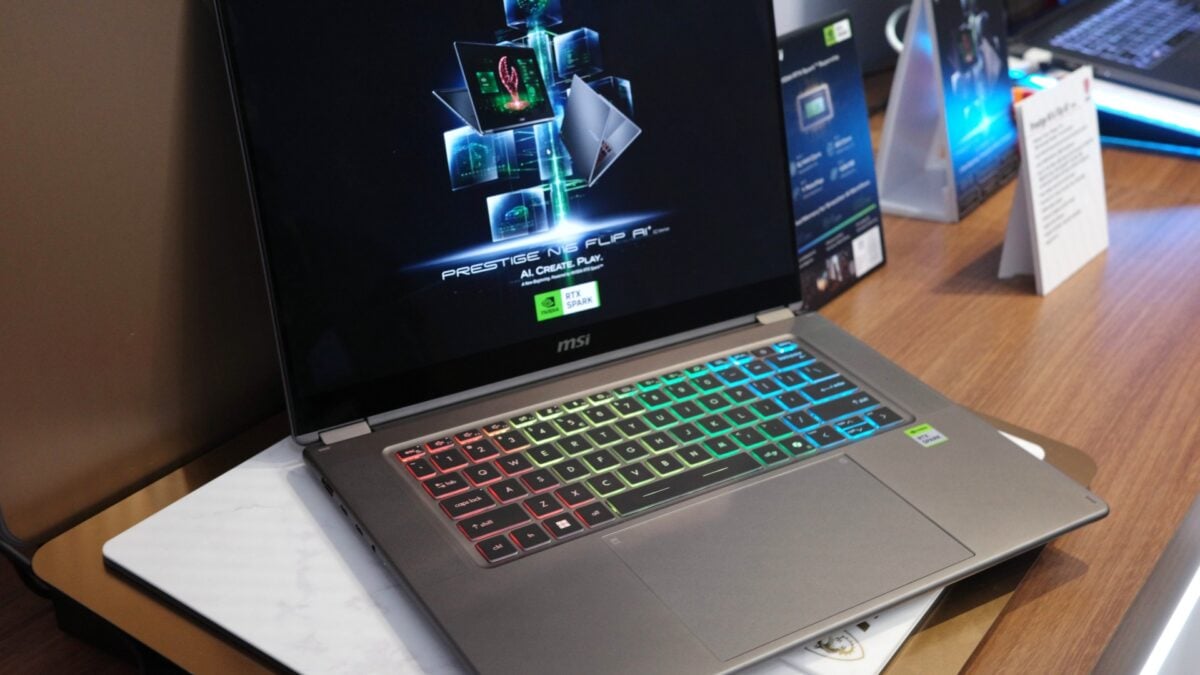
Starting this Friday, you’ll have multiple laptop makers banging on your door, haranguing you about buying what they’ll call a “new class of PC” as your next laptop. They’re promising to revolutionize local AI work, push rendering to peak levels, and still have the performance you want as a gaming device. The reality is more complicated, but Nvidia’s new laptop chip built for pricey devices may finally move PCs in the right direction—pushing for local compute above any AI subscription. Nvidia invited me out to San Francisco to get even more hands-on experience with its laptops and desktops, all running its newfangled N1X chip. That being said, I’ve handled these PCs at Computex and IFA this year, too, so this wasn’t my first rodeo. However, it was the first time Nvidia decided to reveal what precise performance consumers could expect from these laptops. So what’s going on inside these chips? The CPU tile also has a small NPU, but the N1X is built to brute force everything else with CUDA and use upscaling and emulation on the side. © Kyle Barr / Gizmodo The N1X chip is distinct in several ways. One is the CPU tile co-developed with MediaTek. It’s an ARM-based processor distinct from the usual x86 microarchitecture promoted by AMD and Intel. This is called a “Grace” CPU, and the top-end configuration sports an even number of 10 performance (P) cores and 10 efficiency (E) cores spread among two clusters. The GPU is where things get spicy. Nvidia’s plan to push local AI on PCs is a brute-force application of its CUDA GPU architecture. The top-end configuration includes 6,144 GPU cores, the same number as a desktop-level RTX 5070 graphics card. You should not expect anywhere the same performance from a laptop with a limited power threshold, though it’s still a huge hunk of processing power to throw at rendering, gaming, or—yes—AI tasks. The Blackwell GPU tile also includes 24MB of L2 cache and Nvidia’s fourth-gen ray-tracing cores. This Microsoft Surface Laptop Ultra is running ‘Gears of War: E-Day,’ but that’s only with the help of emulation, upscaling, and frame generation. © Kyle Barr / Gizmodo Here’s where things get exciting. Nvidia promises that users will be able to see far better efficiency to reach peak GPU power than a laptop with a discrete RTX 5070 laptop GPU at around 80W of both CPU and GPU power. That’s for both gaming and AI prompt processing. Still, a discrete GPU will be able to max out with much more power than RTX Spark. A dedicated gaming laptop will perform better than any single chip design, especially on a smaller, thinner laptop. While you can find ARM-native versions of apps like Blender that should support the N1X processor on or close to launch, this chip is going to rely on x86 to ARM emulation for many demanding apps. Yes, that means additional CPU overhead for gaming, as well. There are other examples where an RTX Spark laptop just makes more sense than a gaming-ready laptop. One is the unified memory, which is a shared memory pool between the GPU and CPU. If you stack this laptop with more memory, you can expect it to easily meet the VRAM requirements for real-time graphics at higher resolutions. The main question we have to ask is whether these laptops can hit solid framerates when gaming without any extra help. Nvidia let me run through Gears of War: E-Day on medium and high settings, though only ever with DLSS 4.5 and frame generation running alongside it. That’s not quite RTX 5070 levels of performance. Nvidia has routinely said that these laptops, like this HP Omnibook Ultra 16, are good for real-time graphics work while running AI. It may be able to get there, actually. © Kyle Barr / Gizmodo At the very least, Nvidia has promised more future native game support with multiple partnerships with game publishers and developers. The rest of these titles, including Microsoft titles like Gears of War, will be emulated with Microsoft’s Prism x86 to ARM emulator. The Windows maker has claimed its emulator only makes a marginal dent on overall performance when emulating apps, though it may have more impact with CPU-dependent apps or games. Only the highest-end RTX Spark PCs are built for local AI Nobody’s making it easier to break into using local AI with a UX that deviates from the dull and confusing chatbot model. © Kyle Barr / Gizmodo But this is Nvidia, folks. Did you really imagine this laptop launch wasn’t going to push AI? Team Green wants you to believe these laptops can push 120-billion parameter AI models. However, whether you can actually host AI models all on-device or have to offload some of that capability to the cloud may depend on which RTX Spark you buy. There are two variants to RTX Spark that you should understand right out of the gate. Nvidia’s N1X chip that powers these PCs comes in two flavors: one with an 18-core CPU and a 5,120-core Blackwell GPU and another with 20 CPU cores and 6,144 Blackwell GPU cores. Whether the PC is actually made for heavy-duty local AI work may depend less on core counts and more on memory availability. The lower-end RTX Spark models are going to be limited to lower unified memory configurations—either 24GB or 32GB. The higher-end models can go all the way up to 128GB. Not all RTX Sparks are created equally. Some are built for running every AI locally, while others are more centered on gaming and creator workflows. © Kyle Barr / Gizmodo That’s going to make pricing extra complicated. Upcoming laptops like the Microsoft Surface Laptop Ultra cost $2,600 at base with only 24GB of unified memory. Other RTX Spark PCs, like the Asus ProArt P16, start at $2,800 and only get more expensive from there. The top-end Surface Laptop Ultra with the max 128GB memory and 1TB storage will set you back $5,900. Suddenly, Apple’s regular nickel-and-diming for memory upgrades when buying its MacBook Pro doesn’t seem so out of step with the rest of laptop-kind. AMD already made this same move with its Ryzen AI Max+ 300 series, pushing its APU (accelerated processing unit) architecture as far as it would go with a giant GPU. The chipmaker followed up these codenamed Strix Halo chips with Gorgon Halo, the Ryzen AI Max+ 400 chips. Only this time, AMD launched versions of its chip that only support a maximum of 128GB of unified memory. This means every PC running a Gorgon Halo processor is essentially built to be an uber machine explicitly built for local AI tasks. The number of consumer-end machines is so limited that I personally have not had the chance to test them out. Asus, MSI, Dell, HP, Microsoft, and Lenovo are all launching new RTX Spark PCs, all with slightly different specs and price points. © Kyle Barr / Gizmodo Which means, currently, Nvidia can claim to be the one who’s actually pushing AI-native PCs to consumers at price points more people can potentially afford. I’ve long been an AI skeptic, but if there’s one thing I believe, it’s that the future of LLMs is not going to rest on the shoulders of big, expensive, and community-destroying data centers. Local compute that keeps your data secure on-device is the best case for these AI models. Nvidia, ironically the company that’s chief pushing the AI data center build-out workwide, may also end up showing us a better way forward. (Full disclosure: travel and lodging were paid by Nvidia, and Gizmodo did not guarantee any coverage as a condition of accepting the trip).
Nvidia’s RTX Spark PCs Aren’t a Revolution, but They May Change Laptops Forever
Full Article
Original Source
Read the full article at Gizmodo →KhanList aggregates and links to publicly available news content. We do not host full articles from third-party sources. Always verify important information with original sources.