
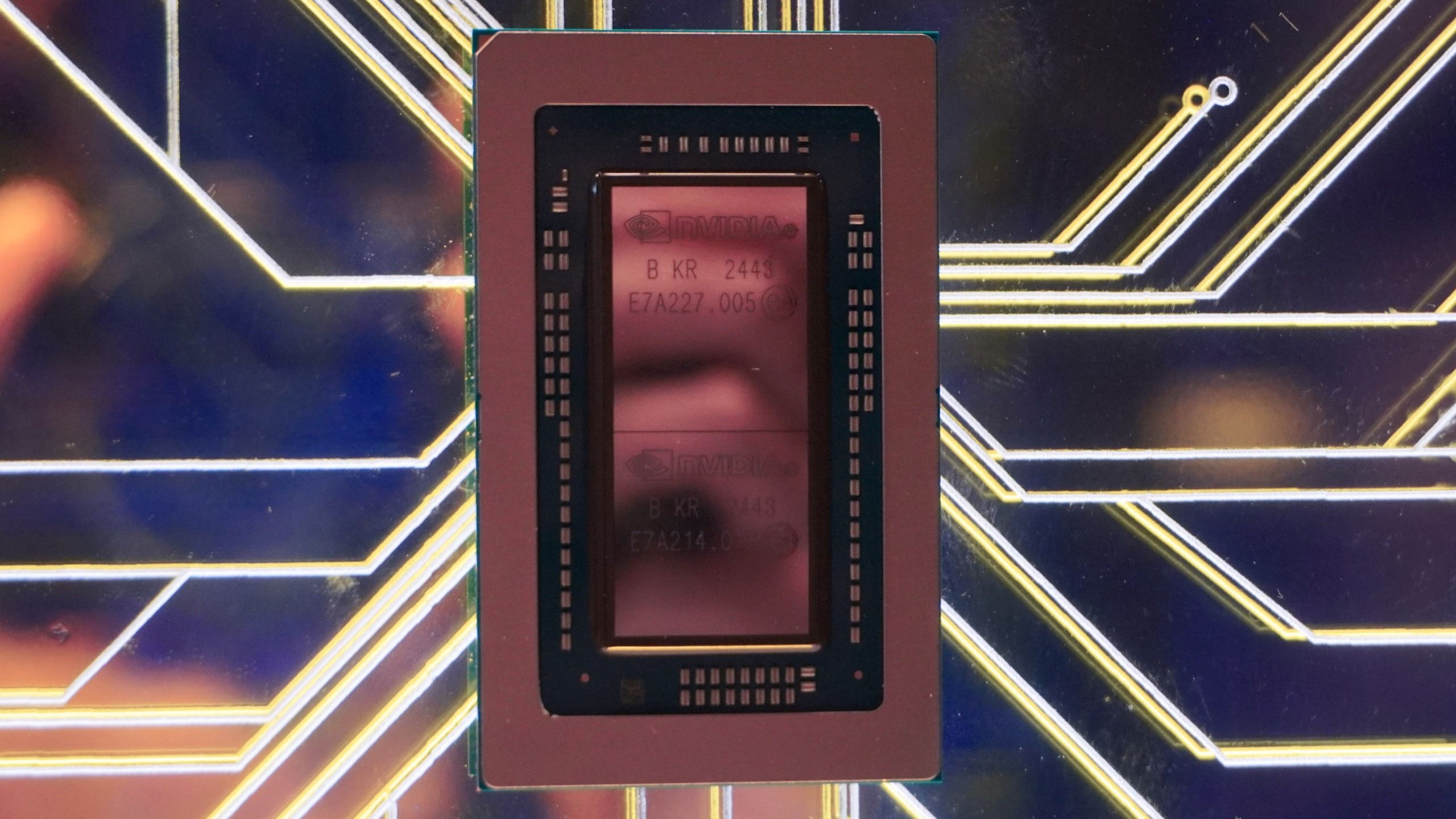
(Image credit: Future) For years, creatives and gamers have had to deal with the two-device compromise: you buy an M-series MacBook Pro for the seamless productivity and all-day battery life, and keep the power-hungry Windows gaming rig at home.I’ve tested RTX Spark a few times now, and I believe it’s the end of that compromise. And at IFA 2026, Team Green has confirmed that the RTX Spark N1X is coming this October.Nvidia is aggressively targeting Apple’s throat. By shifting to the Arm-based Grace CPU paired with Blackwell graphics, as you’d see in its RTX 50-series GPUs, and massive pools of memory, Nvidia is finally bringing the Apple Silicon paradigm to Windows — without sacrificing PC gaming.Impressive power in a 14mm chassisThis isn’t the first foray with Windows on Arm that we’ve seen. Qualcomm’s Snapdragon X2 Elite continues to deliver strong performance and power efficiency. But RTX Spark goes at things a different way by chucking a massive GPU at the silicon.In my time testing, that leads to super-powered prosumer productivity performance (especially with the software integrations across Blender and Adobe’s creative suite), stellar gaming performance and enough fuel for Nvidia’s mission to “reinvent the PC” with local agentic AI. And for that power efficiency side of things, it manages to keep the same performance both on and off the charger!Up until this point, we’d only known about the top-of-the-line N1X chip. Now we know about the baseline option (also called N1X…this could get a little confusing). Swipe to scroll horizontally Spec Configuration 1 (The powerhouse) Configuration 2 (The baseline) CPU 20-core Grace CPU 18-core Grace CPU GPU Blackwell RTX GPU with 6,144 CUDA cores (same count found in desktop RTX 5070) Blackwell RTX GPU with 5,120 CUDA cores (more than the cores found on mobile RTX 5070) Unified Memory Up to 128GB 24GB-32GB Obviously it’s worth noting that with the lower power consumption of a laptop, even though it does have a massive amount of cores, you won’t get the same level of performance as a desktop-class GPU. Just fun for comparison's sake, you know?Get instant access to breaking news, the hottest reviews, great deals and helpful tips.The form factorsWe already know about eight laptops launching with RTX Spark N1X. You can see where I rank them all in a tiered list I did a couple of months ago. Basically, to match the premium specs of that chip, you’re getting premium shells that tick all the boxes needed to take on a MacBook Pro — metallic bodies, gorgeous displays (OLED or mini LED), solid ergonomics and plenty of I/O.There are also a couple of mini PCs from Asus and MSI launching with the chip inside, and here at IFA, we’re getting word on two new systems coming to the party in October too:Lenovo Yoga 9n 2-in-1: Another convertible RTX Spark system has arrived to take on MSI’s Prestige Flip N16. The chassis is just 14mm thin.Acer SFF RTX Spark: A small form factor desktop that would look pretty perfect under my living room TV as well as my desk.So that’s the next advantage over the MacBook — variety of designs.The friction point: Predicting the priceWhile Nvidia was eager to show off the specs, it was noticeably silent on the price. Well, I’m gonna do some bac-of-the-napkin math here to fill this gap and make a prediction. Based on components and the direct competition with Apple, it’s obvious that these machines are going to carry a heavy premium.The baseline prediction: The lower-tier configuration (18-core CPU, 5,120 CUDA cores, 24GB RAM) will likely start around the $1,999 to $2,499 range — pricing it directly against the base MacBook Pro models.The agentic premium: If you want that maxed out configuration with 128GB of unified memory to run massive local AI models, expect a jaw-dropping price tag. Given that a maxed-out MacBook Pro easily pushes past the $4,500 mark, an equivalent N1X will likely land in the $4,000 to $5,000+ range.Bookmark this and remind me in the comments if I get this wrong!The early verdictWay back at Computex 2026, Nvidia CEO Jensen Huang made it clear that he wants to reinvent the PC with RTX Spark. This is all fair and good, but I believe the real showcase of N1X here is not the local AI computation. That part is impressive, but it’s still up for debate on whether people will actually use their computers in this way.The real game-changer here (to me at least) is the fundamental architectural shift that bridges the gap between serious productivity and high-end gaming — complete with all-day battery life (providing it does match up to Nvidia’s claims of course).It’s the MacBook Pro that actually has games to play on, and if everything plays out the way I’m anticipating (and there’s no nasty surprises on the performance front), then Apple is finally going to have genuine, uncompromised competition. Follow Tom's Guide on Google News and add us as a preferred source to get our up-to-date news, analysis, and reviews in your feeds. More from Tom's GuideI wanted to hate Nvidia’s DLSS 5 ‘AI filter’ — but the real DLSS 5 is photorealistic black magicI tested 6 RTX Spark laptops for gaming — and the winner completely shocked meTom’s Guide Computing Awards 2026: 22 game-changing laptops, desktops and peripherals Jason brings a decade of tech and gaming journalism experience to his role as a Managing Editor of Computing at Tom's Guide. He has previously written for Laptop Mag, Tom's Hardware, Kotaku, Stuff and BBC Science Focus. In his spare time, you'll find Jason looking for good dogs to pet or thinking about eating pizza if he isn't already.
Nvidia’s RTX Spark N1X drops this October: Why Apple Silicon should be terrified (and our price predictions)
Full Article
Original Source
Read the full article at Tomsguide →KhanList aggregates and links to publicly available news content. We do not host full articles from third-party sources. Always verify important information with original sources.