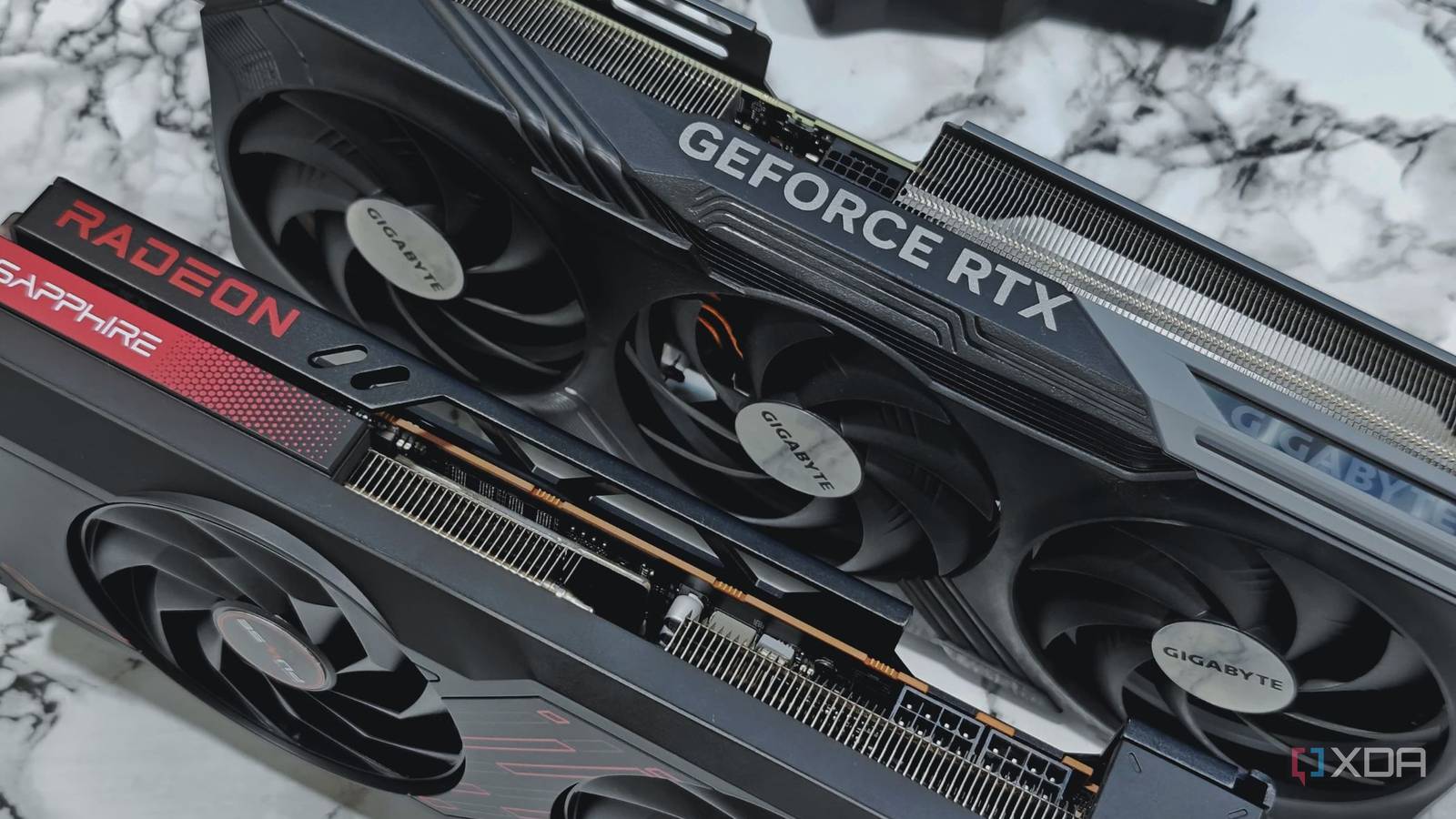
Published Jul 31, 2026, 12:00 PM EDT Abhinav pivoted from a career in banking to pursue his first love in writing. Even while working full-time, he continued contributing as an editor-at-large, a role he has held for more than 7 years. A lifelong tech enthusiast who has built three gaming and productivity powerhouse PCs since 2018, his passion for technology keeps him closely following the semiconductor industry, from NVIDIA and AMD to ARM. His MSc dissertation explored how artificial intelligence will reshape the future of work, reflecting his curiosity about the wider social impact of emerging technologies. All three PCs that I've built for myself over the past decade have had an Nvidia GPU sitting in the PCIe slot. Across all three generations, I've been more than happy with the choice I made. The next time I assemble a build for myself, though, I suspect that I will find myself asking some questions. Most of these questions relate to how Nvidia envisions a future for gaming, and whether it aligns with my own. At SIGGRAPH 2026, Team Green returned to the stage with the highly controversial DLSS 5, clearly in an attempt to get enthusiasts on board with their new neural rendering technology. It was a far more digestible pitch than what was first revealed in March this year, and yet, the premise ended up making Radeon feel more attractive for gaming than it has ever felt before. Here's why I'm switching teams the moment the next generation of GPUs arrive. Nvidia answered one loud complaint, and sidestepped three important ones Four months on, no one knows what DLSS 5 will cost to run Credit where credit's due, Nvidia took the stage at SIGGRAPH 2026 and chose to address the concerns around the upcoming upscaler, at least partially. Team Green has established that DLSS 5 won't see a blanket implementation across every title that uses it, and developers will get three separately trained models labeled A, B, and C, which can be assigned per scene, per character, or per object. The upscaler will also allow for fine-tuning and some more control through sliders, which will govern how aggressively the upscaler works for both structure intensity and tone. Since it is confirmed that developers will exercise more control through object-level masking, it allows studios to preserve the artistic vision for a game whilst simultaneously benefiting from the new upscaler. Evidently, Nvidia has been listening to the community uproar. The presentation did leave some of the most important questions unanswered, and as a potential buyer, these parameters factor into whether my gaming experience can benefit from DLSS 5. There are no published benchmarks, no VRAM figures, no per-model parameter counts, and no accounting of the frame-time costs per model. This is especially relevant because Model A, B, and C each carry different parameter counts, which means they introduce different overheads to memory and compute. The closest thing to a specification thus far is Nvidia's assurance that the models run well on a single GPU and are VRAM efficient, but that isn't enough context to answer on which class of GPU. Then, there's further insult to injury. The earlier GTC preview of DLSS 5 used two RTX 5090s, with one dedicated entirely to DLSS 5 inference. As a buyer, it makes me confused whether my next GPU will be an $800 mid-range card or a $1,200 mid-range one for it to be even slightly future-proof. DLSS 4.5 and FSR 4 already showed what I wanted from AI in gaming Faster frames, but not entirely different ones What makes DLSS 5 especially easy to critique is the fact that the upscaler that I can run on my RTX 4070 Ti Super today already gets the balance right. With Ray Reconstruction and Smooth Motion, my hardware is already faster and images already cleaner without the graphics card company having to alter the artistic decision the developers made. That's exactly what I have always wanted from a GPU, to render what I play, and if possible, render it faster. DLSS 5 is a complete departure from that entire proposition. AI rendering fell into two categories until now, including reconstruction and function approximation, and the upcoming iteration of DLSS now introduces a third that practically no one asked for. Whether DLSS 5 improves the upscaling that I use is a question that will be answered in due course. However, it will certainly introduce a generative stage on top, with an overhead that has been unaccounted for thus far. The GeForce premium over Radeon no longer makes sense FSR 4 closed the gap on everything I use as a gamer For most of the last decade, I justified paying more for a GeForce RTX card because DLSS was better by a long shot, and the ecosystem justified the pricing disparity. With the upcoming generation, DLSS, along with Nvidia's vision for it, has started to look shaky as a proposition. Since it's a factor that influences which card I end up putting in my PC which will be used for games, it is an important consideration. Some of that credit goes to AMD as well. A few weeks ago, I ran a curiosity-driven experiment testing DLSS 4.5 against FSR 4, and I clearly struggled more than I have before to pick a winner on image quality. The features that I use every day exist on both sides of the aisle at roughly equivalent quality, but not equivalent prices. If AMD continues its pattern of undercutting Nvidia GPUs on retail MSRP, then the long-standing Radeon ambition to finally win over GeForce buyers could certainly materialize. Even if I were to make the same argument for someone who uses their GPU for other things such as local AI inference or self-hosting media, AMD still wouldn't be too far off, and this time the argument isn't even about generous pricing. AMD is now shipping day-zero support for cutting-edge local AI models, and AV1 with B-frames has all but caught up with NVENC's long-established superiority. AMD just won over another GeForce buyer I have no doubt that eventually, given enough time, AMD will face these same questions, and FSR will have its own questionable generative stage to defend. Certainly, then, this isn't a permanent verdict, but it never really is in the shifting landscape of this industry. For now, the premium that I've paid happily for a decade is now going to be justified by a feature that I would rather switch off, and that makes the decision rather easy.
Nvidia's DLSS 5 pitch just made my next GPU decision for me, and it isn't GeForce
Full Article
Original Source
Read the full article at Xda-developers →KhanList aggregates and links to publicly available news content. We do not host full articles from third-party sources. Always verify important information with original sources.