
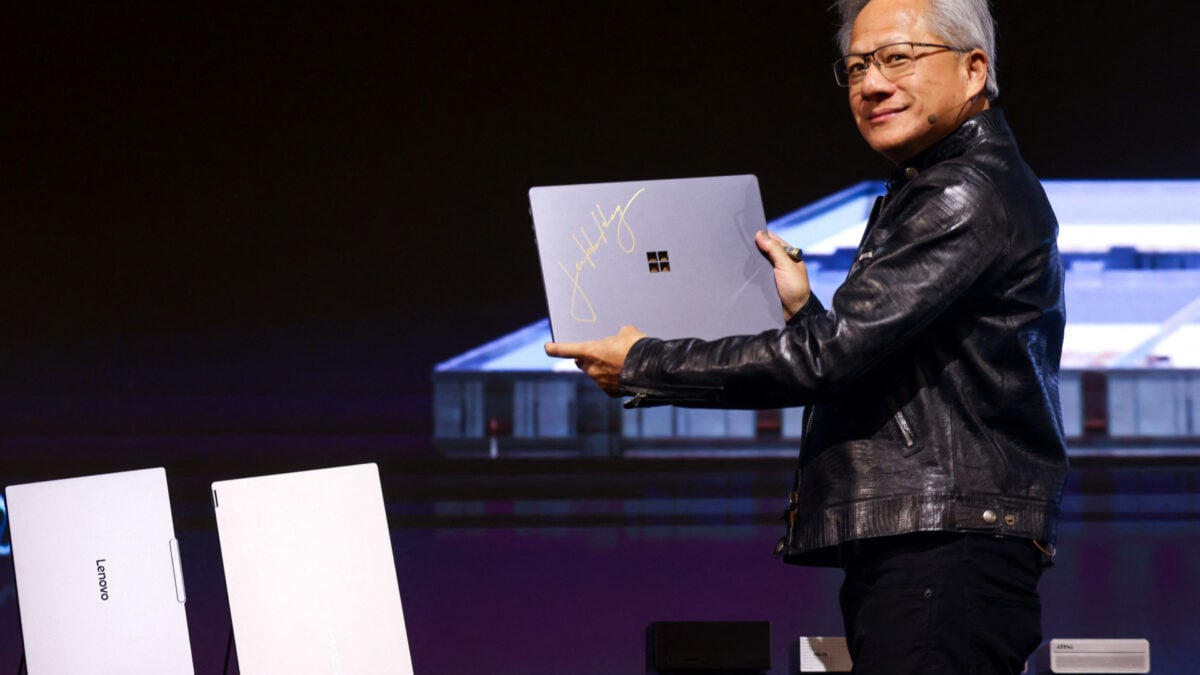
Nvidia, with former CEO Jensen Huang at the helm, was often a caustic presence toward the community that raised both man and company up. Say what you will about the man who made Nvidia what it is today (you can say a lot, frankly), but with Huang stepping down following a rising crescendo of scandals and without his evident love for technology, it’s only going to get worse for gadget lovers. Colette Kress, Nvidia’s chief financial officer since 2013, is replacing Huang as interim CEO. The money person, who up till now only liked to talk about the company’s trillion-dollar AI ambitions, now leads what is still one of the most innovative firms around. We don’t know if that can last. Let’s take a step back and ask where Huang came from. Before the Taiwanese American was rolling out the AI training chips fueling the intelligence boom and bust cycle, he was at the forefront of extolling graphics acceleration technologies that helped the video game industry blossom into 3D graphics. Nvidia’s tech was one of the main lynchpins for computer graphics thanks to its CUDA parallel computing platform, which allowed computers to use the graphics processing unit (GPU) for more than just pushing polygons. All evidence pointed to Huang being more than a mere figurehead. He relied on a “flat” corporate structure with few examples of middle managers. He reportedly had 60 people in his organization directly reporting to him, meaning that whatever the CEO thought was interesting or compelling was often what was worked on. Jensen Huang matters to Nvidia because he can take technologies his engineers believe are possible and turn them into products the whole company commits resources to, takes risks on, and has to deliver. That's why the supply chain gets such strong order visibility and is willing… — 郭明錤|Ming-Chi Kuo (@mingchikuo) November 12, 2026 You can see Huang’s love for gadgets in examples as mundane as the Nvidia Shield, a TV set-top box that has somehow lasted more than a decade. In an interview with Ars Technica, VP of hardware engineering Andrew Bell said that the leather jacket-clad Huang was especially keen on the Shield, hence why the box kept receiving updates despite the company obviously having other priorities. It was only this year, with RAMaggeddon making almost all tech overly expensive (ironically driven by Nvidia’s drive for more AI data centers), that Nvidia killed off its base Shield TV box and left the Shield TV Pro struggling at a $300 price point. During a 2025 Q&A after Nvidia announced its GeForce RTX 50-series lineup of GPUs, Huang said his company wasn’t a gaming company but a “technology company.” And yet, it’s Nvidia’s tech that has been a huge part of our modern gaming ecosystem. Even beyond all its work with PC gaming technology, the reason why the Nintendo Switch 2 does a good job keeping up with modern consoles is thanks to the Nvidia chip inside and its ability to use DLSS, upscaling tech that has pushed the boundaries for lower-end hardware to handle more demanding games. Companies like AMD are still trying to match the visual qualities of DLSS 4.5. The reason why Nvidia has had such a head start is thanks to Huang advancing the technology despite pushback from both gamers and competitors. Jensen Huang was the kind of personality that drove close partnerships, such as with Microsoft’s Satya Nadella. That could suddenly change. © Kyle Barr / Gizmodo Huang was the one to push his company’s tech first. He would often get up on stage and wax poetically about whatever new technology came up, including the kind of tech that users panned. The former CEO tried to push DLSS 5 and its AI-slopified visuals as new “neural rendering,” even though the reality was more complicated. Instead of dropping the tech due to fan backlash, Nvidia modified it to make the AI visual overlay less severe. Users may hate it, but it is just one way Nvidia, under Huang, kept innovating. Huang’s Nvidia was a closeted beast that would sometimes lash out when it felt cornered. Over the last few years, Nvidia gained journalists’ and hardware reviewers’ ire by limiting access to the necessary graphics drivers to GPUs like the RTX 5060 (Gizmodo never requested nor was supplied an RTX 5060 review unit due to these restrictions). During its review period for the launch of its RTX Spark PC lineup, it tried to limit unfavorable benchmarks by claiming that standard tests like Geekbench 7 weren’t a good way to test its N1X chip. Reporters, including us at Gizmodo, ignored that advice. Through it all, you could feel Huang’s attitude and personality, another form of celebrity that was intertwined with his products. Any attack on Huang’s gadgets was an attack on the man himself. Nvidia, under Huang, was also often testy. Worse, the company’s push for AI data centers led to mass price hikes for its hottest consumer commodity, the RTX 50-series GPUs. The company let its consumer business take a backseat to its AI ambitions, though it still cared about optics. You could see it at Computex 2026 this year. Huang is a hometown hero in Taiwan, and as he strolled through the convention halls, customers and companies alike would line up to get him to sign their ever-more expensive motherboards and GPUs. Jensen Huang loved putting his signature on things, especially any tech related to his own brand. © Vernon Yuen / Nexpher Images via Getty Images Despite the company’s dependence on AI chips, Nvidia had its sights on future hardware. Nvidia may have let go of any hope of an RTX 50 Super launch in 2027, but Huang had already talked about sequel laptop chips, the N2X and N3X, which were set to further cement the company’s role in home computing beyond the data center. Huang talked a big game, but if the future is on-device AI, then these chips would be a big part of that transition. We have no idea whether these initiatives will survive under new management. We do not know Kress as a personality, but we know her job history. She has been a CFO for multiple major corporations before joining Nvidia in 2013, including Microsoft and Cisco. Kress has rarely talked publicly beyond Nvidia’s financials and stock price. But if there’s one thing we know is top of her mind, it’s continuing to bankroll the AI boom. Why should Kress’ Nvidia care about all those GPUs and Nvidia Shield TVs that don’t even show up as a blip on the tech giant’s bottom line? Her appointment seems designed to wrangle the shock to Nvidia’s stock price. Nvidia is hunting for a full replacement CEO. Semafor reported Wednesday, based on unnamed sources, that the Nvidia board was considering Apple’s hardware chief, Johny Srouji. We assume Apple CEO John Ternus would rather nail Srouji’s feet to the ground rather than give up yet another exec. In any case, Nvidia desperately needs a hardware visionary in the head role. No matter who takes the spot, Nvidia roots were entwined with Huang’s—both his rise and fall. As much as he vexed us, the company will be inevitably worse off without him—and so will consumers.
Nvidia Without Jensen Will Be Even Worse for Gadgets
Full Article
Original Source
Read the full article at Gizmodo →KhanList aggregates and links to publicly available news content. We do not host full articles from third-party sources. Always verify important information with original sources.