
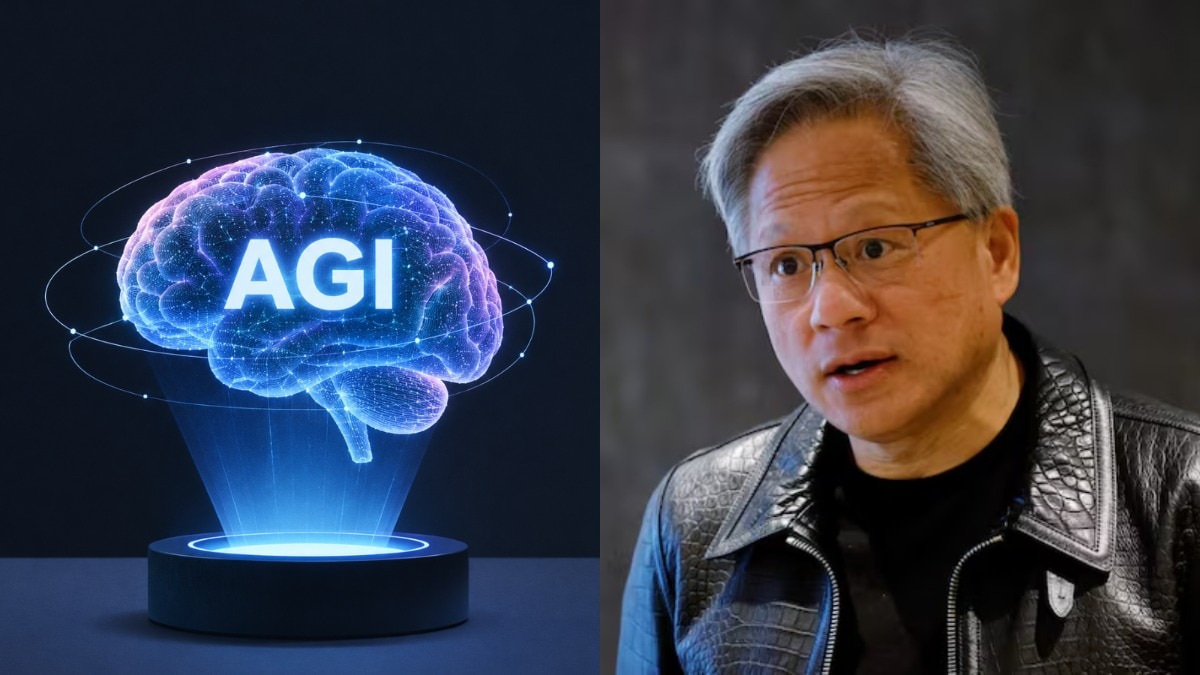
AGI is here, or that is what Nvidia's Jensen Huang and OpenAI think with GPT-6 Astra. But what is AGI? And is GPT-6 Astra really the start of a new AI era?Nvidia CEO Jensen Huang believes that GPT-6 Astra is the start of AGI, but experts are not so convinced. (Photos: AI generated/Reuters)In the world of AI this week, OpenAI made waves with its new model GPT-6 Astra. AI companies release new models regularly, but Astra was different. "It’s not unreasonable to feel that we are now in the AGI era,” OpenAI President Greg Brockman said. The debate around AGI only magnified when Nvidia CEO Jensen Huang claimed “AGI has arrived” with Astra. But what is AGI? And do we finally have it?AGI stands for artificial general intelligence. There is no concrete definition of AGI, though usually it is agreed that AGI, in a sense, refers to a state where machines can start to think like us humans.The promise of AGIFor years, AGI has been the goal for every AI lab, be it OpenAI, Anthropic, or Google. The promise around AGI is big. Silicon Valley claims that it can essentially solve all our problems. “If AGI is successfully created, this technology could help us elevate humanity by increasing abundance, turbocharging the global economy, and aiding in the discovery of new scientific knowledge that changes the limits of possibility,” OpenAI CEO Sam Altman said in a blog post three years ago.The message around abundance thanks to AI is so universal that it may be one of the rare topics where Altman and Elon Musk hold a similar view. Musk, on multiple occasions, has claimed that AI will bring an abundance of resources to humanity. In one such post on X, he wrote, "The future is going to be amazing with AI and robots enabling sustainable abundance for all!" Google DeepMind’s chairman Demis Hassabis has also discussed the potential of AGI. In an X article, he claimed, “The magnitude of this technology’s impact will be unprecedented, perhaps 10x of the Industrial Revolution at 10x the speed.”What is AGI?The expectations around AGI are huge, but as we mentioned earlier, there is no solid definition of what AGI is. But there is some consensus. Nishant Chandra, cofounder of Newton School of Technology, explains, “AGI or artificial general intelligence generally means an AI system that can perform most intellectual tasks as well as, or better than, a capable human.”Rather than focusing on a few tasks, such as coding or generating images, AGI should be a model that can be as good as humans but at a lot of tasks. “AGI is an AI system that can handle many kinds of tasks at a human level, rather than being narrowly good at just one thing,” says Venkatesh Sundar, founder of Indusface. “It is usually described as an AI system as intelligent as humans across domains.”Before GPT-6 Astra, we had quite capable models already – such as GPT-5.6 Sol and Anthropic’s Mythos 5.1. But AGI is supposed to be different. “The important difference from the AI we have today is that it should be able to take on new and unfamiliar problems without needing to be retrained each time,” Naresh Agarwal, senior VP, AI application security platform Harness, explains. “It should be able to move between coding, research, reasoning and real-world problem-solving much like a person can.”The origins of AGI go way back. Experimental physicist Mark Gubrud first coined the term artificial general intelligence in 1997 in a paper, warning about the risks of advanced autonomous systems in a military arms race. The term became popular in the 2000s when Shane Legg, co-founder of Google DeepMind, called AGI an AI system capable of doing all the cognitive tasks a typical human can perform.Venkatesh Sundar noted that ever since then, the tech industry has been working towards AGI. “AGI has been its explicit north star since the term was popularised in the mid-2000s. It marked a deliberate shift away from ‘narrow AI’ toward machines that reason and adapt across domains like humans,” he adds.That is, AGI could potentially give machines the ability to do a lot more. “AGI could make intelligence much cheaper and more widely available,” Nishant Chandra adds.“This could speed up scientific research, help us study diseases, solve difficult problems in mathematics and physics, and make products and services faster and cheaper to create.”Curing diseases like cancer has been another one of the promises made regarding AGI. And we are seeing some progress – even before AGI is here. Moderna’s latest cancer vaccine – intismeran autogene – was designed with the help of AI. In Phase 3 trials, it showed positive results in patients with late-stage melanoma, a serious form of skin cancer.Is AGI really here?Coming back to the start of this article. Nvidia’s Jensen Huang seems confident that humanity is entering the AGI era. But is AGI actually here?American research firm Gartner says that there needs to be more evidence regarding GPT-6 Astra’s capabilities to make such a call. In a memo shared with India Today Tech, the firm explained, “Without more evidence, (you) should ignore the AGI hype for now, and instead focus on use-case specific evaluations, demonstrated business outcomes and reliable autonomy.”Kumar Rajagopalan, VP and India head at IT firm Dexian, gave a reality check on the hype around AGI and Astra. When asked if AGI was here, he replied, “Not quite. Jensen Huang has stated that ‘AGI has arrived,’ while OpenAI does not use this term in relation to Astra, calling it the most intelligent and aligned model instead. The issue emerges due to the lack of the common agreement on what AGI threshold is yet.”Hakimuddin Wadlawala, founder of AI-native cybersecurity firm Aquila I, believes that we cannot rush to a conclusion just yet, partly due to a lack of a proper definition. “It is too early to draw a definite conclusion on this. Current AI models are becoming better and displaying certain features of general intelligence,” he tells India Today Tech. “However, we do not yet have a generally accepted standard that says that the AI has achieved AGI status.”Looking at the broader AI industry, critics like Gary Marcus have dismissed claims of GPT-6 Astra being AGI. “Sad to see Jensen claim that AGI has arrived, with no evidence and no definitions,” he wrote on X.Venkatesh Sundar insists that while OpenAI and Nvidia, two companies that have business relations, are hyping up AGI with Astra, things seem complicated. “OpenAI is claiming it, allies are echoing it, but independent researchers are not treating it as verified,” he explains.Nishant Chandra believes that while Astra is a step towards AGI, there is still some work left before we truly enter a new era of AI. “Astra is a powerful model, particularly for using computers and completing workflows. But it does not perform better than every competing model in every area,” he notes. “We also do not yet have an AI system that can reliably perform the complete job of a capable office worker without regular human checking and guidance.”You may wonder if GPT-6 Astra is not AGI, then what will be AGI? And how would we know if an AI model finally reaches that state?“A genuine AGI should be able to understand a broad goal, divide it into tasks, use different tools, learn what it does not know and correct its own mistakes,” Nishant Chandra adds. “It should complete long and unfamiliar assignments without constant supervision.”Naresh Agarwal agrees. “I don’t think a single benchmark or test can tell us that,” he says. “I would look at whether a system can consistently deal with problems it has never seen before, apply what it knows from one area to another, make reasonable judgements when things are unclear and adapt when something does not go as planned.”If the industry does agree that a model is AGI in the future, the promises made by Silicon Valley could become true, but there are concerns too. “In case AGI proves true, it could bring about a major revolution in scientific research, help in automation, and transform whole sectors like IT, medicine, education, and finances,” Kumar Rajagopalan adds, “Meanwhile, it could lead to serious job problems, security concerns and social consequences connected with the power being held by technology.”A major impact may also happen in cybersecurity – a field where fears have grown ever since Anthropic first released Claude Mythos. “AGI can transform cyberspace and bring forth new types of threats based on autonomous vulnerability discovery and human manipulation,” Hakimuddin Wadlawala states. “This gives rise to the need for AI red teaming that would help develop chatbots and other AI entities immune to various attacks through the discovery of their weaknesses like jailbreaking, prompt injection or inappropriate use of tools.”- EndsPublished By: Armaan AgarwalPublished On: Sep 8, 2026 16:40 IST
Nvidia CEO Jensen Huang claims GPT-6 Astra is AGI, experts say not quite
Full Article
Original Source
Read the full article at Indiatoday →KhanList aggregates and links to publicly available news content. We do not host full articles from third-party sources. Always verify important information with original sources.