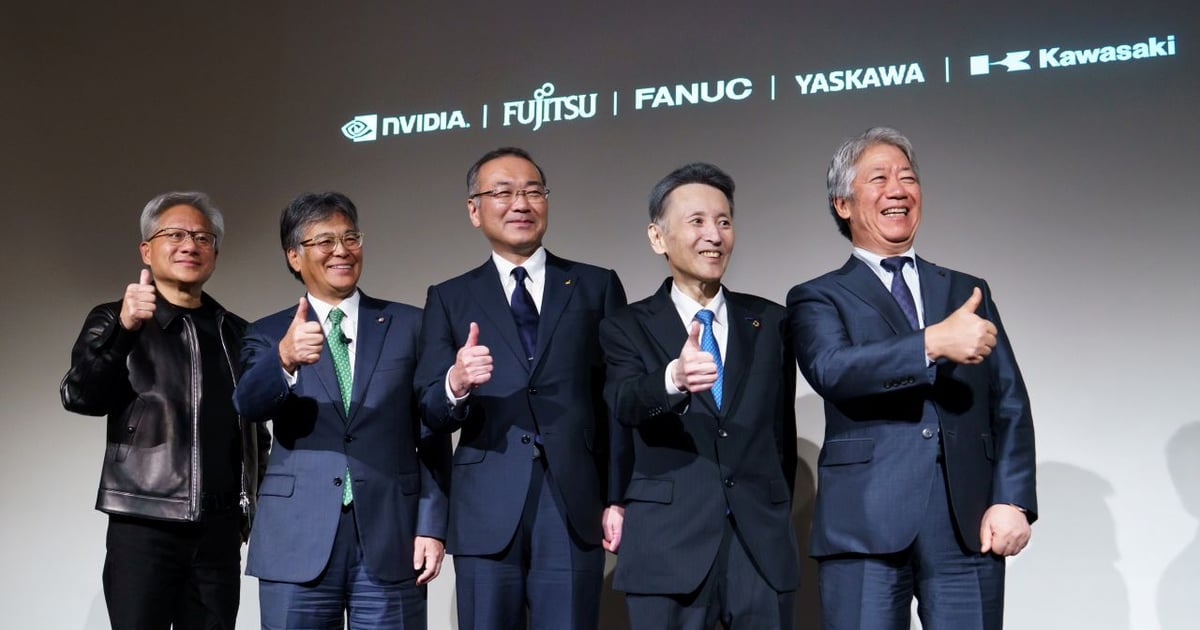
From l to r: Nvidia CEO Jensen Huang, Fujitsu CEO Takashi Tokita, FANUC CEO Kenji Yamaguchi, Yaskawa Electric Vice Chairman Masahiro Ogawa and Kawasaki Heavy Industries CEO Yasuhiko Hashimoto following their joint press conference on July 16, 2026, in Tokyo, Japan.Tomohiro Ohsumi/Stringer via Getty ImagesNvidia is broadly expanding its physical AI and robotics portfolio, unveiling new edge AI hardware, robot foundation models, developer software and industrial partnerships aimed at accelerating deployment of intelligent machines.Unveiled during an event in Tokyo, the updates span Nvidia's entire robotics stack, from AI models and simulation software to edge computing hardware and manufacturing collaborations.Analysts said the breadth of the announcements reflects Nvidia's ambition to establish itself as the industry's full-stack platform for physical AI, strengthening its position across every stage of the robotics development pipeline rather than simply supplying AI chips."Nvidia's announcements further expand their already leading platform toward a full-stack enabler of physical AI," Himanshu Kumar Ojha, a senior director analyst at Gartner, said. "By providing complete, end-to-end reference architectures ... Nvidia is positioning itself as the de facto platform standard for the robotics industry."Related:Toyota Spin-Out Launches From Stealth With $300MCosmos 3 EdgeAs part of the updates, Nvidia launched Cosmos 3 Edge, a new 4 billion parameter world foundation model designed to run directly on edge devices. The model enables robots and vision AI systems to interpret their surroundings, reason in real time and generate actions without relying on cloud computing.However, Alex West, a robotics analyst at Omdia, a division of Informa TechTarget, said the biggest obstacle to deploying physical AI is data rather than the models themselves."The biggest challenge for enterprises is trying to apply AI in environments where data is still messy," he said,While data readiness has become a prerequisite for deploying large language models, he said robotics requires much larger volumes of operational data, including environmental awareness, force feedback and failure modes that are difficult to collect and transfer between machines.That is where Cosmos 3 Edge could prove valuable, West said, arguing its ability to be post-trained makes it better suited to heterogeneous fleets of robots and industrial equipment.Cosmos Coalition Expands to JapanNvidia is also expanding its Cosmos Coalition into Japan, with FANUC, Fujitsu, Hitachi, Kawasaki Heavy Industries, Kubota, NEC, SoftBank, Sony and Yaskawa Electric joining the initiative to develop open physical AI models and robotics applications.In a statement released at a media pre-briefing, Nvidia CEO Jensen Huang described the move as bringing together Japan's mechatronics and Nvidia's physical AI to create "a new era of industrial automation."Related:Chinese Tech Vendors Converge on Humanoid Robotics and Embodied AIThe partnerships underscore a broader shift in physical AI toward ecosystem-based development, where AI developers, robotics manufacturers and industrial firms each contribute different parts of the technology stack."These partnerships are crucial, not just for Nvidia, but more broadly for the evolution of physical AI," West said. "They highlight the fact that physical AI requires convergence of IT and OT."Robot manufacturers often lack the AI expertise needed to build foundation models, he said, while AI companies generally lack the industrial knowledge, customer relationships and go-to-market strategies needed to deploy robotics at scale.Paul Miller, vice president and principal analyst at Forrester, said those partnerships will ultimately determine how quickly physical AI reaches enterprise environments."The best chip in the world is not a lot of use without a robot or a car or a crane in which to embed it," he said, arguing Nvidia's industrial partners provide the operational expertise and credibility needed to turn AI technology into production systems.Toyota and Jetson ThorSeparately, Toyota announced an expanded AI partnership with Nvidia, moving beyond autonomous driving into factories and smart cities.Related:Maker of Digit the Robot to Go PublicBuilding on last year's agreement to develop next-generation driver assistance systems using Nvidia Drive, Toyota will now use Nvidia technologies across vehicle software engineering, manufacturing and urban infrastructure.The expanded partnership includes the use of Omniverse and Isaac Sim to create digital twins of factories, AI models to assist software development, and a multimodal vision-language model developed by Toyota subsidiary Woven to support traffic management and urban intelligence.Nvidia also unveiled the Jetson T3000 and Jetson T2000, new Blackwell-based edge computing modules aimed at powering humanoid robots, autonomous mobile robots and other intelligent machines. The modules offer a smaller, more power-efficient alternative to the flagship Jetson AGX Thor while maintaining support for multimodal AI workloads, including large language models, vision-language models and robot foundation models.Metropolis updated to accelerate vision AI agentsNvidia also updated its Metropolis platform, adding more than 80 developer libraries and AI skills, including enhancements to DeepStream, TAO and Vision AI software.The additions are designed to simplify the development of agentic vision AI systems capable of analyzing live video, generating summaries, identifying incidents and supporting automated decision-making.Taken together, the announcements demonstrate Nvidia's ambition to provide much of the underlying infrastructure needed to build and deploy physical AI, from foundation models and simulation software to edge computing and industrial partnerships.Miller said the strategy could accelerate enterprise adoption, but cautioned that widespread deployment will still depend on overcoming longstanding challenges around data quality, system integration and operational readiness."We also need continued investment in understanding the processes we might want to automate," Miller said. "At Forrester, we talk about the Automation Triangle [balancing physical automation, AI and the human workforce]. Finding the best mix of those capabilities is something that few firms consistently get right yet."About the AuthorContributing WriterScarlett Evans is a freelance writer with a focus on emerging technologies and the minerals industry. Previously, she served as assistant editor at IoT World Today, where she specialized in robotics and smart city technologies. Scarlett also has a background in the mining and resources sector, with experience at Mine Australia, Mine Technology and Power Technology. She joined Informa in April 2022 before transitioning to freelance work.
Nvidia Broadens Physical AI Push With Robotics, Edge AI Updates
Full Article
Original Source
Read the full article at Aibusiness →KhanList aggregates and links to publicly available news content. We do not host full articles from third-party sources. Always verify important information with original sources.