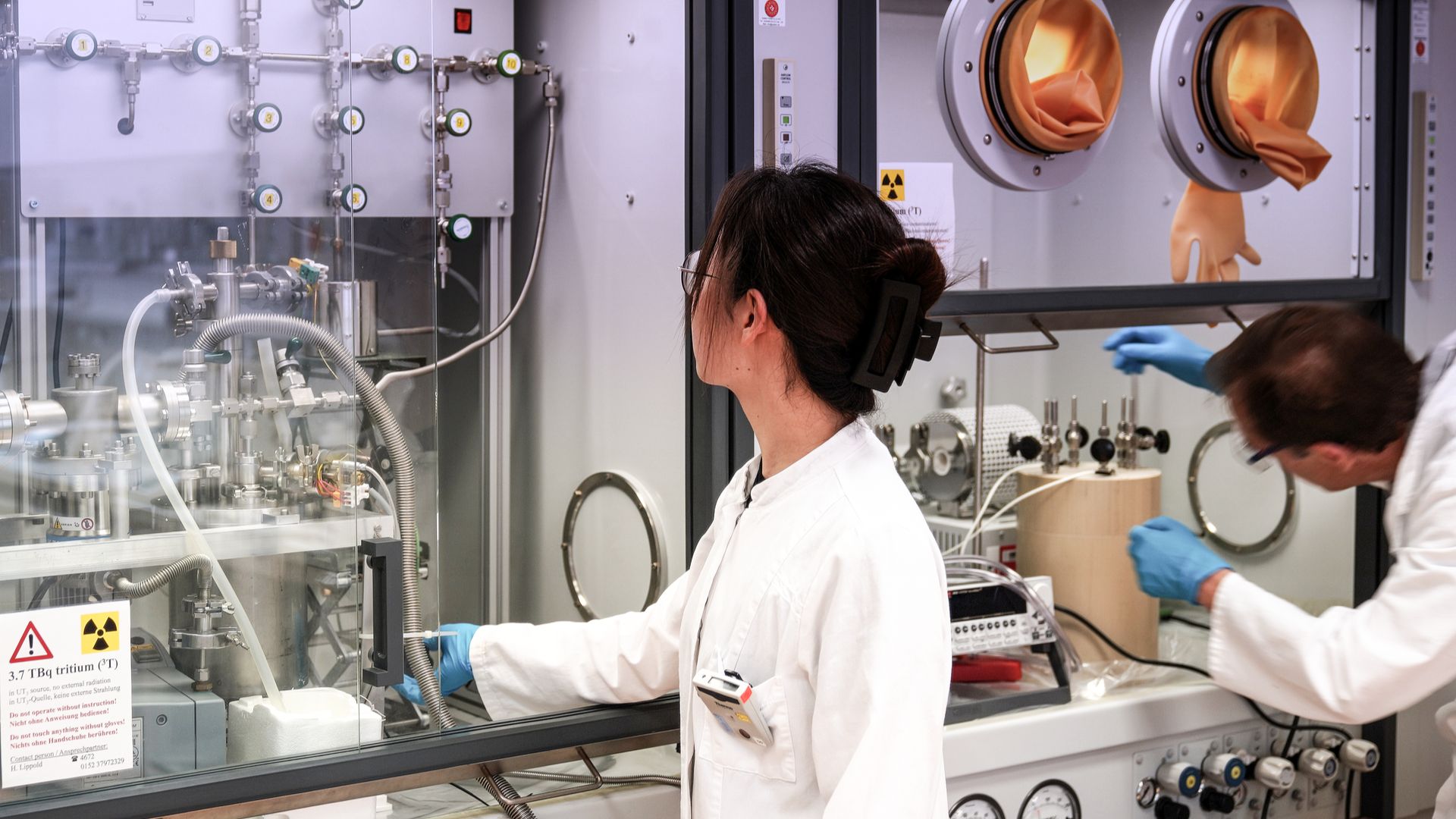
For the first-time ever, researchers in Germany have found a way to filter hydrogen isotopes using synthetic crystals containing silver. The technique solves a key engineering problem for future nuclear fusion power plants by making it possible to recover and recycle unused fuel. The study was carried out by team members at the Helmholtz-Zentrum Dresden-Rossendorf alongside partners at Leipzig University and the Max Planck Institute for Solid State Research. Their work focuses on synthetic zeolites, which are porous materials filled with microscopic channels. Commercial fusion reactors will run on a mix of two heavy hydrogen isotopes, known as deuterium and tritium. When heated inside a reactor, these atoms fuse together to release enormous amounts of energy. “But the fuel is not completely consumed,” said the researchers in a press release. “A significant fraction remains, together with ordinary hydrogen, also known as protium, which can be the product of side reactions with reactor materials or released by outgassing.” Recycling this gas mixture has long presented a serious technical barrier. Because protium, deuterium, and tritium share the exact same chemical structure, standard chemical filters cannot tell them apart. They differ only by the number of neutrons in their atomic nuclei. Exploiting quantum forces to separate isotopes To bypass this limitation, the research team turned to quantum physics. When hydrogen gas enters the silver-loaded zeolite cavities, the molecules interact with the electronic fields around the silver ions. “The key effect arises from the interaction between hydrogen molecules and the electronic structure of the silver ions,” added Prof. Cornelius Fischer, professor at HZDR and Leipzig University. This interaction creates a force field that attracts the gas molecules to the cavity walls. Because deuterium and tritium are heavier than regular hydrogen, they have lower quantum baseline energy levels. This energy difference causes the two heavier isotopes to lock onto the silver sites far more tightly than light protium can. Researchers then use heat to separate the trapped gases. As the zeolite warms up, the molecules break free in stages based on their weight. Protium detaches first at low temperatures, followed by deuterium, while tritium holds on the longest and requires the highest heat to release. In laboratory tests using equal parts of all three isotopes, the process altered the gas balance dramatically. The output shifted from a balanced mixture to a ratio of 1 part protium, 41 parts deuterium, and 175 parts tritium. This marked the first time scientists successfully separated a three-part hydrogen mixture using a solid porous material. Industrial implications with future research “These are not just marginal differences,” Fischer explains. “The separation process is highly efficient even in a single step.” The discovery is vital for building a closed-loop fuel system in commercial fusion plants. Without efficient fuel separation, power plants would waste large amounts of rare tritium and struggle to maintain continuous operations. The silver-doped crystal matrix proved resilient against radiation. Tritium undergoes radioactive decay, emitting particles that can degrade porous materials over time. During multi-hour exposure tests, the zeolite retained its full filtering ability without structural damage. “This is not yet proof for long-term technical operation but an important indication that this class of material is well worth investigating further,” concluded Fischer. “Our task is to understand the underlying mechanisms quantitatively and compare different materials systematically.”Recommended ArticlesGet the latest in engineering, tech, space & science - delivered daily to your inbox.An active and versatile journalist and news editor. He has covered regular and breaking news for several leading publications and news media, including The Hindu, Economic Times, Tomorrow Makers, and many more. Aman holds expertise in politics, travel, and tech news, especially in AI, advanced algorithms, and blockchain, with a strong curiosity about all things that fall under science and tech.
Nuclear fusion reactors benefit from first-ever silver crystal tritium separation
Full Article
Original Source
Read the full article at Interestingengineering →KhanList aggregates and links to publicly available news content. We do not host full articles from third-party sources. Always verify important information with original sources.