
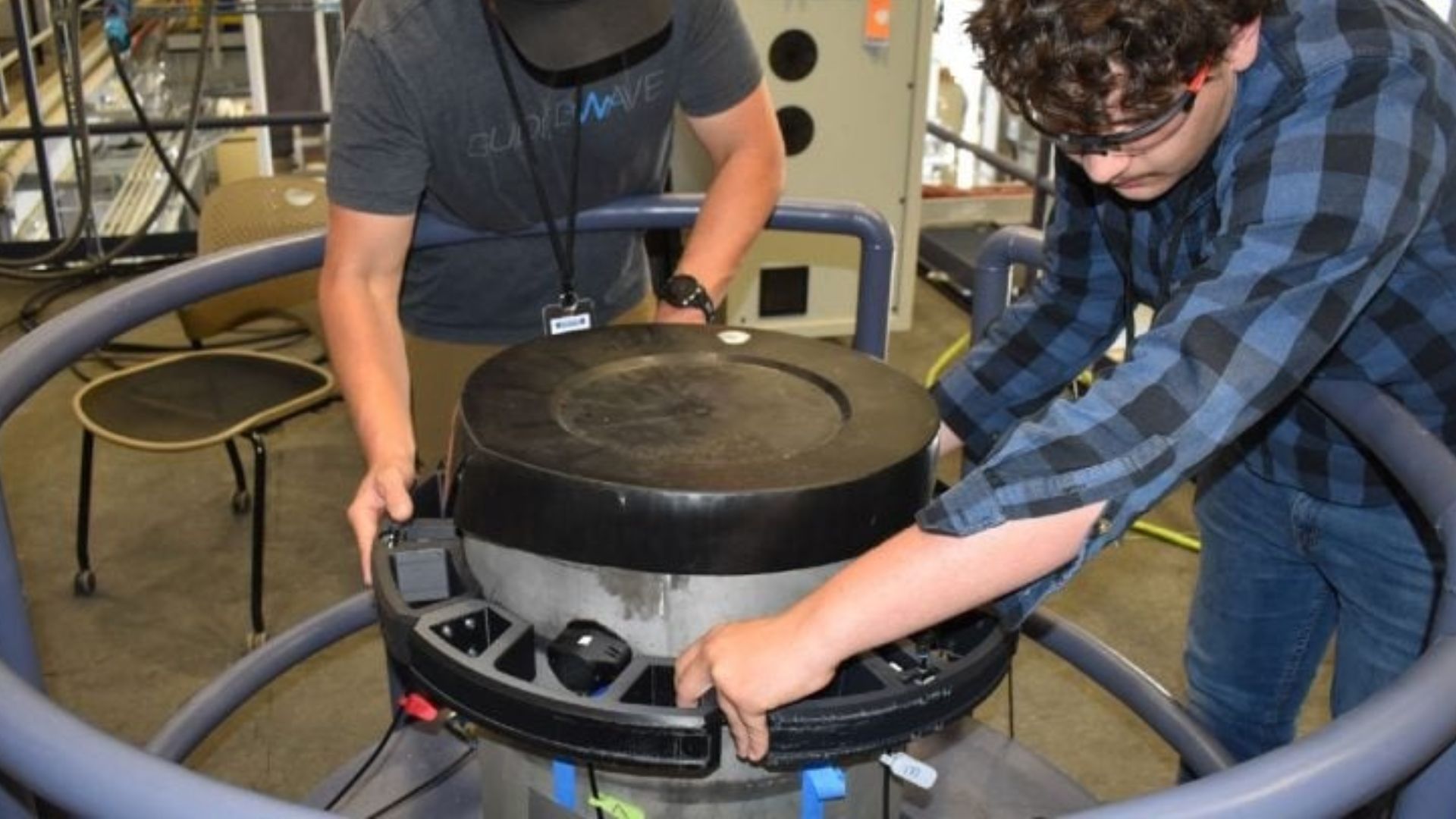
Manually inspecting thousands of massive steel canisters packed with radioactive waste, one by one, would be a major logistical undertaking. Now, the U.S. Department of Energy is working to avoid this logistical challenge. Following successful lab trials in Idaho, the DOE’s Center for Used Fuel Research has tapped Guidedwave to test an automated acoustic emission system at full scale. The technology listens for subtle structural changes in used nuclear fuel (UNF) dry storage canisters. It tracks integrity remotely and continuously. “A future DOE federal UNF storage or staging facility could store hundreds or thousands of dry storage systems, allowing automated and continuous monitoring and inspection approaches to streamline aging management and reduce operational burdens for UNF management at such facilities,” Idaho National Lab stated. Monitoring nuclear waste canisters Metal under stress releases faint, high-frequency ultrasonic waves long before any crack becomes visible to the naked eye. Such microscopic damage, including chloride-induced stress corrosion cracking, poses a well-known risk at coastal facilities like San Onofre. Rather than blasting signals into the steel like traditional ultrasonic tools, acoustic emission sensors sit directly on the canister surface and passively listen. Acting much like a medical stethoscope, the sensors pick up the metal’s own internal stress signals in real time. Currently, nuclear power plants depend on periodic physical inspections to satisfy U.S. Nuclear Regulatory Commission (NRC) aging management rules. Technicians often need to haul specialized gear out to the storage pads for every single checkup. That approach works for individual power plants, though a future federal storage facility could hold hundreds or even thousands of canisters. Automating the process would slash operational costs and human exposure. The US-based firm Guidedwave earned its spot after impressing a panel of DOE and industry experts at Idaho National Laboratory’s Remote Work Mockup and Prototype Lab. Their sensors detect the faint acoustic signatures of stress or micro-cracking long before visible damage appears. The real-world proving ground awaits in Southern California. Starting in February 2027, Guidedwave will spend roughly a year testing its gear on a Holtec UMAX dry storage canister at the San Onofre Nuclear Generating Station. No actual nuclear fuel will sit inside the test unit. Electric heaters will mimic the intense thermal loads and harsh environmental conditions generated by spent fuel. 2027 test on nuclear waste canisters San Onofre offers far more than a random testing ground for nuclear waste storage. Shut down in 2013 and currently undergoing decommissioning, the Southern California facility houses over 100 canisters of spent fuel right along the Pacific Ocean. It is an ideal real-world proving ground for corrosion and structural monitoring gear. Reportedly, the plant is slated for demolition by 2028, but its nuclear waste will remain. Spent fuel is expected to remain on-site for decades because the United States currently lacks a permanent repository that accepts commercial radioactive waste. Success at San Onofre could reshape how the nuclear sector manages aging infrastructure. Commercial reactor operators could voluntarily adopt the passive monitoring tools if they update their existing NRC aging management plans. Federal regulators do not require continuous acoustic tracking to meet current safety standards, yet a proven automated system offers a compelling alternative to manual labor.Get the latest in engineering, tech, space & science - delivered daily to your inbox.Mrigakshi is a science journalist who enjoys writing about space exploration, biology, and technological innovations. Her work has been featured in well-known publications including Nature India, Supercluster, The Weather Channel and Astronomy magazine. If you have pitches in mind, please do not hesitate to email her.
Nuclear fuel canister monitoring tech advances to full-scale demonstration in US
Full Article
Original Source
Read the full article at Interestingengineering →KhanList aggregates and links to publicly available news content. We do not host full articles from third-party sources. Always verify important information with original sources.