
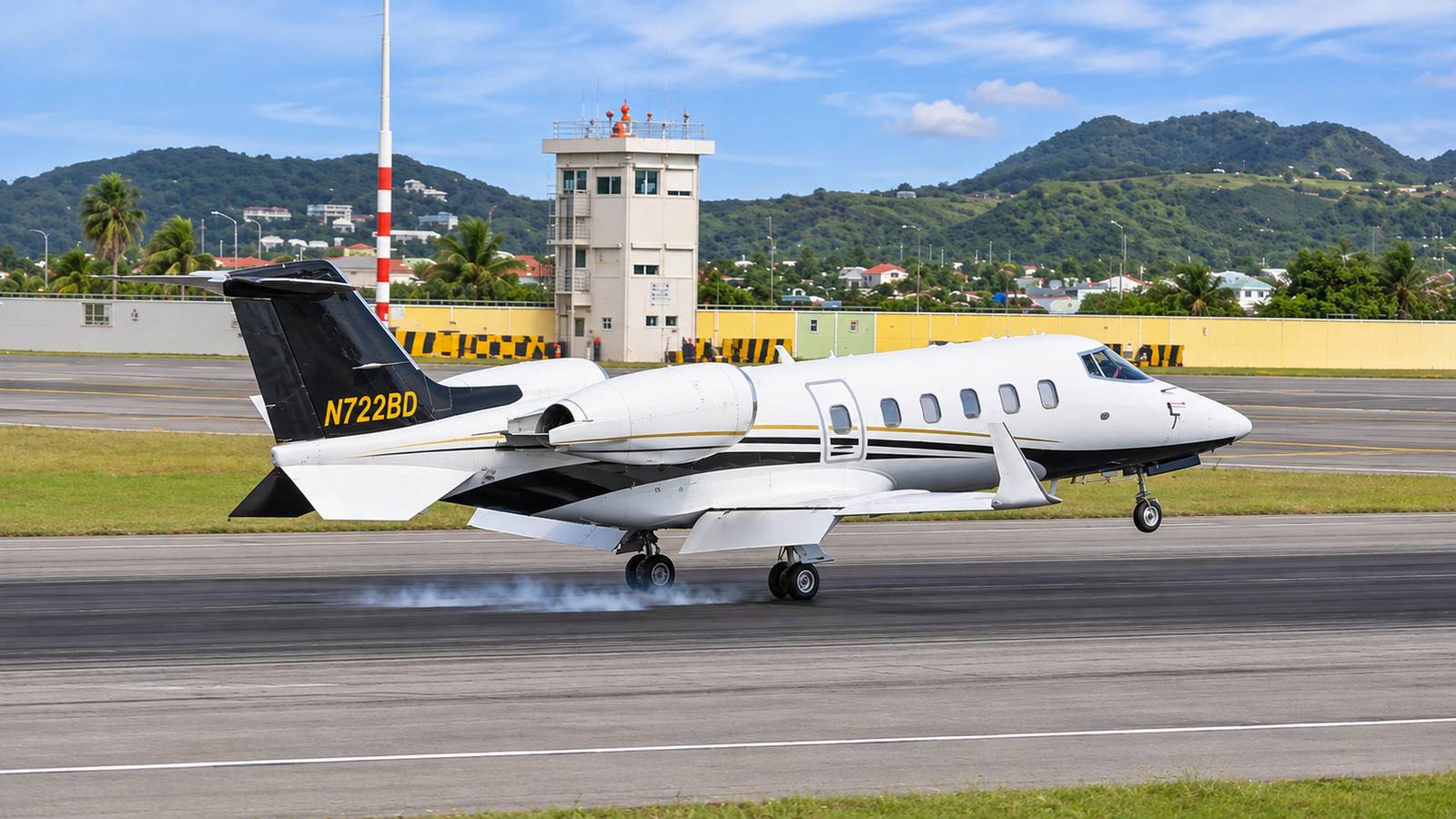
Published Nov 9, 2026, 7:02 PM EST Journalist – Aaron is an aviation and travel journalist with 14 years of experience in the travel and tourism industry. His background spans airport operations, aviation infrastructure, and travel consulting, having worked with global organizations across New Zealand, Europe, and North America. Combining industry expertise with firsthand travel experience across more than 52 countries and five continents, Aaron covers airlines, airports, aviation policy, and the wider travel sector. He is based in Canterbury, New Zealand. His work has been published in Simple Flying and featured by MSN, SAM CHUI Aviation & Travel, EIN News, Pakistan Defence, and Climate Depot. The on-scene phase of the investigation into the South Florida Learjet crash that occurred on November 1 has been completed. The National Transportation Safety Board ( NTSB) has now handed over the scene after a fatal crash earlier this month when a Learjet 60 crashed into the ground, killing all nine occupants on board Federal investigators were able to successfully recover the aircraft's Cockpit Voice Recorder (CVR) from the wreckage; this has now been sent to the NTSB laboratory in the country's capital for readout and audio analysis. Cockpit Voice Recorder Recovered And Sent To Washington Credit: Mike Illien | Flickr Evidence has been found that reiterates the mid-air breakup indications. The NTSB Board Member, Tom Chapman, confirmed in the active investigations report that the investigators have found evidence that the plane had begun to break up in the air before it made impact. The debris, including a section of the plane's tail, was located more than 3.8 miles (6.11 km) from the crater left by the plane's high-speed trajectory in Greenacres, Florida. Reviewing weather and atmospheric conditions, it is suggested that the jet encountered severe weather during its flight from Austin Bergstrom International Airport (AUS) to the Bahamas. The air traffic control audio recordings by co-pilot Nathalia Filgueiras reported that there were icing conditions that caused severe turbulence over and above 700 feet (213 meters), which was before the jet issued a Mayday call. The ultimate loss of control and detachment of the critical tail control surfaces rendered the plane uncontrollable, which ultimately led to the nose-down, high-speed descent that resulted in the plane's crash into a residential Florida roadway. The impact crater left by the Learjet's crash initially filled with water due to heavy rain, which initially slowed parts of the recovery until the water was pumped out. The Next Steps In the Investigation Credit: Daderot | Wikimedia Commons With all physical wreckage now documented and components collected from the impact scene, the NTSB will now shift its focus to the data extraction and laboratory analysis of all the evidence. This will include the download and evaluation of the audio to be recovered from the voice recorder. Mapping of the flight data and flight track relative to the severe convective storm cell that expanded on its flight path will enable a radar and meteorological reconstruction of the fatal flight. This will be undertaken at the same time a structural examination of the airframe is conducted, where the tail assemblies and other parts of the jet are analyzed to identify the ultimate sequence of the structure's failure. It is expected that a preliminary report will be issued by the NTSB over the next few weeks; however, the probable cause of the incident will not be expected for up to two years. Details of the aircraft involved in the incident, as per data from Craft, are outlined below: Aircraft Registration N722BD Serial Number (MSN) 271 Registered Owner LR60271 LLC Registration History Issued on January 4, 2023 Hex Code A9AB17 Engines Two Pratt & Whitney PW305A Nine Occupants Killed Onboard Learjet 60 Identified Credit: Simple Flying All nine occupants onboard the Learjet traveling from Austin to the Bahamas were identified as two crew members and seven passengers. The flight crew were Captain Jeff Gregory and Nathalia Gadelha Filgueiras. Captain Gregory was a veteran aviator and the pilot in command of the jet. He lived in Gilbertsville, Pennsylvania, and had a background in charter and commercial aviation. Filgueiras was just 20 years of age and a Brazilian American pilot who grew up in Boca Raton, Florida. Of the seven passengers was Adam Robinson, an Austin-based tech entrepreneur and the founder and CEO of software platforms Retention, RB2B and MoltSets. His wife, Helen Sharep, and their two children, Emma (4) and Charlie (2), also perished when the plane plummeted and crashed into the ground. Family friends Rachael Reed and Charmi Fehr, alongside the family nanny Anita Maria Cetina, were also on board and sadly lost their lives. The jet at the center of the incident is that of Bombardier Learjet 60, which carried registration N722BD. It is registered to LR60271 LLC of Wilmington, Delaware, and was operated by charter company Aurora Aviation.
NTSB Recovers Cockpit Voice Recorder From Miami Crash As On-Scene Investigation Ends
Full Article
Original Source
Read the full article at Simpleflying →KhanList aggregates and links to publicly available news content. We do not host full articles from third-party sources. Always verify important information with original sources.