
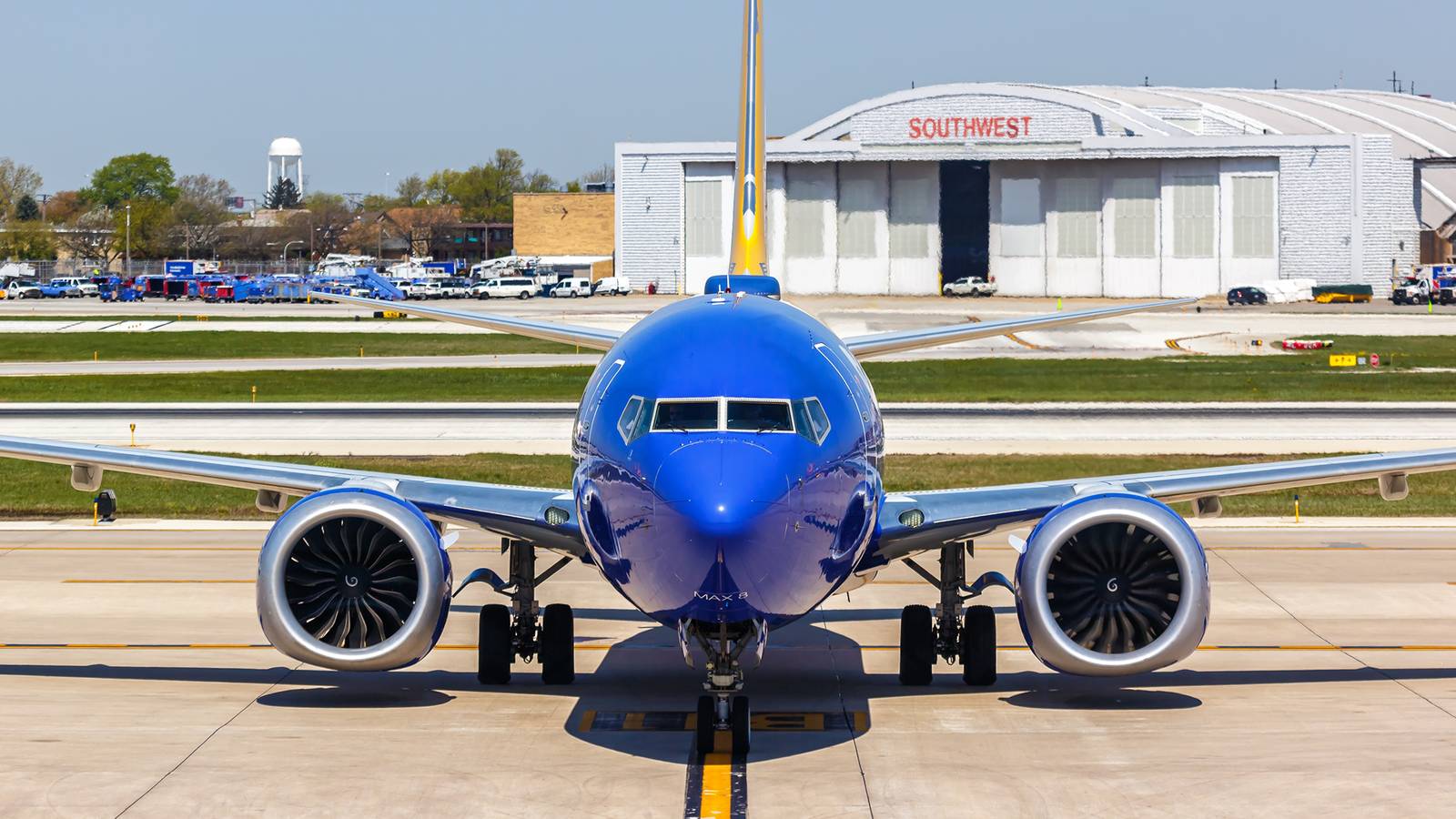
Published Nov 7, 2026, 1:15 AM EST Luke has over a decade of experience as a travel writer and aviation analyst. As a passionate traveler based across the Middle East and Asia, Luke offers strong insights into the industry. Based in South East Asia. A Southwest Airlines Boeing 737 MAX flew 44 times with undetected storm damage to its tail after missing a post-storm inspection, then later passing a flawed maintenance test. The aircraft then experienced a Dutch roll event, prompting an investigation by the National Transportation Safety Board (NTSB). In its final report on the May 2024 accident, the NTSB found that severe winds damaged the plane while it was parked in New Orleans nine days earlier. The damage affected the standby rudder power control unit's (PCU) mounting structure and its connection to the vertical stabilizer, resulting in improper rudder operation. However, a series of maintenance oversights allowed the damage to go undetected for nine days and 44 flights. Damaged Southwest 737 MAX Went Undetected For Nine Days Credit: Angel DiBilio | Shutterstock The aircraft involved was a Boeing 737 MAX 8 (registration N8825Q), which had been in service for less than 18 months when the following events occurred. On May 16, 2024, it was parked overnight at Louis Armstrong New Orleans International Airport (MSY) when strong winds damaged the vertical stabilizer structure around the standby rudder PCU. However, the aircraft showed no obvious external damage, and no inspection was conducted. Date May 25, 2024 Airline Southwest Airlines Flight code WN746 Aircraft Boeing 737 MAX 8 (N8825Q) From Phoenix To Oakland Fate Landed safely after Dutch roll event N8825Q then left New Orleans the following morning and completed 38 flights over the next week without any reported rudder problems. However, on May 25, while operating Southwest flight 746 from Phoenix Sky Harbor International Airport (PHX) to Oakland International Airport (OAK), the crew experienced "a small amount of Dutch roll" at 34,000 feet, which lasted a few seconds and occurred again at 32,000 feet. A Dutch roll is defined by the NTSB as "a coupled oscillation in an airplane’s yaw and roll axes." The phenomenon causes an aircraft's nose and wings to oscillate in opposing movements, potentially making it difficult to control. The 737 MAX continued and landed safely in Oakland, but inspections found damage to the standby PCU's mounting bracket and surrounding vertical stabilizer structure. Investigators also found that a scheduled maintenance test in Houston two days earlier had been incorrectly signed off, despite evidence that the rudder was not moving correctly. The NTSB stated the probable cause as: "Damage to the standby rudder power control unit connection to the vertical fin due to an extreme high wind event while the airplane was parked, which remained undetected and resulted in anomalous operation of the standby rudder power control unit." How Southwest's Maintenance Checks Missed The Problem Credit: Southwest Airlines Boeing's maintenance manual for the 737 included inspections for aircraft exposed to extreme winds, but it did not specify a wind speed threshold. Southwest also had no procedure for alerting maintenance control when parked aircraft experienced extreme winds. As a result, no inspection was carried out immediately after the storm. Following the storm damage, the aircraft completed 38 flights before it underwent a scheduled overnight maintenance check in Houston on May 23, just two days before the Dutch roll event. This included a test requiring a mechanic to observe the aircraft's tail and visually confirm that the rudder moved correctly in both directions. However, hangar footage of that test showed the rudder moving to the right but not to the left, with nobody positioned at the rear to observe it. Despite this, Southwest's maintenance records showed the test as passed, and the aircraft returned to service. The following day, the crew of the aircraft's fourth flight after the Houston check disconnected the yaw damper after it appeared to overcorrect during turbulence. The yaw damper was deferred under the minimum equipment list (MEL), and the jet flew one more sector to Phoenix, where the system passed a functional test and was returned to service. Flight 746 was the aircraft's sixth flight since the Houston check and its 44th since the storm in New Orleans. Southwest And Boeing Set 65-Knot Wind Thresholds Credit: Robin Guess | Shutterstock Following the accident, Boeing revised its 737 maintenance manual in May 2025, requiring an extreme high-wind inspection when ground winds reach 65 knots (75 mph). This is close to but still below the 73-knot (84 mph) gusts recorded at New Orleans on the night N8825Q was damaged. Meanwhile, Airbus sets a higher threshold for most of its aircraft, requiring an inspection when ground winds exceed 80 knots (92 mph). Southwest also introduced new inspection procedures and conducted checks across its entire MAX fleet. Between June 17 and 20, 2024, the airline inspected all 231 737 MAX aircraft in its fleet at the time, finding no similar damage. It now monitors weather reports for winds above 65 knots, triggering an inspection program.
NTSB: Missed Inspections Let Storm-Damaged Southwest 737 MAX Fly 44 Times Before Dutch Roll Accident
Full Article
Original Source
Read the full article at Simpleflying →KhanList aggregates and links to publicly available news content. We do not host full articles from third-party sources. Always verify important information with original sources.