
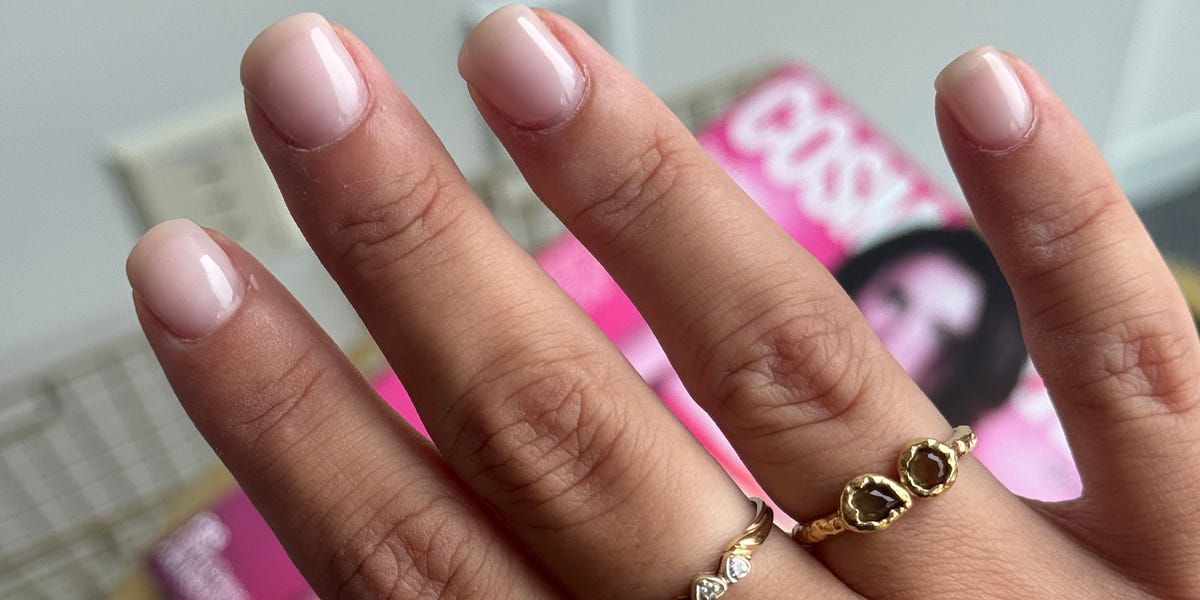
My nails have gone through it the last few years. Monthly gel extensions practically destroyed my nails, prompting me to try press-on nails for a few months to cover up how wretched and damaged they were. My poor removal habits (i.e., ripping them off) made this just as damaging as the gel I tried to get away from. In the last few months, I’ve meticulously cared for my nails, bringing them back to health before trying any new manicure techniques.Now, my nails are smooth and healthy, but my cuticles could use some serious work. Enter: the Ukrainian manicure technique, a “waterless” manicure that focuses on serious cuticle care. I headed to MVK salon in New York to try it out myself and got all the info straight from the source.“With this manicure, the nail plate keeps its appearance for longer, and because the coating sits deep and clean, it can last three to four weeks,” says Viktoria Kolodii, founder and creative director of MVK (which has salons all over the world). “We use cuticle nippers and scissors to give a cleaner result, and we use either water or keratolytics to soften the skin first,” she adds. This is often called a combined manicure, meaning they use both an E-file and manual tools to clean the nails and cuticles.“The Ukrainian manicure isn't just about nails—it's a tradition, a technology, a set of standards,” Kolodii adds. “It's about safety, sterilisation, and a culture of self-care. It's about the time a woman devotes to herself, caring for her body. It's more than a coating—it's how you treat and take care of yourself.”This technique is often paired with a simple nail color or design. “Right now, natural single-tone and nude coatings are popular—the kind of finish that almost reflects you, like a mirror manicure,” says Kolodii. “French is still a popular one: a thin coating with a fine, delicate line.”What’s the difference between a Ukrainian manicure and a Russian manicure?Kolodii explains that the idea of a “Russian” manicure has changed a lot over the years. “It once referred to a technique using scissors and soaking the hands in water—something American clients saw as a distinctly ‘un-American’ approach, brought over by technicians from the post-Soviet region,” she explains. “Today, people use the same term to mean the opposite: a dry, e-file manicure done without water, which gained popularity precisely because clients and dermatologists grew more cautious about shared soaking bowls.”Now, though, there isn’t necessarily a separate “Russian” technique that differs from the rest of the Slavic region, she explains. “There's the E-file-only technique, there's the classic one (done with cutting tools only), and there's the combined technique, where we work with both the e-file and hand tools.” Typically now in America, the E-file-only approach is what most of us view as the traditional “Russian” technique.“What we do at MVK, a combined manicure approach, is the same work Ukrainian technicians have long practised and refined,” she says. So when you go to a salon and are deciding between the two manicure types, make sure to ask what happens in their service, as there isn’t necessarily a standard rule that all Russian or Ukrainian manicure techniques entail.FWIW, both Russian and Ukrainian manicures are dry, but another common difference lies in how close they get to the cuticle. In a Russian manicure, the nail tech will slightly lift up your cuticle line and slide gel polish underneath it for a seamless effect (and much longer wear time). With a Ukrainian manicure, though, they paint the polish to the edge of the cuticle, but not under it.What happens in a Ukrainian manicure?I’ve wanted to try a Russian manicure since the first time it popped up on my Instagram feed, but I’ve been afraid. Would it hurt? How intense would the e-filing be? But it was a super easy process that has fully converted me.Add Cosmopolitan as a preferred source in your Google search results.Use your Google account to add this to your settings.To start, my nail tech immediately filed my nails to my desired shape (mine were already short, or else she would have cut them to start). Then, she buffed them to smooth the surface of my nail. From there, we began the deep cuticle care. She started by pushing them back with a wood stick, but then we really got into the good stuff. She used the electric file to even further push back my cuticles and clean them up, all before snipping them with a cuticle nipper to make sure there was no excess cuticle or hangnails around my nail bed.The pre-polish step of the manicure made sure my nails looked pristine and took around 35 minutes—much longer than a typical manicure. Once my nails were finally ready, we got into polish. I went for a gel polish, as it lasts the longest and gives me the shiniest manicure (I’m also impatient and cannot wait for regular polish to dry). This was the same process as always: dehydrator, followed by a base coat, then one to two coats of polish, then a top coat. The biggest difference, though, was how meticulously she applied the polish so as to get it as close to my cuticle as humanly possible. She even had me flip my hand over after every coat, before curing under the UV lamp, to make the polish spread without streaks or bumps.Beth Gillette/CosmopolitanProsThis is easily the most clean-looking manicure I’ve ever gotten. My cuticles still look hydrated and smooth, even a week later. Kolodii says that the manicure itself lasts up to 10 days, while the gel polish can last up to three to four weeks.It lasts a long time. Of course, it’s gel polish, so that helps. But really, pushing the cuticles so far back and painting so close to them majorly cuts down on how fast you see grow out. I’m a full week in, when my nails would start to look worn, and they look brand new.Ukrainian manicurists specialize in simple, clean designs—so if you want a good sheer manicure, they know what they’re doing. “The ‘virgin manicure’ was our signature as a nail studio long before it became a trend,” says Kolodii. “Ukrainian nail schools always taught us that the most important thing is to clean the nails so they look truly clean—a fresh look, nails that look well-cared-for and neat, without heavy or bright coating.”Beth Gillette for CosmopolitanMy nails a week after my Ukrainian manicure.ConsBecause there’s so much work with the E-file, some people might find it a bit uncomfortable. I didn’t have an issue because my nail tech was extremely gentle and consistently asked if I felt okay.It’s not a quick manicure, so if you’re short on time, probably not the mani for you. But! How long it lasts might make up for that in the long run.Final verdictFinally: I get the hype. Immediately upon leaving MVK, I knew I had a go-to nail spot. A full week later, my nails still look immaculate. I can’t believe how shiny, smooth, and fresh they look, even a week later. And the cuticle care is unmatched. I felt like I got a true manicure, not just a polish application. I fully can’t imagine getting anything else now.Meet the expert: Viktoria Kolodii is a nail artist and the founder and creative director of MVK, a nail studio with 10 salons in six countries, including New York, Krakow, Vienna, Barcelona, Warsaw, and Berlin.Why trust Cosmopolitan? Beth Gillette is the beauty editor at Cosmopolitan with eight years of experience researching, writing, and editing hair, makeup, nail, and fragrance stories.Beth Gillette is the beauty editor at Cosmopolitan, where she covers skincare, makeup, hair, nails, and more across digital and print. She can generally be found in bright eyeshadow furiously typing her latest feature or hemming and hawing about a new product you "have to try." Prior to Cosmopolitan, she wrote and edited beauty content as an Editor at The Everygirl for four years. Follow her on Instagram for makeup selfies and a new hair 'do every few months.
Now That I’ve Tried a Ukrainian Manicure, I’ll Never Go Back
Full Article
Original Source
Read the full article at Cosmopolitan →KhanList aggregates and links to publicly available news content. We do not host full articles from third-party sources. Always verify important information with original sources.