
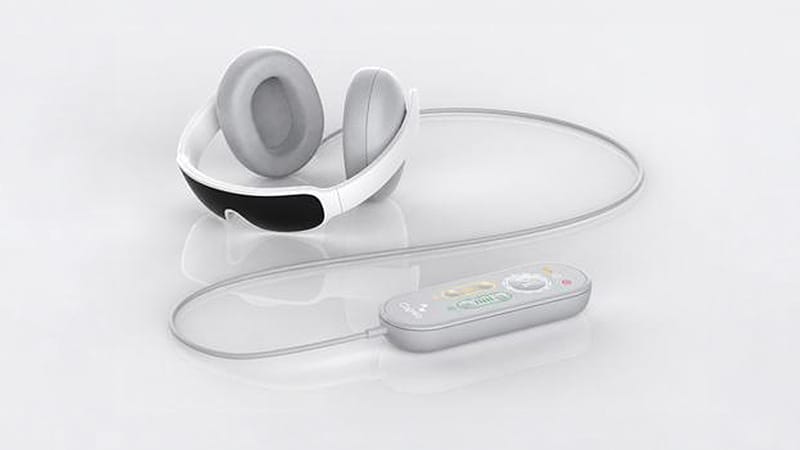
An investigational, at-home, noninvasive device that delivers light and sound stimulation failed to slow cognitive and functional decline in the overall phase 3 HOPE trial in mild-to-moderate Alzheimer’s disease (AD).However, a prespecified subgroup analysis showed a consistent signal of benefit in patients with mild disease. In this subgroup, using the Spectris device (Cognito Therapeutics) was associated with a 56% slowing of decline in daily function and a 47% slowing of worsening on a measure of cognition and function compared with sham treatment at 12 months.“In the mild group, Spectris was favored on all five efficacy endpoints,” study investigator Marwan Sabbagh, MD, of Barrow Neurological Institute in Phoenix. However, these subgroup findings were exploratory, and the nominally significant differences were not adjusted for multiple comparisons, he noted.The findings were presented on November 16 at the 19th Clinical Trials on Alzheimer’s Disease (CTAD) Conference.Spectris delivers synchronized visual and auditory stimulation at 40 Hz through a wearable headset during daily, 1-hour sessions at home. The approach is designed to stimulate gamma-frequency brain oscillations, which are involved in cognitive processing, including attention and memory.In preclinical models of AD, 40-Hz light and sound stimulation has been shown to reduce amyloid and tau pathology and protect against neuronal and synaptic loss. Small, early clinical studies have also suggested potential benefits on brain structure, cognition, and daily function, although a phase 2 trial failed to meet its primary efficacy endpoint.The phase 3, randomized, double-blind, sham-controlled HOPE trial enrolled 673 patients with biomarker-confirmed mild-to-moderate AD and Mini-Mental State Examination (MMSE) scores of 15-28. Participants were randomized within mild (MMSE 21-28) and moderate (MMSE 15-20) disease severity strata to active Spectris treatment or sham stimulation for 12 months.The primary endpoint was change from baseline on the integrated Alzheimer’s Disease MMSE and ADCS-ADL Rating Scale (iADMARS), a composite measure of cognition and daily function.In the overall modified intention-to-treat population of 663 participants, the primary endpoint was not met. There was virtually no difference between active treatment and sham at 12 months on the iADMARS, with mean changes of -8.97 and -8.82 points, respectively (P = .919). There were also no statistically significant differences in the overall population on secondary endpoints.Signal in Mild ADHowever, prespecified analyses suggested that disease severity and sustained treatment use may influence outcomes, Sabbagh noted. Although patients with moderate AD showed no consistent evidence of benefit from active treatment, results consistently favored Spectris over sham across all five efficacy measures at 12 months among those with mild disease.In mild AD, compared with sham, the device was associated with a slowing of decline on the Alzheimer’s Disease Cooperative Study-Activities of Daily Living (ADCS-ADL) scale (56%; P = .016); the ADCS-Instrumental ADL scale (53%; P = .034), the Clinical Dementia Rating-Sum of Boxes (CDR-SB; 47%; P = .004), the iADMARS (42%; P = .072), and the MMSE (29%; P = .369). Only the differences on ADCS-ADL, instrumental ADL, and CDR-SB reached nominal statistical significance.Larger treatment effects emerged in a prespecified per-protocol analysis involving 169 patients with mild AD who had used the device for at least 6 months, achieved at least 70% treatment compliance, and had no important protocol deviations.In this subgroup, slowing of decline reached approximately 82% on both measures of daily function, 64% on the CDR-SB, 73% on the iADMARS, and 69% on the MMSE. All differences except on the MMSE were nominally statistically significant.Additional exploratory analyses using the patient- and caregiver-informed “What Matters Most” framework showed a 60% slowing of decline on a composite measure of abilities considered important to everyday life among patients with mild AD (P = .04).Spectris was generally well tolerated, with no unanticipated adverse device effects reported. The most commonly reported adverse device events were headache and tinnitus. Seizures, an adverse event of special interest, occurred in 0.9% of the Spectris group and 0.3% of the sham group.Treatment compliance was comparable between groups, averaging approximately 67%, and investigators reported that blinding was maintained. However, Sabbagh noted that only about 60% of participants completed the 12-month study.Given the substantial attrition, failure to meet the primary endpoint, and exploratory nature of the subgroup analyses, the findings in mild AD require confirmation in future studies.The developer plans to discuss the results with the FDA and pursue a potential regulatory pathway for Spectris AD in early symptomatic disease. The device has received FDA Breakthrough Device Designation.Mixed Results — How Science Moves ForwardLaura Nisenbaum, PhD, interim chief science officer of the Alzheimer’s Drug Discovery Foundation (ADDF), which provided funding to support the phase 3 trial, emphasized the importance of further evaluating the potential benefit in mild AD.“While the HOPE study did not meet its primary endpoint, the signal in the mild Alzheimer’s subgroup raises important questions that are worth exploring further,” Nisenbaum said in a statement.“Daily function is what patients and families tell us matters most,” she added, emphasizing the importance of determining whether the apparent slowing of decline holds up as additional data become available.Nisenbaum said a noninvasive option like Spectris, without the potential for drug-drug interactions, could eventually have a role alongside pharmacologic therapies in combination treatment strategies.Isobel Coleman, DPhil, CEO of the ADDF, also emphasized the value of investigating novel therapeutic approaches despite the mixed results.“Mixed results are part of how science moves forward. For the millions of Alzheimer’s patients who are not candidates for antiamyloid therapies, or who need options beyond a single drug, these findings add important new information,” she said in the statement.“Studies like this move us closer to a future where multiple therapies tailored to each patient can become the standard of care,” Coleman added.The HOPE trial was sponsored by Cognito Therapeutics. Sabbagh reported receiving consulting fees from Cognito Therapeutics and several other pharmaceutical and biotechnology companies and holding stocks in multiple healthcare companies.
Novel Device Promising in AD Despite Missed Primary Endpoint
Full Article
Original Source
Read the full article at Medscape →KhanList aggregates and links to publicly available news content. We do not host full articles from third-party sources. Always verify important information with original sources.