
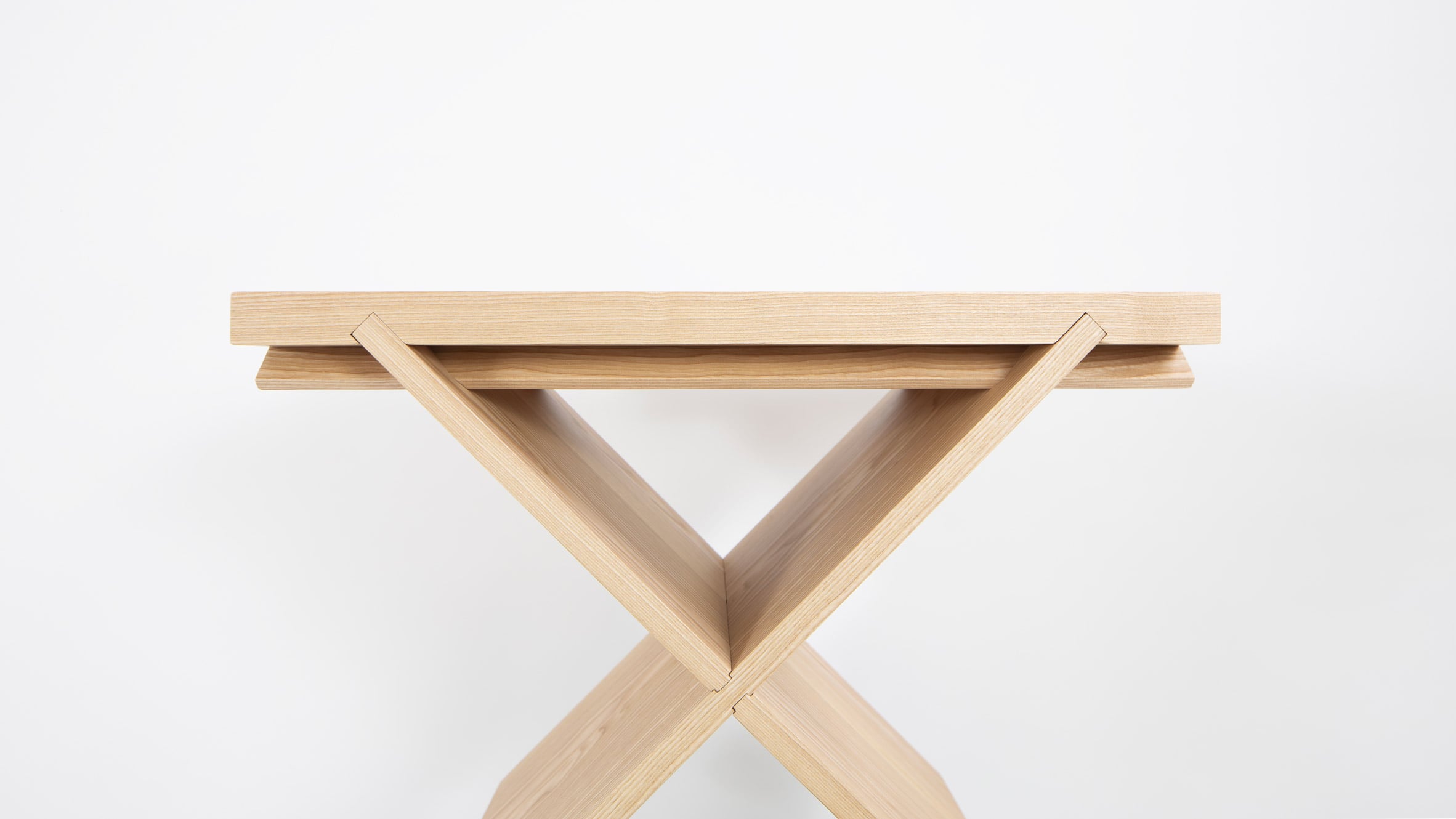
Berlin studio Allen Kaufmann Architekten has adapted a traditional woodworking joint to create a flat-pack range that can be assembled completely without tools – and it’s been voted furniture design of the year by Dezeen readers. No glue, screws, brackets or other fasteners are used in the Dado tables and shelves. Instead, their solid-timber construction is held together using only one deceptively simple type of joint: a narrow trench cut across the length of one piece of wood so another can slot into it. Known as a dado or housing joint, it has been a fixture of woodworking for thousands of years. But Allen Kaufmann Architekten has reimagined this traditional technique as the only thing holding up an entire self-supporting furniture range that can be easily flat-packed, assembled, demounted and repaired. “I started with the traditional dado cut, a simple groove cut into timber, and asked whether that basic operation could become an entire structural system rather than simply a joint,” explained studio co-founder Justin Allen. His patented joint, developed over several years of prototyping, turns dado cuts on their head – or more precisely, at a 45-degree angle – so they can be used to join not just two pieces of wood but four. This allows a vertical element, a horizontal element and two diagonal braces to lock together at a single point through simple geometry. “Visually, it has something of a post-and-beam construction, with intersecting diagonal bracing, almost like the inside of a timber barn,” the architect explained. “But the geometry and the way all four elements meet are specific to Dado, giving the joint its own distinct appearance.” So far, Allen has used this same logic to create a table and a modular shelving system, using a limited set of repeated parts. As Allen sees it, this offers a more elegant solution to current joinery systems. Furniture with permanent fixings is cumbersome, expensive and emissions-intensive to transport, he argues, while traditional flat-pack systems rely on different screws, brackets and fittings that can be lost or damaged. In both cases, the joints limit how often and how easily the furniture can be disassembled and reused, which can lead to an otherwise functional piece being abandoned. With Dado, Allen has avoided the need for fixings and left the joints themselves exposed, in the hope that the furniture’s owner will be able to understand how it works and how it might be maintained. “The connection remains visible, so the joint becomes the detail, the structure, the assembly and ultimately the design,” he explained. Each of the range’s standard components is CNC milled with machine precision. This allows the whole range to be produced by a single workshop anywhere in the world – another win in the transport department. Dado was named furniture design of the year in this year’s Dezeen Awards public vote and is now in the running to be crowned overall winner by a jury of leading industry figures including Norman Foster, Michael Anastassiades and Jaime Hayon. There, it is up against projects from Tom Fereday, Yabu Pushelberg, String Furniture and more. Read more
Nothing but a single joint holds together Dado furniture
Full Article
Original Source
Read the full article at Dezeen →KhanList aggregates and links to publicly available news content. We do not host full articles from third-party sources. Always verify important information with original sources.