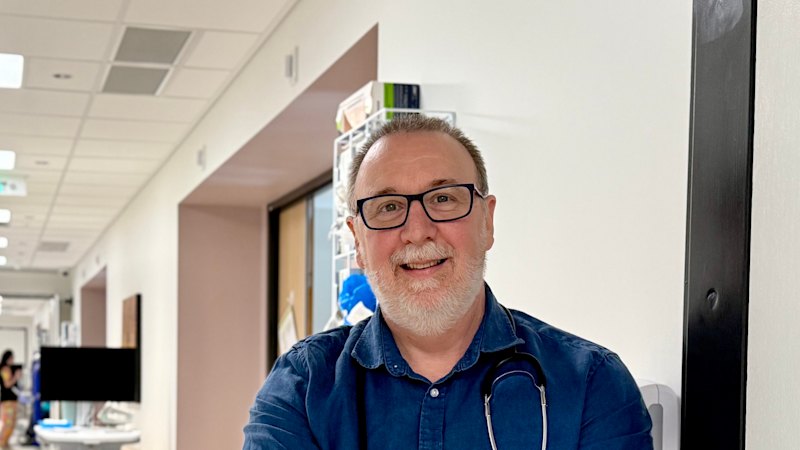
How do you treat someone who knows they’re dying? It’s a contradiction at the heart of Dr Ross Cruikshank’s work as a palliative care doctor.His patients are terminally ill – people with metastatic cancer, organ failure or degenerative disease.Dr Ross Cruikshank has worked in palliative care for nearly two decades. Courtney KrukMortality, a notion most people won’t reckon with until old age, has been drawn close by a life-limiting illness.“Usually by the time we get involved, they’re at peace with their prognosis,” says Cruikshank, who serves as the director of palliative care at Ipswich Hospital.“They know they’re never going to be cured … and we make sure that they understand they’ve got a life-limiting illness.“But to have a palliative care team there in the background, [means] they know that if things go awry, if they get pain, if they get shortness of breath, we’re here to help.“That’s our job.”Contrary to the perception that death is imminent, Cruikshank says palliative care is about “affirming life right up to the point of death”.“We don’t sort of hove into view like the Grim Reaper as soon as [someone is diagnosed].“It’s not that at all. It’s really almost the opposite of that.”When the inevitability of terminal illness does arrive, Cruikshank says his job is to help patients die well.“It’s obviously a stressful time when you’ve got a loved one who’s been diagnosed with a terminal illness … there’s a lot of uncertainty there, and family members in particular can get very anxious or distressed about what’s going to happen to their loved one,” he explains.“One of the real honours of being in palliative care is that if you can give someone a good death … if you can make sure that it’s peaceful, comfortable [and] gentle … then [the family will] have good memories.”Cruikshank recounts one of the first patients he treated after starting at Ipswich Hospital.A woman in her mid-30s had a glioblastoma, a type of brain tumour, and was experiencing frequent seizures.Knowing she had limited time left with her family, the care team was faced with finding a way to keep her comfortable and the seizures under control, and alert enough to communicate with her loved ones.“It took a lot of tweaking, but we did get the medications right in terms of settling down those seizures,” Cruikshank says.“For the last 48 hours before she did inevitably slip into unconsciousness, she was able to be awake and alert and converse with family.“I remember that one and that was really gratifying.”The idea that palliative care is only for people close to death is a common misconception, Cruikshank says. Courtney KrukPeak body Palliative Care Australia say the differences between caring for people dying now, compared with care before advances in medicine, are stark.“People mostly live longer, even with a terminal illness. There are far more options to choose from for treatment, including more effective pain management.“Where care is provided, and by who, has changed as well.”Treating the terminally ill wasn’t a specialty Cruikshank set out to pursue when at 29 he defected from a career in law and moved from Mackay to Brisbane to study medicine at the University of Queensland.Influenced by the death of his father from prostate cancer, after passing his physician exams, he enrolled in an oncology program.A stint as a palliative care registrar at Redcliffe Hospital was intended as a sabbatical of sorts but 20 years on, Cruikshank remains attached to end-of-life care.“You can get people that are resistant to palliative care because I guess they’ve got that attitude that ‘I’m going to fight this every step of the way’, and that perhaps going to palliative care is giving up.“That’s one of the things we really try to dispel. We tell every patient that you can do this on your own terms.“Palliative care isn’t about giving up. It’s about having another team in your corner that’s going to make the rest of your life one of quality and comfort.“Everything we do is around fixing [symptoms] and providing psychological support while their body decided how much time they have left.”Start the day with a summary of the day’s most important and interesting stories, analysis and insights. Sign up for our Morning Edition newsletter.More:HealthcareHospitalsIllnessQueensland HealthDeathFrom our partners
‘Not the Grim Reaper’: What people get wrong about doctors like Ross
Full Article
Original Source
Read the full article at Smh →KhanList aggregates and links to publicly available news content. We do not host full articles from third-party sources. Always verify important information with original sources.