
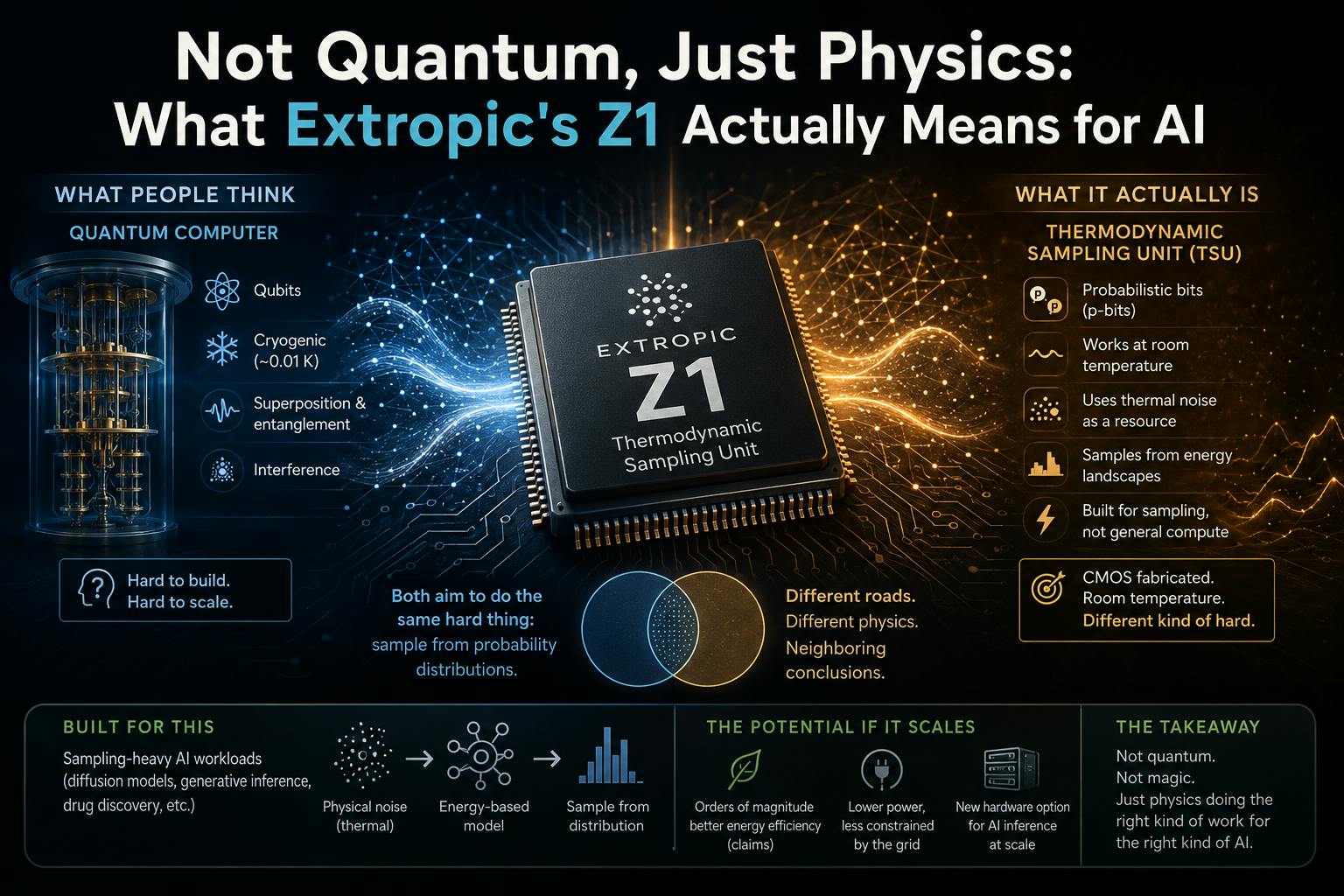
While dipping my toes in Italian waters during my summer holidays, the Extropic's Z1 announcement was made. Let me explain what the chip actually does, then get into why the "did they build a room-temperature quantum computer" questions, and then the part I actually think matters, which is what this does to the economics of running AI models if it works at scale. What people think they're looking at I've now had a version of this conversation enough times that I can predict the exact phrasing. Someone forwards a clip of Guillaume Verdon talking about the Z1, or a tweet about "thermodynamic computing," and the message attached is always some version of "wait, is this the quantum computer thing?" It's not a dumb question. The company was built by someone whose entire prior career was quantum computing, TensorFlow Quantum, quantum machine learning research at Google, all of it before Extropic existed at all. The founder used to build quantum computers for a living. So when he shows up with a new chip and starts talking about probability distributions and physical randomness, the association is right there waiting to be made. But the Z1 is not a quantum computer. No qubits, no cryogenics, no dilution refrigerator, nothing that relies on superposition or entanglement in the physics sense. It's fabricated on standard CMOS processes, the same manufacturing world that makes the chip in your laptop, and it runs at room temperature. What it is instead is stranger in a different way, and explaining that difference is most of this post. So what is it Extropic calls the Z1 a thermodynamic sampling unit, or TSU. The core idea is to stop fighting the physics that digital chips normally spend enormous effort suppressing. A transistor in a normal CPU is engineered to sit cleanly at 0 or 1 and resist thermal noise, because noise is the enemy of deterministic computation. Extropic's approach flips that around. The Z1 is built from probabilistic bits, p-bits, that are deliberately allowed to fluctuate under thermal noise, and the chip's job is to shape and harvest those fluctuations rather than eliminate them. Each Z1 packs hundreds of thousands of these p-bit circuits, wired together so the whole network settles into a state that represents a sample from a target probability distribution, rather than the answer to a deterministic arithmetic problem. That's the actual mechanism, and it's also exactly why the quantum comparison keeps getting made. Quantum computers are, at a very high level, also machines for sampling from distributions that are hard for classical digital computers to compute directly. Extropic's own pitch leans into that framing rather than away from it, up to and including Verdon describing thermodynamic computing as picking up where quantum computing's promises stalled out, minus the need for anything to be cooled near absolute zero or protected from decoherence. The company is, in effect, staffed by people who spent years explaining quantum computing to investors and journalists, now explaining a different technology using a lot of the same vocabulary, because the underlying math genuinely does rhyme. Sampling, probability distributions, physical randomness doing computational work instead of a deterministic algorithm doing it. It's close enough conceptually and far enough apart physically that the confusion isn't really anyone being sloppy. It's two different roads that happen to arrive at neighboring conclusions. Why this specific mix-up won't go away A few reasons stack on top of each other here. The founder's background is the biggest one, there's no getting around a CEO whose name is attached to Google's quantum machine learning library talking about a chip that samples probability distributions using physical randomness, without people's minds going straight to qubits. The language is the second, Extropic's own writing describes the Z1 as extracting computation from thermodynamic fluctuations, sampling directly from energy-based models, exploring a landscape rather than calculating a path through it, and every one of those phrases has a cousin in quantum computing literature. And the pitch itself invites the comparison on purpose. Extropic has explicitly framed thermodynamic computing as the practical alternative to quantum computing for AI workloads, not a totally unrelated category, which is a smart positioning move and also guarantees people will keep asking whether it's secretly the same thing. What it's actually built to do The specific claim Extropic is making is about sampling, and sampling turns out to be a bigger piece of modern AI than the phrase suggests at first. A large fraction of what generative models do at inference time, running a diffusion model, sampling from a learned distribution to generate an image or a token, is mathematically a sampling problem that GPUs currently solve by brute-forcing dense matrix multiplication over and over. That's an indirect, energy-expensive way to sample from a distribution using hardware that wasn't built for the job. A TSU is, in principle, built for exactly that job. Instead of simulating randomness in software on top of deterministic transistors, it generates genuine physical randomness and shapes it directly into the sample you want. Extropic's own published work applying their software stack to energy-based generative models and to drug discovery problems claims several orders of magnitude better energy efficiency than the GPU approach to the same sampling task, and the whole reason the company exists is the bet that this gap holds up as the hardware scales from hundreds of thousands of p-bits toward the billion-p-bit clusters they've said they want to build next. What it isn't built to do matters just as much. This is not a general-purpose replacement for a GPU or a CPU. You can't run arbitrary code on it. It doesn't do the dense linear algebra that trains a large language model today, and it doesn't produce the same output twice for the same input, because that's not what a sampler is for. If a workload needs a deterministic, exactly reproducible answer, a probabilistic chip is the wrong tool by construction, not by an engineering shortfall someone will eventually fix. What it means for AI if it actually scales The honest framing of where AI compute is stuck right now is that the industry has been solving an energy problem by throwing more energy at it, bigger GPU fleets, more power draw per rack, data centers that increasingly get sized around grid capacity rather than chip capacity. Extropic's bet is that a meaningful slice of what those GPUs are doing, specifically the sampling-heavy, generative half of the workload, was never a great fit for dense deterministic arithmetic in the first place, and that letting physical noise do that work directly instead of simulating it digitally is both cheaper and, done right, faster. That's a narrower and more falsifiable claim than "we solved quantum computing," and I think that's exactly why it's more likely to be true. It doesn't require breaking new physics. It requires a chip that behaves the way Extropic says it behaves at a scale nobody has built yet, which is a hard but very ordinary kind of hard, the kind semiconductor manufacturing has gotten reliably good at solving for sixty years. If the Z1 and its successors deliver anything close to the efficiency gains being claimed, the interesting consequence isn't just cheaper inference. It's that a category of AI workload that currently has one hardware option, buy more GPUs, gets a second option built from entirely different physics, at a moment when GPU supply and power availability are the two hardest constraints in the entire industry. That's a bigger deal for how AI gets built than "quantum computer" would have been anyway, because it's a claim about next year's data center, not a claim about a machine that's been five years away for twenty years running. I still don't have a tidy one-line answer for people who ask if Extropic secretly cracked quantum computing. What I've settled on is something closer to: no, but the person who built it used to build quantum computers, borrowed the vocabulary because the math is genuinely a cousin, and ended up with something that might matter faster precisely because it isn't that. Sources:Extropic Hardware page: extropic.ai/hardware, extropic.ai/writing/from-one-to-one-billion (X0 → Z1 progression, Z1 accelerator cards, THRML library, energy-based model and drug discovery benchmarks, roadmap to billion-p-bit cluster), extropic.ai/writing/thermodynamic-computing-chips-in-america ($75M CHIPS R&D letter of intent, Z1.5, onshore manufacturing, mature process nodes) The AI Insider: Extropic $75M CHIPS announcement: theaiinsider.tech (July 29, 2026 press release details, TSU definition, rack-scale systems) Interesting Engineering: "Smart thermodynamic chips could outperform GPUs and slash power": interestingengineering.com (X0 dual-fab testing, Z1 as first production-scale chip) Times of AI:"Extropic's Thermodynamic Chips May Solve AI's Energy Problem": timesofai.com (250,000 p-bit figure, diffusion model framing, Verdon's background and public persona) Wikipedia: Guillaume Verdon: en.wikipedia.org/wiki/Guillaume_Verdon (TensorFlow Quantum, Google X quantum ML background, Extropic founding), Thermodynamic computing: en.wikipedia.org/wiki/Thermodynamic_computing (TSU mechanism, sampling from energy-based models vs. matrix multiplication) First Principles podcast transcript: Extropic public debut: firstprinciples.fm (Verdon/McCourt discussing thermodynamic vs. quantum computing manufacturing maturity) LinkedIn: Guillaume Verdon
Not Quantum, Just Physics: What Extropic's Z1 Actually Means for AI
Full Article
Original Source
Read the full article at Hackernoon →KhanList aggregates and links to publicly available news content. We do not host full articles from third-party sources. Always verify important information with original sources.