
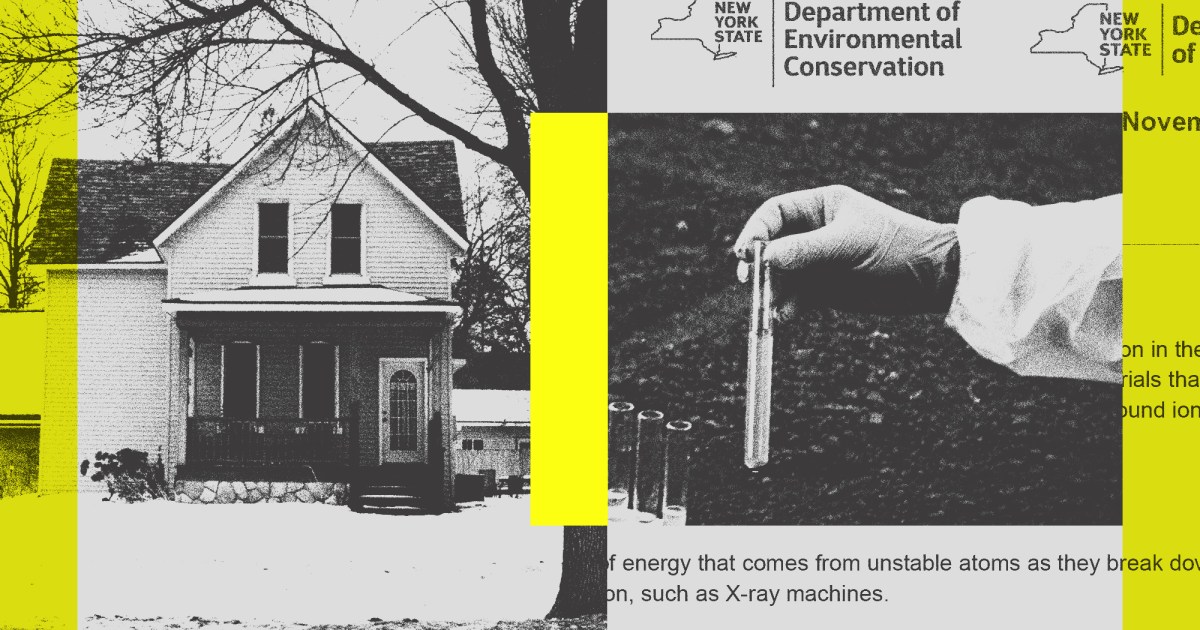
Mother Jones illustration; Getty; Unsplash Get your news from a source that’s not owned and controlled by oligarchs. Sign up for the free Mother Jones Daily. Five years ago, when she was 19 years old, Lexi Hawk bought her dream home in Niagara, New York, for $129,000. The little blue ranch sat on an acre of land with surrounding trees, a nearby creek, and bluejays and cardinals she would feed peanuts to. This would be her forever-home, she thought, and never anticipated that she would find herself owning a house contaminated with radiation, living in a stranger’s home, and celebrating the holidays there. “At my old house, I already had my Christmas tree up last year around this time, and I was so excited for it,” she told me. “This year, I don’t have anything up. It’s so weird being in someone else’s house.” During our video call, Lexi’s three-year-old daughter, Bailey, crawled over her mom into the camera’s view—her toddler face covered in blue eyeshadow and lipstick she applied herself. Lexi laughed, but her smile faded quickly. “It’s starting to affect her,” she said. “I think she’s confused about the move, and she’s definitely been acting out lately, and it’s been making me very sad.” Lexi, her fiance Trevor Bradley, and Bailey are one of four Niagara families who were relocated into temporary housing by the NYS Department of Conservation (DEC) and the Environmental Protection Agency during an ongoing investigation into industrial radiation contamination in New York’s Niagara and Erie counties. After having to uproot her family and pets, and bringing only their most necessary possessions, the reality of the situation has caught up with Lexi. “I think it’s really starting to hit me now,” she said. “Being out of that house, it’s finally like, ‘oh my gosh, are we ever going to go back there?’” In March, over 100 households across Niagara County received a joint letter from the EPA and the DEC that radiological surveys had identified high levels of hazardous contamination on their properties, which they suggested originated from a “hub of manufacturing of atomic weapon components during World War II and other industries using or producing radiological materials.” According to the DEC’s Niagara and Erie County Radiological Assessment dashboard, the investigation is “being performed out of an abundance of caution” for residents. When she received the initial letter, Lexi wanted “to know what’s going on,” so she immediately asked the two agencies to come to her property and evaluate it. When the agencies responded, they asked her to sign a “property access form” stating she must formally agree not to file suit against New York State, the EPA, or any other agencies involved in the radiological survey. She refused. For months, Lexi and her neighbors fought with government officials to remove the clause that made it impossible to sue, but the state would not budge. Only after hosting a joint press conference in July with another concerned resident, Carolyn Johnson, did the DEC and EPA finally agree to remove the waiver of rights. “We did our press conference on a Friday,” she recalls, “and by Monday, they were in my yard.” On July 13, environmental specialists began to scour her acre of land with ATVs, backhoes, and radiation-testing equipment. Certain spots in her yard, like the pile of leaves Bailey played in last fall, were recorded at “200 times above background,” the baseline radiation level at any given location. In other areas, the specialists told Lexi, the yard “maxed out our equipment at over a million counts per minute.’” While the DEC states “naturally occurring radiological materials vary between soil and rock types,” the Nuclear Regulatory Commission notes that “a typical natural background radiation level is anywhere from five to 60 counts per minute or more.” Officials also took soil samples and used RAD8 machines to test for thoron and radon in the house—radioactive gases that form when radioactive building materials break down. Less than a week later, Lexi received a call from the EPA and DEC that she would be temporarily relocated. “It was scary to hear,” she said. “Like, wow. It’s actually that bad.” From there, she and her fiance worked with the agencies to find a suitable home that could accommodate the three of them and their dog, while being within 30 to 45 minutes of where she used to live. “It took them a long time,” she recalled. “They offered the relocation on July 18, and [we] didn’t move until a couple weeks into September.” Eventually, they were able to settle on a house whose owners had moved out of the country. Lexi is grateful, but she said it’s uncomfortable living in someone else’s home. “It feels like being at a hotel where you don’t want to break anything,” she said. “The other day, the closet door fell off the hinge, and I had a full blown panic attack. That’s why I bought my house so young. I didn’t like feeling responsible for other people’s stuff.” For its residents, the Niagara region has become almost synonymous with contamination. In the 1970s, an investigation of the Love Canal neighborhood, which is located approximately five miles from Lexi’s home, revealed that the community had been exposed to decades of dumped, toxic chemicals, and that the exposure was likely the cause of a litany of health problems including birth defects, diseases, and early death. Hundreds of families were evacuated between 1978 to 1980, and the disaster helped usher in the passage of the federal Superfund Act. Today, Love Canal is considered to be one of the biggest environmental disasters in American history. But Niagara’s toxic legacy extends far beyond chemical contamination and includes pervasive radioactive waste, the by-product of what The New York Times called “corporate greed and government indifference.” One contributor to this was atomic contamination from the Niagara Falls Storage Site, which stockpiled and disposed waste from the Manhattan Project, the top-secret World War II program to create the world’s first nuclear weapons. Add to this decades of industrial “slag,” a glass-like byproduct with naturally occurring radioactive properties, from local chemical manufacturing and metal processing companies that had been repurposed at little cost to fill roads, yards, and even the voids in cinderblock foundations of suburban homes. “It’s everywhere we worked and played, and went to school. Everywhere has all of these issues in the air, soil, and groundwater. I think devastating is the only word I can come up with.” According to the EPA and the Nuclear Regulatory Commission, long-term exposure to ionizing radiation can lead to increased rates of various cancers–leukemia, breast, bladder, colon, liver, lung, ovarian, multiple myeloma, and others, as well as cardiovascular diseases. Lexi’s grandmother died young from blood cancer, and her mother currently has environmentally-linked breast cancer. “This is the story of so many people in Niagara Falls,” said Christen Civiletto, an environmental lawyer from Niagara Falls who also represented local residents in environmental contamination lawsuits over Love Canal’s toxic exposure. For Civiletto, these stories are also personal. Her dad died at 63 from a rare cancer related to ionizing radiation, and she was diagnosed with melanoma at 31. “It’s everywhere we worked and played, and went to school. Everywhere has all of these issues in the air, soil, and groundwater,” she told me. “I think devastating is the only word I can come up with.” In the late 1970s and 1980s, the federal government conducted aerial “gamma scans” over Niagara Falls to identify Manhattan Project-related radioactive sites. The surveys identified only 100 anomalies—hot spots of radiation—including several locations on Military Road, which bisects Lexi’s street. But decades later, sporadic independent testing from 2016 began to identify more locations that hadn’t come up hot on the original surveys. “The state knew,” Civiletto said, that there were “radioactive hotspots that didn’t show up on the scans from the 1970s and 1980s.” From 2023 to 2025, both the state and federal government began conducting additional aerial and road surveys, which ultimately identified properties like Lexi’s as being radioactive. “They might believe that they were acting quickly for a government for the scale of what had to be done, but I don’t think it was quick enough,” Civiletto said. Since then, both she and researcher Caitlin McShane put together an interactive repository of every documented hazardous-waste and radioactive site in Niagara County. One of Lexi’s neighbors, Jackie Linkowski, 40, and her husband Jeremy, 37, have radioactive fill in the foundation of their house. They don’t have any children (Jackie tells me she’s never been able to get pregnant), but they have six cats, and two dogs and a hedgehog are buried in the backyard. Since living at that property for the past 13 years, Jackie tells me that she and her husband have experienced debilitating fatigue and exhaustion, which they both chalked up to aging. “I started having grand mal seizures two years after I moved into that house,” she said. “My husband, his legs would just randomly go numb.” When Jackie was also assessed for spinal disc degeneration, the doctor asked her if she was lifting heavy weights. After Lexi’s house was evaluated, independent and state testing recorded extremely high levels of radiation in the Linkowski’s yard and inside their home. They too have since been relocated to temporary housing 40 minutes away from their old house. Jackie says she’s grateful to be in temporary housing that’s safe, but she misses the feel of her own house during the holidays. “I loved our house at Christmas time. We used to call it the ‘cozy gingerbread house,’” she said. “I miss everything—waking up and seeing our yard covered in snow. I miss my neighbors. It’s not going to feel that way now. It’s just different.” Processing this experience over the last few months—the exposure, the testing, the relocation—has come with a great emotional cost. “My husband and I were just looking at pictures on our phone…of me holding my dog that passed away. And now, I just think, ‘we were getting blasted with radiation there.’ It feels like a death that keeps dying.” I asked Jackie if she ever plans to return to her old house. “Never,” she said emphatically. “I will never go back to that house and live in that neighborhood. I’ll never live in Niagara County again.” “I just think, ‘we were getting blasted with radiation there.’ It feels like a death that keeps dying.” Kellie Motyka, 48, and her husband Mike, 51, who have also been relocated, discovered it was difficult to convince the government that their house was a hot spot. Originally owned by her grandfather, Kellie’s house is a duplex that she, her husband, sister, and 20-year-old niece have lived in on and off since 2003. They eventually provided a home for Kellie’s elderly mother. When representatives from the EPA and DEC came to her door, Kellie says they were “nonchalant” about the situation, telling the couple “they would dig up the bad dirt and put new dirt down, like it was just no big deal.” But when it came time to actually test their property, the EPA and DEC scanned the front yard—not her house. It was only after reporter Dan Telvock of WIVB-TV Buffalo, who has been investigating Niagara’s contamination for months, brought an independent engineer to scan Kellie’s house with his own Geiger counter and found high levels or radiation did the state relent and agree to conduct their own tests inside the house. Kellie is convinced that it was only the press coverage that finally convinced the DEC and EPA their home should be tested. Like Lexi and Jackie, Kellie is grateful she and her husband are out of their house and not being “blasted by radiation every day.” Her sister, who lived on the other side of the duplex, was only 45 years old when she suffered a stroke. Her mother had chronic obstructive pulmonary disease. Kellie wonders if those health issues should be attributed to lifestyle alone. “My mother just passed away [in] January of this year,” she said. “Could she have had maybe five [more] good years?” Kellie also thinks about all the belongings they had to abandon, including her late mother’s possessions. Mostly, Kellie is frustrated by how the government has handled the entire situation. “You know, eventually, we all ended up getting out, and we’re all somewhere safe, and [we’re in] these beautiful homes for now,” she said. “But the whole process, from the testing to the notification to the relocation, it just seemed like they were unprepared.” The fourth relocated family, Carolyn Johnson, 59, and her husband John, 60, are administrators for the local Save Our Backyards WNY with Lexi and Kellie. Carolyn and Lexi were the co-leaders of the original community press conference in July. “We’re all devastated to find out that our properties were once used for industrial dumping for both radioactive and toxic chemical waste,” Carolyn said in a video that was posted to the Facebook group. “We’ve had inadequate testing and data by both state and federal government agencies and the lack of enforcement actions taken against polluters through tax dollars for superficial investigations that have cleared properties that might actually be poisoning the people still living on them.” Since home testing first began in July, over 1,000 households across western New York have now been notified of potential radioactive activity on their property. Lexi is still the only person she knows to have gotten soil sample results back from the government—which arrived on the day after Election Day, months after they were taken. But still, she hasn’t received an analysis of those scientific results, much less a specialist to explain them. Meanwhile, she and Jackie have been waiting for results from the test for the radioactive gas thoron. Even though the gas has been proven to be linked to lung cancer, the EPA has no cleanup standard for because it dissipates so quickly. But in Lexi and Jackie’s homes, thoron is constantly emanating as it decays and gets replaced with new gas from the foundation of their homes. While the DEC and EPA are covering the cost of the home evaluation testing and temporary relocation, the families are still calling on the state and federal governments to provide permanent relocation and the funds to buy out their homes, which have significantly decreased in property value. Even if a full remediation is completed, “my house has been all over the news,” Lexi said. “People know, and I don’t think anybody would ever want to buy it. And if they did, they’re going to offer me a very low amount.” These families—whom Lexi calls “the core four”—and other Niagara residents have asked Governor Kathy Hochul to add the more than 1,000 radioactive hot spots to either a state or federal Superfund site, which would trigger an investigation, mandatory cleanup and oversight, and liability enforcement for hazardous waste contamination. After Love Canal was established as the first Superfund site, hundreds of families were relocated and received financial compensation through government buyouts and legal settlements. But even decades later, residents who moved back to the neighborhood continued to report illnesses from leaching chemicals. In July, Gov. Hochul said that she understands “the news that finding any radioactive material in an area can be extremely unsettling for the families who live there,” and her priority is to “do testing, [and] get people the answers as soon as possible.” And in a statement emailed to Mother Jones, Gov. Hochul’s senior communications advisor Ken Lovett said, “[t]he Governor has been clear in words and actions that the health and safety of these families remains a top priority.” Lovett went on to say that the “New York Superfund Program cannot be used to address sites contaminated solely with radioactive material,” because, under environmental conservation law, radioactive waste is not considered hazardous on its own and instead must be deferred to the federal government. “It would take the State months, if not years, to get a State law passed, promulgate regulations, and hire enough staff to implement cleanups in the region. That is why the State and EPA have teamed up and are committed to expeditiously moving forward under the federal Superfund,” Lovett stated. In August, Republican State Senate Minority Leader Rob Ortt introduced a bill to include radioactive waste in New York’s Superfund program. The EPA and NYDES separately acknowledged Mother Jones‘ request for comment but did not provide a response by publication. Beyond being added to a Superfund list, the families are also advocating for lifetime medical monitoring for their entire community so they can continue to assess their health in the years to come. “I don’t think that’s too much to ask,” Kellie said. “Radiation affects everybody, it affects men, and women more. It affects children the most.” Christen Civiletto, the Love Canal attorney and Niagara Falls resident, said she’s looking for reparations. “Not only is this a turning point, but to me, this is accountability time.” Lexi told me that she’s concerned about her fellow neighbors who continue to remain in their homes. “We want our neighborhood to be relocated because it’s not just the four of us.” And of course, she’s worried about her daughter, who was born in the very house her family has had to abandon. At that moment Bailey popped into the video frame. We all smile and laughed appreciatively. Then we heard her chanting: “Radiation! Radiation! Radiation!”
Not Far From Love Canal, Families Are Fleeing Their Radioactive Homes
Full Article
Original Source
Read the full article at Motherjones →KhanList aggregates and links to publicly available news content. We do not host full articles from third-party sources. Always verify important information with original sources.