
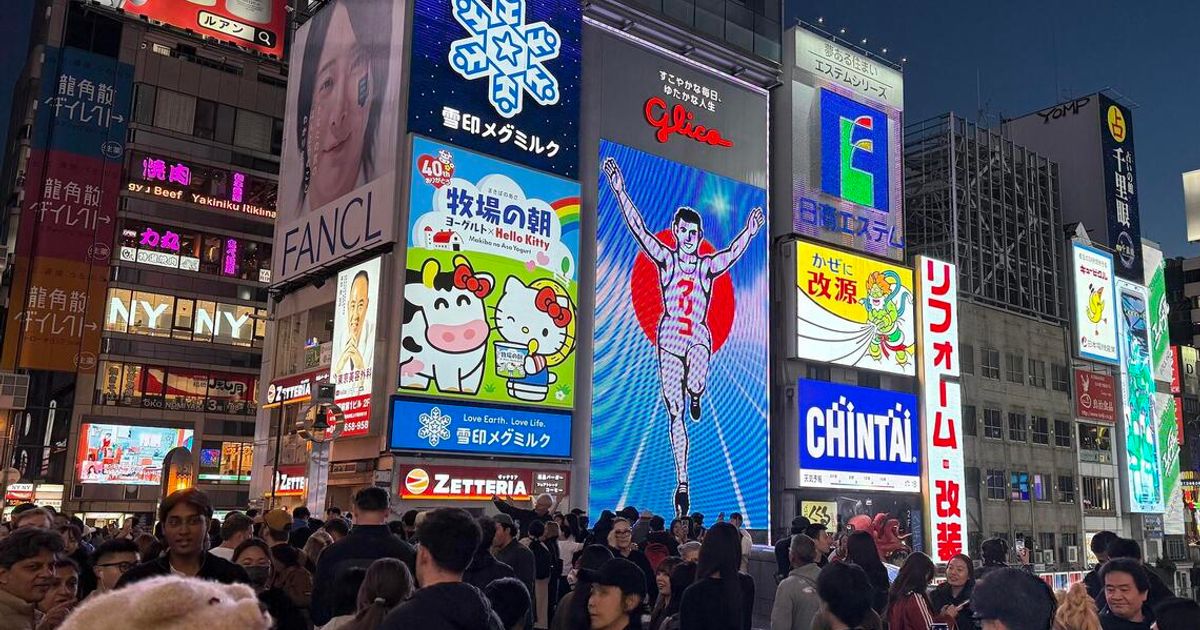
OSAKA – The most obvious sign that Tokyo and Osaka are poles apart, despite being separated by only a 2½-hour ride on Japan’s shinkansen high-speed rail, is how people stand on escalators.In Tokyo, people intuitively stand on the left. In Osaka, they stand on the right, ostensibly out of a refusal to do things “the Tokyo way”.That fierce local pride – and a longstanding desire to break Tokyo’s monopoly on national life – has now moved to the centre of Japanese politics, with Osaka widely viewed as a shoo-in to become Japan’s secondary capital.That is especially true given that the legislation itself was muscled onto the national agenda by the Osaka-based Japan Innovation Party (JIP), a regional force that seized an opportunity to partner with the ruling Liberal Democratic Party after the latter’s 26-year alliance with Komeito splintered in October 2025. In July, Parliament approved a landmark law to create at least one “secondary capital”, or “backup capital”, that can take over government functions if a disaster paralyses Tokyo, a prefecture of 14 million people, nearly 10 million of whom live in its 23 core wards.Under qualifying criteria approved by the Cabinet in October, a secondary capital must be a prefecture that accounts for at least 2.1% of national gross domestic product and has a city with at least 1.2% of the national population. It must also be in an economic sphere outside Greater Tokyo, sitting outside the envisioned damage zone of a major Tokyo quake or Mount Fuji eruption.This means only four areas make the cut: Hokkaido (with Sapporo as the prefectural capital), Aichi (Nagoya), Osaka and Fukuoka.The Japanese government said on Nov 27 it will accept applications in June, with multiple prefectures to be designated by end-2027 before the initiative begins in the fiscal year starting April 2028. Each backup capital will be allowed regulatory and tax reforms to enable it to act as an economic “growth engine”.JIP leader and Osaka Governor Hirofumi Yoshimura, 51, told a news conference in Tokyo on Nov 25 that his goal was not to create a “mini-Tokyo”, but to “leverage Osaka’s unique character and strengths to contribute to Japan’s growth and enhance the nation’s resilience”.Osaka Governor Hirofumi Yoshimura is pushing for the prefecture to be the secondary capital of Japan, saying that Osaka’s unique character and strengths will contribute towards the country's growth and resilience. PHOTO: HIROFUMI YOSHIMURA/FACEBOOKHe added that Osaka was a natural fit, citing how the Bank of Japan, the Tokyo Stock Exchange, and public broadcaster NHK all maintain business continuity plans with backup functions in Osaka.And since no one area is disaster-proof in Japan, having backup capitals will create national resilience that will come only with reducing the overconcentration of government and business functions in Tokyo, he said.Telegenic and combative, Yoshimura boasts 1.3 million followers on X – the third-largest following among Japanese politicians, behind only Prime Minister Sanae Takaichi and former foreign minister Taro Kono.He has stoked controversy with previous remarks, such as when he suggested banning a prominent critic from entering the 2025 Osaka World Expo, touted povidone-iodine mouthwash as a way to counter Covid-19, and proposed “zero-year-old voting rights” that would allow parents to cast proxy ballots for their children to counter Japan’s “silver democracy”.His push for the backup capital has also been denounced by opposition lawmakers as a political sleight of hand to revive the JIP’s flagship “Osaka Metropolis Plan” that reorganises Osaka City into Tokyo-style special wards, with an envisaged Osaka Metropolitan Government that governs the entire Osaka prefecture.This takes a leaf from Tokyo, where the Tokyo Metropolitan Government oversees the entire prefecture, including 23 core wards that are semi-autonomous municipalities with city-like legal status focusing on day-to-day municipal services.By contrast, the 24 wards of Osaka City are currently administrative subdivisions of the Osaka City government. The JIP’s scheme involves abolishing Osaka City as a single municipality and restructuring the 24 wards into four “special wards” by 2031.The argument is that, with Osaka prefecture’s core bureaucratic and business functions heavily concentrated in Osaka City, this creates substantial overlap in local governance.Yoshimura said the plan is vital to eliminating bureaucratic gridlock: “You could think of it as the merger and subsequent reorganisation of two companies that operate similar businesses.”Osaka prefecture is home to 8.8 million people, of whom 2.8 million live in Osaka City. Voters have already narrowly rejected the scheme twice, in 2015 and 2020, over concerns that it would dilute the city’s local identity, bring unclear financial benefits and disrupt day-to-day municipal services. Critics argue that Yoshimura is using the prestige of national politics and backup capital status to force through a third referendum in 2027.Pride and destinyBeyond political calculus, the idea of designating Osaka as a secondary capital taps into deep civic pride and a sense of historical destiny.Tokyo’s identity was forged by samurai administration after the Tokugawa shogunate made Edo the capital in 1603. Osaka, by contrast, thrived as a freewheeling merchant hub that earned it the moniker “the nation’s kitchen”. Throughout the Edo period (1603-1868), Osaka served as Japan’s breadbasket, where rice from across the country was warehoused, traded and distributed. The canal-side Dotonbori district was already bustling by the 1660s, frequented by merchants in Japan’s commercial beating heart. Where Tokyo refined tatemae, or the elaborate art of diplomatic tact, Osaka merchants bluntly greeted each other with “Mokarimakka?” (“Are you making money?”).Centuries later, this divide remains audible. Tokyoites are often stereotyped as reserved and formal, while Osakans are seen as louder, friendlier, and unapologetically direct.I have also come to find that the local dialect, Kansai-ben, captures much of that charm with a clipped, rhythmic efficiency reminiscent of Singlish set against standard English.Conversations with Osaka-born friends and newsmakers, from diplomats to corporate executives, reveal an effortless ability to code-switch between standard Japanese in business settings and the punchier local cadence in casual environments.A 34-year-old friend who works in sales observed: “There’s definitely this contrast with Tokyo; it’s not that people don’t get along, it’s just harder to break the ice there. In Kansai, there’s a certain openness. If you strike up a conversation and say, ‘Let’s go hang out’, you become friends very easily.”Another, a government bureaucrat, said: “We talk fast and we say what we mean.”Such differences are the lifeblood of manzai, the rapid-fire double-act comedy born in Osaka and akin to Chinese xiangsheng (cross-talk). At its purest, the rational character (tsukkomi) trades barbs with a foolish partner (boke), with the punchline often arriving when the more sensible concedes to the other’s ridiculous logic.Dialects aside, Osaka has a long track record of commercial disruption that rivals Tokyo. In 1730, merchants established what is widely recognised as the world’s first organised futures market with the Dojima Rice Exchange. Two centuries later, Osaka gave Japan and the world everyday icons such as capsule hotels, conveyor-belt sushi, takoyaki (octopus balls), and instant noodles. The rivalry has also played out in steel and glass. Osaka boasted Japan’s tallest skyscraper with the 300m Abeno Harukas from 2014 until 2023, when Tokyo’s 330m Azabudai Hills seized the crown.Now, the city is riding the wave of its growing national political clout and momentum from its successful hosting of the World Expo.And come 2030, Osaka will mark another national milestone when Japan’s first integrated casino resort opens on the waterfront.Osaka is unapologetically about having a good time, and the loud, irreverent commercial engine is determined to play a larger role in a country long governed by Tokyo-centric consensus.
‘Not a mini-Tokyo’: Osaka bids to become Japan’s second capital
Full Article
Original Source
Read the full article at Straitstimes →KhanList aggregates and links to publicly available news content. We do not host full articles from third-party sources. Always verify important information with original sources.