
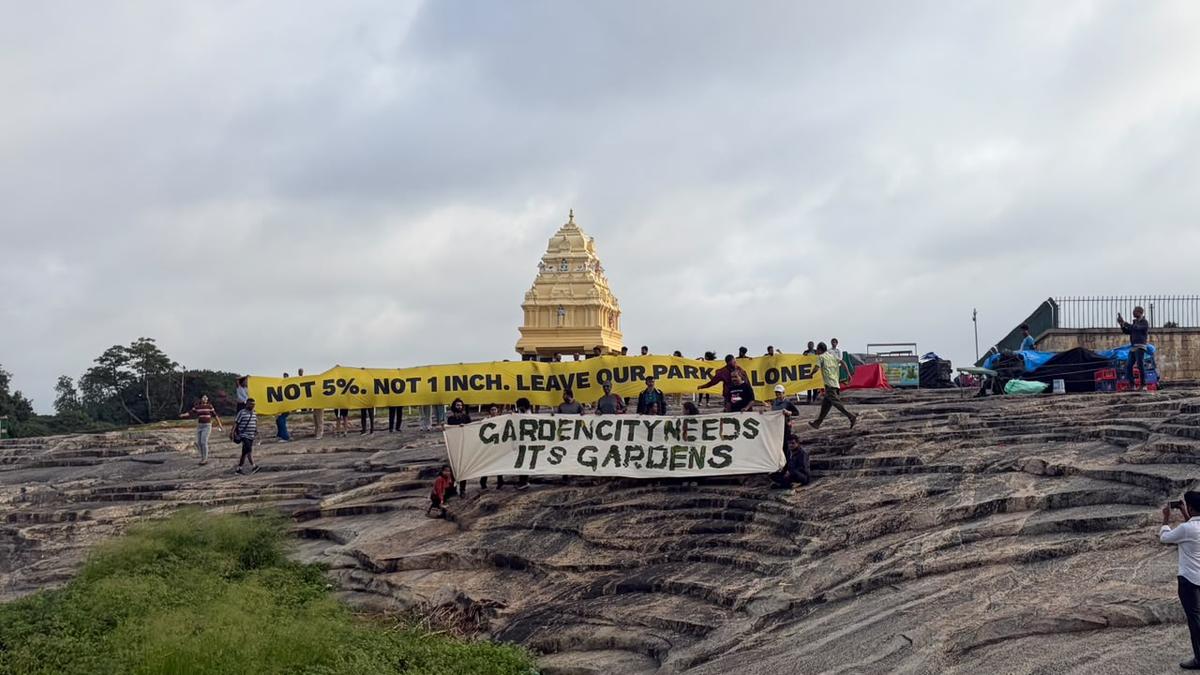
The opposition to Karnataka’s move to allow the alienation of up to 5% of park for public infrastructure projects brought together more than 200 citizens, resident associations and civil society groups at Lalbagh on Thursday (August 27, 2026), who have requested Chief Minister D.K. Shivakumar to roll back the amendment. Under the banner “Not 5%, Not one inch. Leave our parks alone”, the coalition said Bengaluru, which is already grappling with shrinking green cover, rising temperatures and uneven access to public parks, could not afford to lose even a portion of its existing green spaces. Letter to CMAs part of the resistance, a human chain was formed around Lalbagh Rock to demonstrate that Bengaluru’s green spaces are public assets that must be protected. The group has also submitted a letter to the Chief Minister opposing the Bill. In their letter, the groups opposed the amendment to the Karnataka Government Parks (Preservation) Act, 1975, arguing that the move went against the very purpose of the parent legislation. “The law, the Government Parks (Preservation) Act, 1975, is for preserving parks. The government cannot bring an amendment to alienate 5% of the park, which goes against the very objective of the parent Act,” said Kathyayini Chamaraj, Executive Trustee of CIVIC. The coalition has demanded that the amendment be withdrawn and that existing parks and gardens be protected from diversion, conversion, fragmentation or construction for non-park and non-ecological uses. It has also sought a requirement that all infrastructure projects first explore alternatives that do not involve the use of existing parks or green spaces. The groups have called for transparent public consultation before any proposal affecting public green space is considered, and for comprehensive environmental, social, health and wellbeing assessments of such proposals. The coalition has also demanded that parks and urban green spaces be formally recognised as essential infrastructure within urban planning and development frameworks. | Photo Credit: Special arrangement ‘Environmental safeguard, not surplus land’The groups said parks were not vacant land, but essential public infrastructure providing climate regulation, rainwater management, biodiversity, recreation and spaces for social interaction and everyday wellbeing. “Bengaluru is becoming hotter and more climate vulnerable, yet the Karnataka government is making it easier to take away one of the city’s most important forms of natural infrastructure. Parks help cool neighbourhoods and provide people with relief from heat and pollution. At a time when the city needs more climate resilience, allowing even portions of these spaces to be diverted is a step in the wrong direction,” said Selomi Garnaik, Climate and Energy campaigner at Greenpeace India. She said the government must stop treating public green space as surplus land and recognise it instead as an essential environmental safeguard. Treat parks as essential infrastructureCiting research, the coalition said Bengaluru’s urban green spaces play a critical role in protecting the city from heat. A study of 262 urban green spaces found that parks were, on average, 2.23-degree Celsius cooler than their surroundings, with their cooling effect extending up to 347 metres beyond their boundaries, the group pointed out.Access to parks is already uneven, the letter pointed out. Research by the Indian Institute for Human Settlements has found that nearly 28% of Bengaluru’s wards have either no park or only one park. Any further reduction in public green space, the groups said, would deepen this deficit, particularly for communities that depend most on accessible public spaces. “We recognise the need for essential infrastructure in Bengaluru. However, infrastructure development must not come at the cost of existing ecological and social infrastructure. The environmental, health, social and wellbeing costs of losing public green space must be considered alongside the financial and developmental value of proposed projects,” the letter said. The coalition has also demanded that parks and urban green spaces be formally recognised as essential infrastructure within urban planning and development frameworks, with their ecological and social value protected alongside other public infrastructure.
Not 5%, not even an inch: Bengaluru citizens demand rollback of amendment to alienate park land
Full Article
Original Source
Read the full article at Thehindu →KhanList aggregates and links to publicly available news content. We do not host full articles from third-party sources. Always verify important information with original sources.