
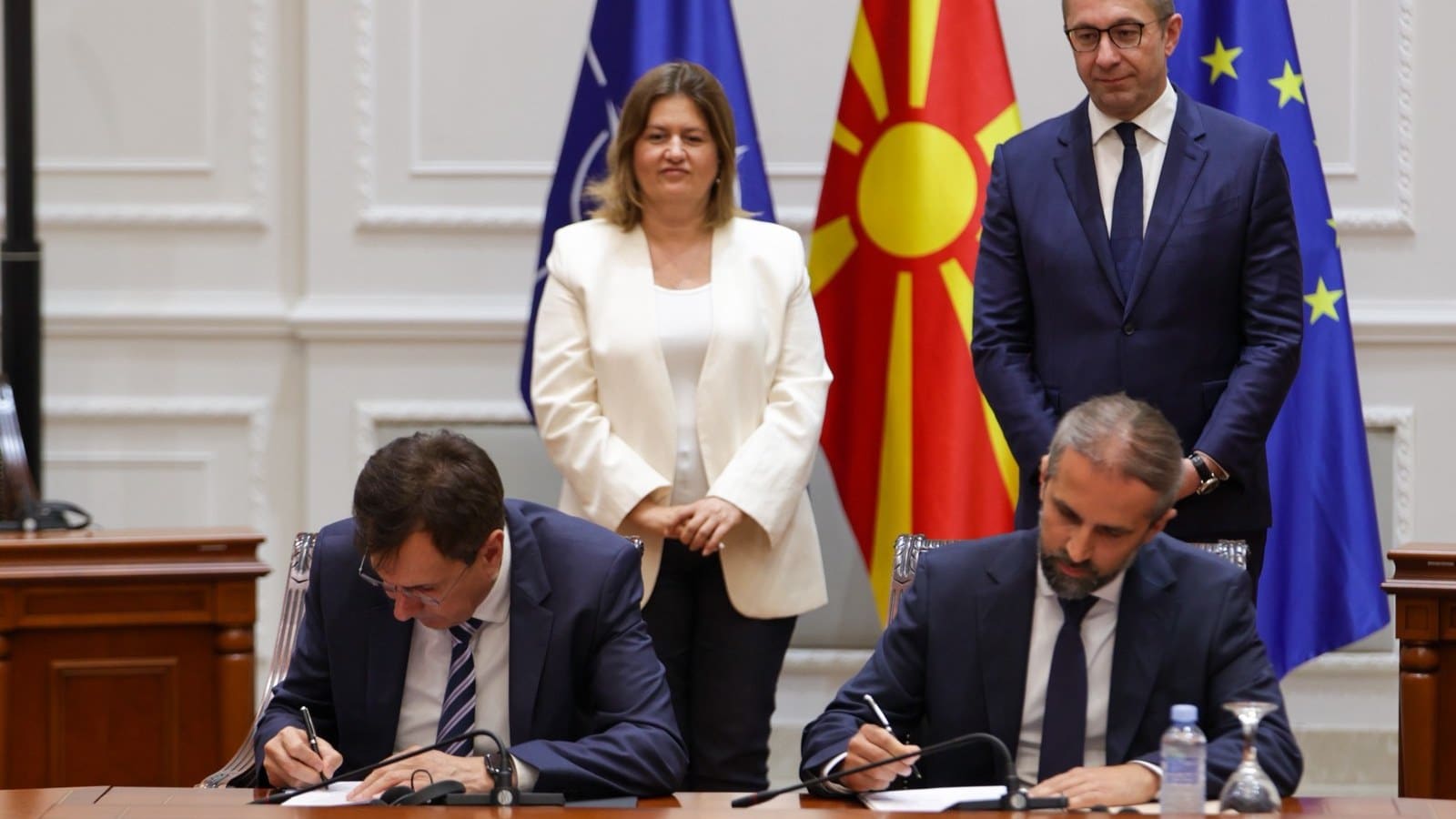
The signing of the new gas interconnector agreement between North Macedonia and Serbia in Skopje. Photo: Government of the Republic of North Macedonia. North Macedonia’s gas network could be connected with Serbia’s system as early as 2028, under an agreement signed by the two countries in Skopje on Thursday. The project involves the construction of a 67-kilometre pipeline, which should be completed by 2027. It is part of a broader effort to knit together the gas networks of Southeast Europe and enable diversification for a region that has historically relied heavily on Russian supplies. The new link will be developed alongside a separate North Macedonia-Greece interconnector, which is expected to be operational in 2027. At the signing event, North Macedonia’s Prime Minister Hrisitijan Mickoski said that together, the two projects would grant his country “full vertical energy connectivity”. The pipelines may also turn North Macedonia from a largely end-point market into a key part of a south-north transit route, allowing gas entering from Greece to move towards Serbia and potentially further into Central Europe. The Alexandroupolis terminal is particularly important to this strategy. Its floating LNG facility can receive gas from global suppliers and feed it into Greece’s transmission system, giving countries in the region access to supplies beyond traditional pipeline sources. The European Union and the countries involved have been promoting the new infrastructure as part of the wider Vertical Gas Corridor linking LNG infrastructure and gas networks across Southeast and Central Europe. Mickoski has also framed the project in geopolitical terms, saying the planned route could carry US LNG from Alexandroupolis through North Macedonia and Serbia towards Hungary and Austria. He added that he hopes North Macedonia’s other Northern neighbor, Kosovo, would build a similar interconnector with his country. LNG from other sources – such as Azerbaijan – could also use the route, creating more options for the region. Mickoski estimates the eventual capacity could be between three and six billion cubic metres annually, making it a potential competitor to Russian gas supplies in the region. Serbia, in particular, remains strongly dependent on Russian gas. In 2025, Serbia imported around 2.76 billion cubic metres of gaseous natural gas. Of that, 2.45 billion cubic metres were imported from Russia, 232 million cubic metres from Azerbaijan, and 112.5 million cubic metres from the EU. However, Belgrade has increasingly been seeking alternative sources and routes. It has already reserved 300 million cubic metres of capacity at the Alexandroupolis LNG terminal for the next 10 years. The timing of this new infrastructure also reflects a fundamental shift in Europe’s energy map. The EU formally adopted legislation this year to phase out the use of Russian natural gas. LNG imports will be subject to a full ban from the start of 2027, with pipeline imports to follow in the autumn. Serbia is making links with North Macedonia and Romania a priority for diversifying its supply routes. Meanwhile, the Energy Community – which includes all six Western Balkans countries as well as EU member states – says stronger cross-border infrastructure will improve the security of supply across Southeast and Eastern Europe.
North Macedonia, Serbia Sign Pipeline Agreement to Enable Regional Gas Link
Full Article
Original Source
Read the full article at Balkaninsight →KhanList aggregates and links to publicly available news content. We do not host full articles from third-party sources. Always verify important information with original sources.