
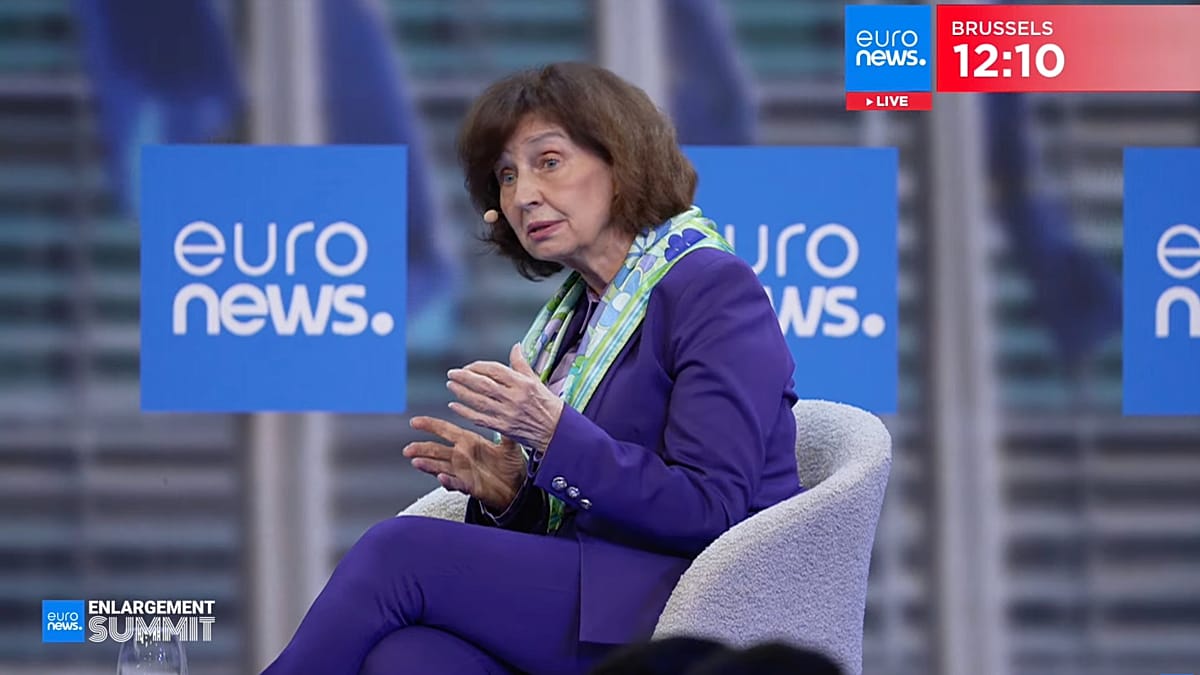
Published on 3 November 2026 - 13:26 GMT+1•Updated 13:34 North Macedonia's President Gordana Siljanovska-Davkova has said her country's EU accession hopes are being held hostage by Bulgaria, which is demanding constitutional changes to recognise the Bulgarian minority. ADVERTISEMENT ADVERTISEMENT "We are champions at changing the constitution – 26 times – most of the amendments are imposed," Siljanovska-Davkova said on the sidelines of the Euronews Enlargement Summit on Tuesday. In power since 2024, Siljanovska-Davkova argued that further concessions cannot be imposed without public support. "My legitimacy derives from the citizens and belong to them. So how can I promise you that we will change the Constitution?," North Macedonia's leader said. North Macedonia has been asked to amend its constitution to explicitly include Bulgarians among the country's recognised communities. The change was agreed as part of a compromise to unblock the accession process, but has encountered resistance in Skopje. In 2022, the EU adopted a French-brokered compromise. North Macedonia agreed to amend its constitution to explicitly recognise Bulgarians as a minority community, but such amendments require a two-thirds parliamentary majority, which the government has not secured. The President said 80% of citizens oppose the constitutional changes, while the proposed amendments have not even passed the first stage in the parliamentary constitutional commission. Siljanovska-Davkova said the main obstacle to her country's European integration was not a lack of reforms or compliance with EU requirements, but what she described as a lack of political will among neighbouring countries. North Macedonia, a small Balkan country of around 1.8 million people, is governed by a conservative-led coalition that has held power since mid-2024 with a solid parliamentary majority. Its path towards EU membership, however, remains blocked by a long-running dispute with neighbouring Bulgaria. The country first applied for EU membership in 2004 and became an official candidate in 2005, but its progress has been hampered by political setbacks. Siljanovska-Davkova said the EU accession dispute is part of a longer history of concessions made by North Macedonia in its pursuit of EU membership. She pointed to the 2018 agreement with Greece, under which the country changed its name from Republic of Macedonia to North Macedonia, ending a decades-long dispute that had blocked its NATO and EU ambitions. The latest constitutional demand raises questions about how far a candidate country should be expected to go to satisfy bilateral disputes before joining the bloc, Siljanovska-Davkova said. Hoping to resolve political divergences among its neighbors, the North Macedonian leader said she intends to keep pursuing a solution through dialogue. “I have met previous presidents and the current prime minister several times [...] I expressed the same feelings and the same tension, and I will continue to do that only through dialogue,” she said. However, Siljanovska-Davkova stopped short of directly accusing Bulgaria of deliberately obstructing accession, instead calling for "pragmatism" and "greater political willingness" among neighbouring countries.
North Macedonia leader hits back at Bulgaria's demands for constitutional change
Full Article
Original Source
Read the full article at Euronews →KhanList aggregates and links to publicly available news content. We do not host full articles from third-party sources. Always verify important information with original sources.