
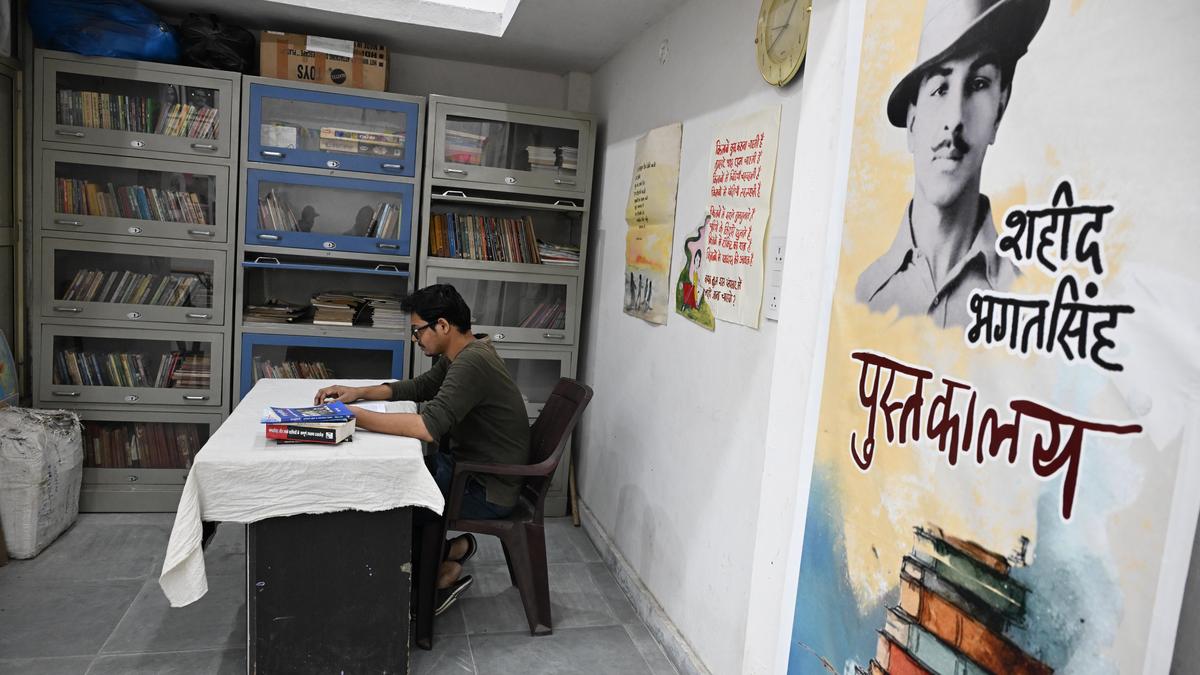
Chhavi, 12, walks around a large hall clutching a brightly coloured magazine titled Kopal. Dressed in her school uniform on a Tuesday afternoon, she settles into a small reading corner and begins leafing through it. Bookshelves line the walls, which are decorated with handmade posters and drawings by children. A long banner bearing the words ‘Shaheed Bhagat Singh Yuva Kendra’ hangs in another corner, identifying the modest space as a neighbourhood study centre.As the centre fills with the chatter of children, its founder and teacher, Yogesh Swami, recalls how, less than a fortnight ago, a team of Delhi Police personnel arrived at the premises. The visit was the latest instance of police scrutiny of the centre, which came under the scanner following the Noida workers’ protests.“I started this library almost 20 years ago,” Mr. Swami told The Hindu. “The area comprises a working-class population employed in small-scale, labour-intensive industries. In 2005, there was only one government school in the area and I saw children struggling with education,” he said.The library initially operated from an open plot across the street. “With only 20 children from the neighbourhood, we started holding classes in basic language and mathematics. Slowly, it developed into a study centre with games, workshops, camps, movie screenings and much more,” Mr. Swami said.Since April, however, the centre’s functioning has been severely affected. “We are not able to hold regular classes anymore as there is only one teacher now. When it started, a whole group of volunteers from Delhi University used to come to teach,” he said.The ‘conspiracy’While the library has been under the scanner of the Uttar Pradesh Police, it recently saw other police visit, this time by Delhi Police. Ahead of a protest against severe air pollution at Ramlila Maidan on November 11, five or six local policemen arrived early in the morning, although the protest was scheduled for 4 p.m.“They forced us to step outside without telling us why. When we refused, they said we were ‘kidnapping’ the children. They sat outside for hours until our lawyers asked them to show legal documents authorising their visit. They did not have anything, so they left,” Bhaskar, a teacher at the centre, said.On April 16, three days after violence was reported during the Noida workers’ protests, a police team arrived at the library at 2.30 a.m. “They came looking for Aditya Anand, one of the eight activists arrested in connection with the protest. I told them he was not here. They still searched the entire place and went upstairs, although the search warrant permitted them to search only the ground floor,” Mr. Swami said.Manish (name changed), a resident who was returning from his night shift, said he saw the police outside the library during one of the searches. “I saw them standing outside the library and making a video, pretending as if they were asking for Yogesh’s permission to step inside. I asked the purpose of their visit and whether 2.30 a.m. was the time they usually conducted their ‘general inquiries’. They did not answer me and just left,” he said.Two days later, a large contingent of police personnel arrived, wearing helmets and carrying lathis. “Around 70-80 of them were inside the library and about the same number were in the street. They were in full riot gear, as if they were about to unearth a massive bomb,” Bhaskar said.“They threw away books, ransacked almirahs, climbed lofts and made a complete mess of the place during their ‘search’, which lasted nearly six hours,” he added.Residents said the library had become an integral part of the neighbourhood and condemned the police searches. “We all went when the inauguration took place. We sang songs, clapped when children won prizes in painting and writing competitions, and even played games with them. During Covid, Yogesh distributed food in the area and we all helped with flour and vegetables,” Usha, a resident, said.The library came under the scanner of the Uttar Pradesh Police following the April 2026 Noida workers’ protests. Investigators alleged that its inauguration on March 22 was used by activists to plan the workers’ movement. In the chargesheet and the grounds for invoking the National Security Act (NSA) against Akriti Chaudhary, the police described the event as a meeting at which activists had “prepared the strategy of the proposed violent workers’ movement”.Chaudhary, a Delhi University history graduate and student activist associated with the labour-rights movement, was identified by the police as an active member of Mazdoor Bigul Dasta and accused of being part of the alleged conspiracy.On September 2, the Allahabad High Court quashed her detention under the NSA, observing that the State had failed to produce material establishing her alleged role in inciting violence. The court also ordered ₹5 lakh in compensation and directed her release if she was not required in any other case. Chaudhary had challenged the allegations, maintaining that the library’s inauguration had been publicly announced 23 days before the protests.
Noida library for underprivileged children under police scanner; repeated searches disrupt learning
Full Article
Original Source
Read the full article at Thehindu →KhanList aggregates and links to publicly available news content. We do not host full articles from third-party sources. Always verify important information with original sources.