
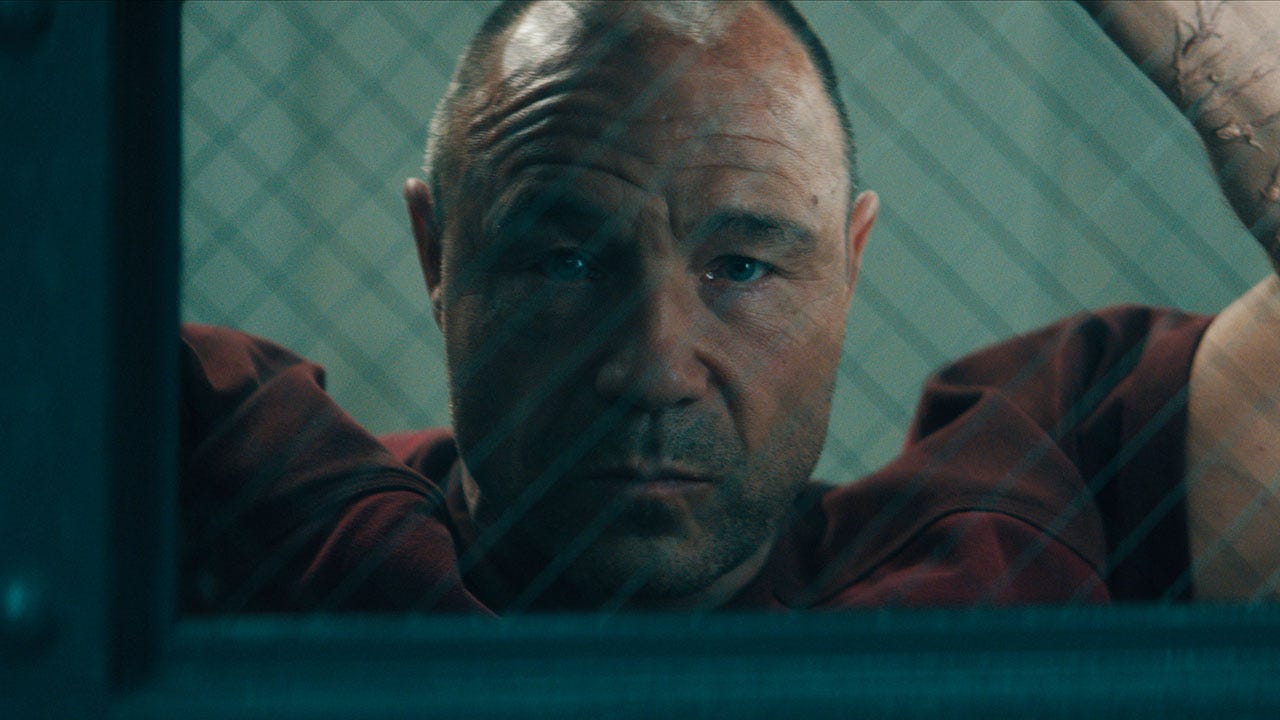
Spoilers follow for Nocturne Episodes 1 and 2, which are available on Apple TV now.Apple TV’s new thriller series, Nocturne, aims to draw audiences in with just the right balance of the familiar and the unexpected. The show asks what happens when a boy thought to be the victim of a serial killer returns alive, and follows the criminal mastermind as he maneuvers law enforcement during their race to save any other victims who may still be out there. Over the course of these first two episodes, viewers are left with questions — a mix of plot-driven intrigue, interest in character development, and a touch of side-eye around potential logic gaps or plot conveniences.Nocturne is based on Lars Kepler’s crime novels (The Sandman and Lazarus), and adapted by Rowan Joffe and John Hlavin for TV. These debut episodes lay the groundwork for convicted killer Jurek Walter’s unfolding scheme to free himself (he is astonishingly well played by Stephen Graham), set against multiple law enforcement officers’ attempts to a) stop him from doing more harm and b) find any of the still-living victims. Jurek was convicted of a series of brutal killings, which devastated a small town. He managed to get a jury to buy into an insanity defense, or we must presume he did, as he’s in a psychiatric hospital rather than a prison. (Side note: how he pulled that off is a nagging question, as nothing in his demeanor suggests an insanity defense would fly… If it’s simply that he’s a sociopath, wouldn’t that apply to all killers? Moving on.)From a technical perspective, the show does a beautiful job of dropping us in this world. The opening shot of Episode 1, “Lazarus, Come Forth,” establishes a sense of foreboding, danger, and claustrophobia that will become a refrain throughout the series. We get the sense that the creature we are encountering is not unlike a lion in a cage. The camera moves down a cold, concrete hallway toward cells that feel (purposefully) hidden and forgotten — the shot is all the more suffocating because the dark walls of the cell entryways initially obscure the sides of the frame. This is our introduction to Jurek, and it’s notable that the series starts by putting us in the mindset of the killer. He feels trapped and eager to get out. For some yet-to-be-revealed purpose, his gritty, simultaneously menacing and soothing voice whispers to the patient next door, luring the man to seek freedom by any means necessary, even with violence (in this case, against himself). This is Jurek’s central arc across the first two episodes. He is brilliant and adept at psychological warfare. He also seems to believe he’s entitled to his freedom, or at the very least that there is some legal loophole that will get his conviction overturned if only he can expose the lie that former homicide detective Jonah Lynn (Liev Schreiber) told to seal Jurek’s fate. Jurek taunts Jonah towards the close of the first episode with an offer of “the truth for the truth” when Jonah and Special Agent Quinn (Poorna Jagannathan, lately of Lanterns) visit him. In other words, Jurek will help them find more of his victims, specifically Felicia Frost — the missing sister of Michael, the boy who’s come back from the dead — if Jonah confesses to lying in court. This raises the stakes for everyone, including Agent Quinn, who’s already taken a risk by bringing a retired cop she doesn’t know this close to her case. If his old lie blows it up, that’s on her, with a missing girl’s life on the line.While some crime dramas give us only as much information as the characters searching for answers have, this one puts the audience a step ahead. It’s an interesting choice, and may ultimately be a misdirect.“While some crime dramas give the audience only as much information as the characters searching for answers have, this one puts the audience a step ahead. It’s an interesting choice, and may ultimately be a misdirect. Here’s what appears to have happened: a hospital worker named Karl (Rory Culkin) is assigned to the team that oversees Jurek. Their first encounter, like others in the series, is crafted with impressive tension: Karl searches for a missing weapon beneath Jurek’s metal bed, gets caught by his pant leg, and can’t free himself before Jurek comes to from a sedative — the trapped animal motif plays throughout. Before the scene is over, Jurek has pressed a note into Karl’s pocket, urging him to smuggle it out to his lawyer (more on the questions this raises in a bit).The note Jurek hands Karl seems to set everything in motion: the strong implication is that, lawyer or no lawyer, it contained Jurek’s instruction to an accomplice to free Michael. Jonah is actively drawn back into the case when Michael turns up alive, as the children’s mother, Ida Frost (Chrissy Metz), and the residents of the town trust him more than anyone else in law enforcement. Also advocating for his participation is FBI agent Saga Bauer (Zazie Beetz), his goddaughter, the child of his deceased partner, and someone he effectively raised. (She eventually goes undercover as a patient in Jurek’s secured ward in order to ascertain who is leaking messages and endangering lives.)The reality is, Jonah has clearly never given up on finding the remaining missing persons associated with the case: as Agent Bauer discovers via his giant murder board, he’s been methodically searching an enormous grid, single-handedly, for years. The case is deeply personal for both of them. Jonah carries guilt for having quit the force after the (seemingly unrelated?) accidental death of his wife and child. And Jurek (or rather his accomplice) was responsible for kidnapping Bauer’s stepmother, Rebecca. It’s also implied that Bauer’s father committed suicide after his wife’s disappearance. Through Agent Quinn’s vocal skepticism, the show addresses the inappropriateness of having either Jonah or Bauer involved in the investigation, given their personal connections to Jurek. The story excuses the conflict of interest (not to mention that Jonah is no longer an officer of the law) by pointing to their familiarity with the case and the ticking clock on saving Felicia. The dynamics and interwoven tragedies all tied to Jurek stretch credulity, but the production value and strength of the performances are enough to keep the viewer engaged through a good deal of character, plot, and relationship table-setting. At its core, this is a battle of three savants with real stakes: two on the victims’ side, deploying their individual skills to best a mysterious, murderous genius. That brings us to the tightrope the series walks.Stephen Graham and Liev SchreiberWhen crime dramas lean on preternatural intellect, whether it’s Sherlock Holmes or his foil, Moriarty, they run the risk of reading as a lazy sort of magic trick, where the detective or killer effortlessly “knows things” they’d need to in order to keep the story moving. Indeed, Jonah’s near-instant recognition of where Michael was being held, and Jurek’s Derren Brown-level ability to read people (pegging Karl’s guitar playing and Jonah’s partner’s violent alcoholism), open the door to the kind of conveniences that could lose a modern audience as the series unfolds. It already causes one to wonder: if Jurek is in possession of that kind of mental acuity, why did he get caught while his partner went free? Fortunately, Graham, who stunned the world with Adolescence last year, is deeply compelling, allowing us to give ourselves over to his performance. That isn’t to undercut the potent talent of the rest of the cast, or the visual storytelling. The show is beautifully shot, with well-crafted production design. It immerses us in a rustic exterior world that vacillates between gray and worn, and comfortingly familiar. The forest landscapes are striking, but dense and dangerous in a way that mirrors the cold, stifling confines of the hospital Jurek is housed in.Schreiber is delivering a grounded, understated portrayal of a grieving man who is just a bit too tired to fully fight against terrible ideas (Bauer’s undercover operation) and far too invested to stop himself from digging, with or without permission. One moment that stands out is when Agent Quinn tells Jonah she’s sorry for the loss of his wife and child; he nods, and unbearable pain flashes in his eyes for an instant before he moves on. Beetz is convincing and deeply affecting as a chameleon-like agent willing to harm herself (physically or otherwise) to close a case. It’s clear that this particular operation may drive her to a breaking point for multiple reasons: Jurek’s uncanny ability to read others and play on their weaknesses, her own stepmother’s disappearance (which he is connected to), and, not least of all, that it taps into the trauma of a woman who was the child of a mentally ill mother and addict father. That fear comes through as she prepares to enter the ward, right after visiting her mother. Beetz gives the sense that Bauer is unsure whether she’s crossing a line she won’t be able to come back from, where fact and fiction are too close. Bill Camp is also endearing as Chief Ellison, particularly as he talks about what the Frost kids meant to the town; he looks vulnerable, like a man who knows he is out over his skis, but wishes he wasn’t.Zazie BeetzIt took a moment for me to recognize Culkin as the compassionate nurse, Karl. Physically, his hair is doing a great deal to support the transformation, but this is also a side of the actor less seen on screen. There was one moment, when he first sees Jurek on the security cameras, in which I was left to wonder if he had some nefarious intent. But for the most part, he reads as a man of incredible kindness and skill with patients whom most of society writes off and exiles. That said, it’s odd that an employee who demonstrates an extraordinary amount of empathy is tapped for a job that puts him right in the crosshairs of a person known to exploit those instincts, and in a dangerous environment that requires a certain degree of toughness. Additionally, Karl, who is clearly driven by financial need (he accepts the new job the moment he’s informed that it comes with a raise and tells Jurek he can’t afford to lose it), inexplicably risks his career for a dangerous criminal he just met.So, that leaves us with a couple of options: this is a piece of plotting that doesn’t logically track, or Karl isn’t who we think he is. If it’s the latter, perhaps Karl was “sent” into the hospital with purpose. It’s strangely convenient that Jurek’s day nurse went missing (and is likely dead), making room for Karl to take over. Theoretically, the patient who injures himself in the opening sequence could have gotten word to Jurek’s partner to get rid of the day nurse and make room for Karl. But how could Jurek have known that the exact right personality type for his purposes was working a few floors above him, let alone that he’d get the job? Was Karl a plant, then, and Jurek’s accomplice? That doesn’t square with their first encounter, where, with no witnesses, Jurek treats Karl as a stranger and insists he is still a human deserving care. And if someone else on staff was steering Karl, Jurek already has a partner on the inside, so why would he need Karl? Those are just a few of the questions that may or may not pay off at the close of the series. There are smaller dangling threads as well. For example, Jonah finds footprints both in the building where Michael was held and outside the missing day nurse’s home, so why in the world would he hold them back from the FBI? Ostensibly, he’d do anything to find Felicia, so that type of behavior simply doesn’t track. Ironically, the serial killer is doing a better job of asking for help and relying on a partner.That said, the series works in no small part because Graham is simply impossible to look away from. He’s playing a killer who appears to have a (forgive the Dexter reference) code that makes sense to him. He says he “wants people to pay for their crimes.” Yes, that was in reference to Jonah’s “lie,” but the way he looks at the nurse who is rude to Karl reminds me of Hannibal Lecter’s deep disdain for bad manners. Graham’s depiction of Jurek is utterly magnetic and mercurial; when Jonah and Quinn visit, he breaks into a fit of giggles at the idea that she’s a “special” agent, as if the word itself is a joke, and moments later he’s commanding the room, telling them with understated menace that they’re only there because he brought them there. He really does seem to own them. The minute he’s off the screen, I crave more time with him.Rory CulkinThis entirely serves the series, because it allows us to believe that others could fall under his spell, even Bauer, a smart, capable, stony FBI agent with oceans to lose. There is a deep irony that he’s maneuvering and clawing his way to freedom, given his brutal kill method of burying victims alive. He complains that he’s been in solitary, but his partner has kept a child in the dark so long that the boy went temporarily blind. There’s also a very small possibility that he is, in some way, innocent, and that he has been “made worse” by his circumstances. Either way, for those on both sides of the law, this is a story about freedom, loss, redemption, and revenge, and the first two episodes have given me enough to stick with it for now.VerdictNocturne is a classic crime drama featuring a detective and a killer, both with savant-like tendencies. High production values and stunning performances elevate the material, and though plot contrivances may eventually deliver diminishing returns, the first two episodes do enough work to keep the viewer engaged with the series.
Nocturne Episodes 1 & 2 Recap and Review
Full Article
Original Source
Read the full article at Ign →KhanList aggregates and links to publicly available news content. We do not host full articles from third-party sources. Always verify important information with original sources.