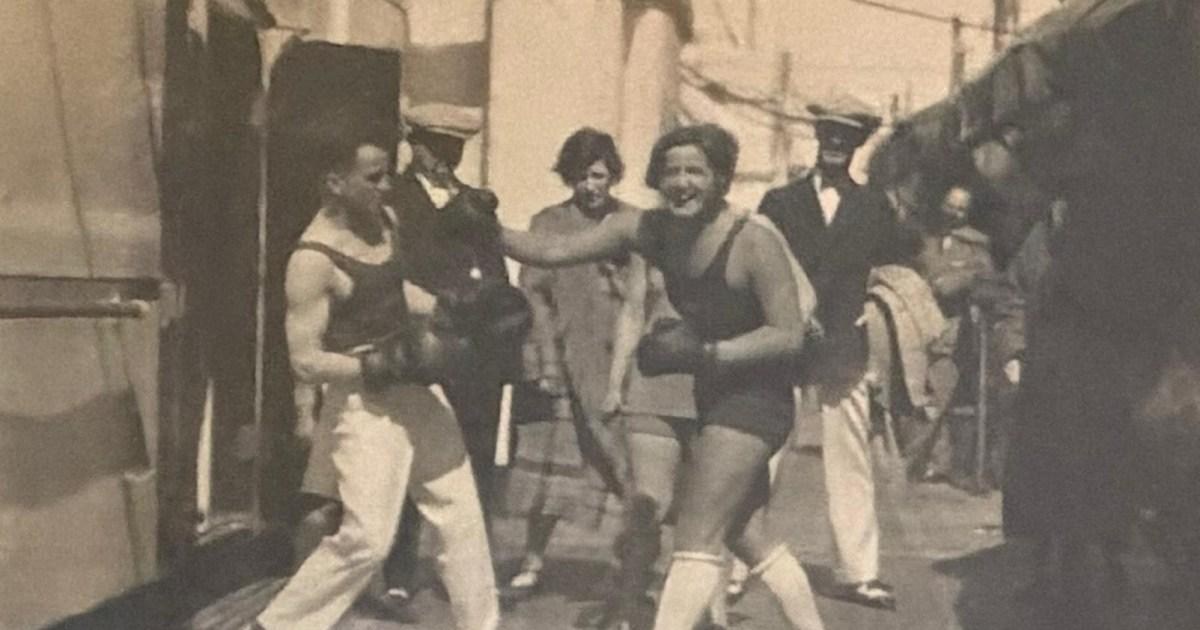
Gertrude Ederle was asked to provide her passport after the gruelling 14-and-a-half hour swim (Picture: Bettmann Archive) 100 years ago, a 20-year-old woman swam across the English Channel faster than anyone ever before. What made Gertrude Ederle’s achievement all the more remarkable wasn’t just the speed or the fact it had only previously been completed by men, but that a childhood accident had almost robbed her of the opportunity – and her life. Born in 1905 in Manhattan to German immigrant parents, Gertrude(also affectionately known as Trudy) was one of seven children, and the family often spent their summers in the Highlands on the New Jersey coast. Not a natural-born swimmer, when Gertrude was just seven she nearly drowned in after falling into deep water. It was a hugely traumatic experience for the young girl, but instead of dissuading her from setting foot in water again, the experience drove her to learn to swim. As a child, Ederle almost drowned (Picture: Supplied by Glenn Stout) Ederle (right) had a close relationship with her family, including her father Henry Ederle and sister Margaret Deuschle (left) (Picture: Topical Press Agency/Getty Images) Quickly, Ederle’s swimming talents were recognised and she got a world record at 12 (Picture: William Charles Morrison / TRUDY: Gertrude Ederle — The Life Behind the Headline) As Gertrude’s confidence in the water developed, by 12 she was a member of the Women’s Swimming Association, a club founded by Charlotte Epstein. Ask Metro Use AI to go deeper into the stories you care about – powered by Metro and trusted publications. This was an institution in which female participation and training in sport during the era were taken seriously. It also helped Gertrude set her first world record in the 880-yard freestyle – becoming the youngest world record holder in swimming. Going international By the age of 19, she held 29 different amateur US national and international records. In this picture of the U.S. Olympic Girl’s Swimming Team heading to the 1924 World’s Championships, Charlotte Epstein is standing four from the right, while Gertrude Ederle sits far left (Picture: George Rinhart Corbis Historical via Getty Images) By the time she was 19 she held almost 30 medals (Picture: Trudy Ederle Foundation / Gertrude Ederle Private Collection, courtesy of William Charles Morrison) She then brought three medals back from the 1924 Paris Olympics. One gold in the 4x100m freestyle relay with her teammates and her own bronze medals for the 100m and the 400m. Following her stellar performance in France, Gertrude was offered funding by the Chicago Tribune and The New York Daily News to attempt to be the first woman to swim across the English Channel. At the time, the fastest swim time was 16 hours, 33 minutes by Enrique Tirabocchi, and although many women aspired to complete the challenge, only two women had ever attempted it: Walpurga von Isacescu in 1900 and Annette Kellerman in 1905. Both failed. The swim was a mammoth task, with the length ranging from 21 to over 35 miles depending on tidal currents, along with the risk of hypothermia, jellyfish and other dangerous sea life. She was 19 when she made her first attempt to swim the channel (Picture: Trudy Ederle Foundation / Gertrude Ederle Private Collection, courtesy of William Charles Morrison) A failed attempt Gertrude’s first attempt on August 18, 1925 turned out to be unsuccessful – the reason why has never fully been understood, even to this day. What is known is that nine hours into her swim, her trainer, Jabez Wolffe, instructed the spotter who was swimming alongside Gertrude to retrieve her from the water after she started to seemingly struggle. Under the rules of the Channel Swimming Association, any physical contact with a swimmer disqualifies their attempt. The ensuing rumour mill included claims that it was jealousy that prompted Jabez to do this, as the trainer had failed to cross the Channel 22 times himself. Ederle with a team mate (Picture: Trudy Ederle Foundation / Gertrude Ederle Private Collection, courtesy of William Charles Morrison) Ederle making her first attempt to swim the Channel in August 1925 (Picture: Bettmann Archive) Others believe that he thought she had become unconscious and was truly concerned about her safety. Some even suggest that Jabez drugged her tea to deliberately sabotage her. The trainer always denied the allegations, insisting Gertrude had collapsed after she suffered a cramp. Whatever the reason, Hanna Hubert, from the Trudy Ederle Foundation, says that Gertrude ‘never judged about it.’ ‘People make up whether she was sabotaged or not, but that’s not the important question to ask. It’s just one part of the story,’ she tells Metro. She retrained intensely for her second attempt (Picture: Trudy Ederle Foundation / Gertrude Ederle Private Collection, courtesy of William Charles Morrison) Following her failed attempt, Gertrude faced major backlash, with critics insisting it was proof that women were not strong enough to swim the Channel. But she remained undeterred and returned to New York convinced to try again. Under the continued guidance of the WSA and her new coach, Bill Burgess, who had successfully swum the channel in 1911, Gertrude continued to train. Her second attempt would come a year later on August 6, 1926, when at 7.05am, she set off from Cap Gris-Nez in France. Follow Gertrude’s route across the Channel in real time here Over the next 14 hours and 34 minutes, Gertrude battled jellyfish, andfreezing cold and rough weather conditions as the sea swelled and ebbed. It resulted in her swimming for 35 miles, a longer distance than past athletes due to the harsh conditions. When her trainer became concerned that she would not make it through the conditions and instructed her to stop, Gertrude responded: ‘What for?’ Bill Burgess coating Trudy Ederle with grease prior to her start on her second channel swim attempt (Picture: Bettmann Archive) The swimmer had ‘begged’ her dad, Henry, to ensure that nobody would remove her from the water unless she said so. Finally, at 9.39pm, ‘bleary-eyed’ and exhausted, Gertrude reached the shores of Kingsdown, Kent. She was greeted by a British immigration officer on the coast, asking for her passport. He had no idea of the historical feat the young woman had just achieved. Ederle completed the swim on her second attempt, less than a year after her first try (Picture: The Print Collector via Getty Images) Gertrude’s perseverance had finally paid off, with her finishing one minute shy of being two hours faster than the five men who had completed the swim before her. According to Hanna, Gertrude’s sister Margaret helped her ‘really improve’ the second swim. ‘For example, her bathing suit was tearing on her in the water, so they did a two-piece. It was a scandalous thing, but it helped her to have less wounds.’ Margaret also suggested her sister use candle wax on her goggles as a sealant to stop water from entering, something other swimmers had yet to consider. Ederle had many adoring fans after she completed the feat (Picture: Trudy Ederle Foundation / Gertrude Ederle Private Collection, courtesy of William Charles Morrison) Unwanted Fame Upon Gertrude’s return to New York, an estimated crowd of 2 million people lined the street in a monumental ticker tape parade to celebrate her. She was dubbed by President Collidge as America’s Best Girl and went on to receive endorsements, contracts, film deals and even songs and dances named after and referencing her. But she didn’t complete the swim for fame, fortune or recognition, says Glenn Stout who spent years researching and writing Gertrude’s biography, Young Woman and the Sea. He believes she simply did it for herself. After the successful swim, Ederle, shown with her bubble boat, was approached by theatrical managers offering her contracts for an appearance on the stage. (Picture: George Rinhart/Corbis via Getty Images) ‘She wasn’t overtly trying to make a statement, but I think you end up making a statement when your motivations are true and genuine,’ he tells Metro. ‘True change comes when you stay in the moment and satisfy yourself first. And I think that’s what she did.’ Hanna agrees. ‘She just wanted to swim. Her sister Meg was the one to fill out all the papers for competitions, and to bring her ideas, like swimming the English Channel.’ Later life Fame was hard for Gertrude, who was known to be an introvert. She retreated from the public eye in 1928 due to mental and physical stress, as faster, flashier swimmers began to hit the headlines. Ederle was a very introverted woman (Picture: Hulton-Deutsch Collection/CORBIS/Corbis via Getty Images) Having suffered from measles as a child, which had caused hearing loss, Gertrude had been warned by doctors to avoid swimming, especially in the English Channel, as the cold and salt water would cause her hearing to deteriorate. As predicted, after her record-breaking swim, her hearing deteriorated until she became almost fully deaf. Gertrude’s struggles continued after she suffered a brutal fall down 15 steps at her apartment building in New York in 1933, which led to her sustaining a severe spinal injury and being told she would likely never walk or swim again. Still, she persisted, and in 1939, recovered enough to be able to swim at the New York World’s Fair – although she never attempted the Channel or any other major swims again. An inspiring legacy Gertrude, who never married or had children, passed away in New Jersey in 2003, at the grand old age of 98 – and her story continues to be met with awe. Glenn decided to write her biography after coming across the swimmer’s amazing drive and achievement while he was working as a sports journalist. ‘Women’s sports have a lot of stories – and a lot of overlooked stories,’ he says. In her lifetime, Gertrude Ederle coached movie star Bebe Daniels on how to make the Catalina Channel swim, Hollywood, California, January 25, 1927 (Picture: Underwood Archives/Getty Images) Although the book was his ‘all-time worst seller’, a copy was spotted in a second hand store in LA by the filmmaker, Jeff Nathanson -best known for writing two of the Rush Hour films and his work with Steven Spielberg -which helped Gertrude’s tale reach a new audience. Starring Daisy Ridley, the film Young Woman and the Sea was released in 2024, receiving a very respectable 88% score on Rotten Tomatoes. ‘Gertrude’s story changed people’s lives and inspired people,’ explains Glenn. ‘I’ve heard from people who have sat with their children and read the book together, and young girls who have done school projects and won competitions on Trudy.’ Ederle’s legacy lives on, now 100 years after she was the first woman to achieve the swim (Picture: Trudy Ederle Foundation / Gertrude Ederle Private Collection, courtesy of William Charles Morrison) Meanwhile, the Trudy Ederle Foundation was formed earlier this year with the aim of helping to transform former professional athletes into later careers, inspired by Gertrude’s transition into teaching deaf children to swim at the Lexington School for the Deaf. ‘Pioneer is a good word for her,’ says Glenn. ‘Nobody expected her to do it, yet she did.’ Arrow MORE: I’m 76 and transgender – life is far harder for trans kids today than it was for me Arrow MORE: I don’t care what people say — I’ll never stop using my hotel buffet hack Arrow MORE: I was convinced I was going to meet my soulmate – but I had been lied to in the worst way
‘Nobody expected her to do it’: Gertrude Ederle nearly drowned as a child – so she became the first woman to swim the English Channel
Full Article
Original Source
Read the full article at Metro →KhanList aggregates and links to publicly available news content. We do not host full articles from third-party sources. Always verify important information with original sources.