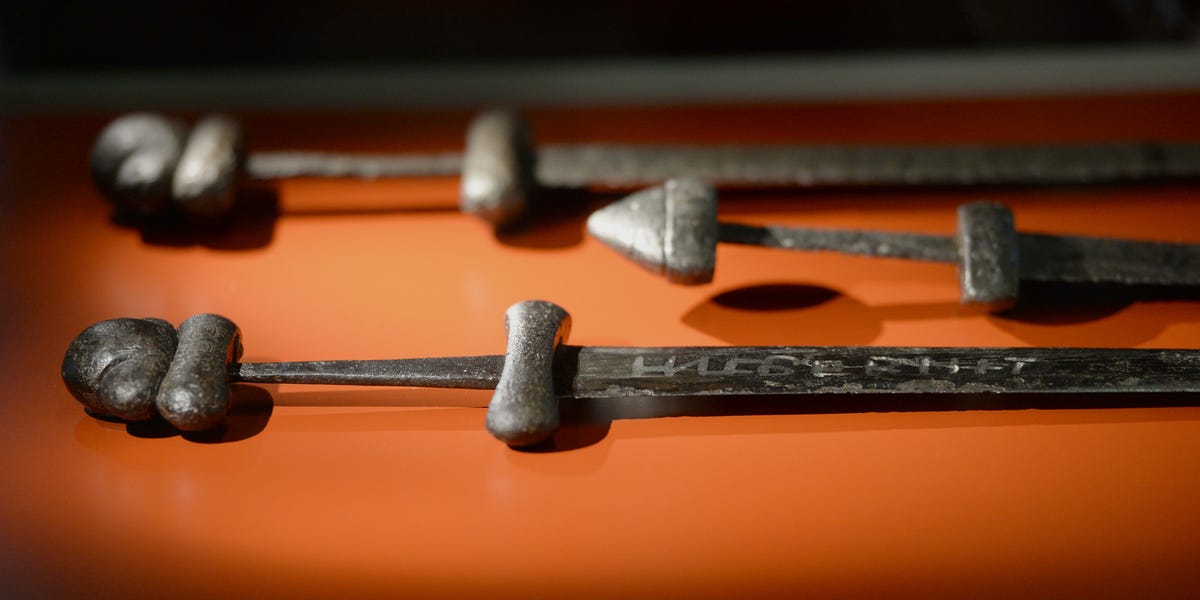
5 min readHere’s what you’ll learn when you read this story:Thought to have been produced around 800-1000 C.E., the Ulfberht was the ultimate sword of a Viking warrior because its manufacturing process made it impossible to break.Unlike swords made of iron that still had rock inclusions, or slag, Ulfberht blades were pure steel tempered and strengthened with carbon from coal, charcoal, or bone.Where the name “Ulfberht” came from is debatable, but recent evidence has found a connection to “wolf” names in the line of King Athelstan of Britain. Immortalized by countless battle recreations and the Viking metal band Rebellion, the Ulfberht wasn’t just a sword, but a status symbol. Any adversary who found themselves on the wrong end of one quickly discovered why. Its almost legendary resistance to breaking made it devastatingly superior to ordinary blades. What made this sword so formidable was its high-quality crucible steel, created during an era when blacksmiths might not have understood how elements react and interact, but knew something about steel.At the Neues Museum in Berlin, thousands of admirers come to view relics of Viking warfare, including swords bearing the Ulfberht inlay (alternately spelled Vlfberht or Ulfberh). Yet some of these legendary blades survived only in pieces, which may seem surprising for a sword renowned as nearly unbreakable and capable of slicing through chain mail. For decades, no one could explain why these fragments existed at all. Genuine Ulfberht swords were forged from steel specially treated for ultimate flexibility, making them nearly impossible to shatter. And if a warrior fell in battle clutching one, the blade couldn’t simply be destroyed—it had to be heated and bent to keep his spirit from haunting the living. So there’s only one explanation for any sword bearing the Ulfberht name found in pieces: it was never a genuine Ulfberht at all.Vikings usually fought with axes or spears, but the wealthiest warlords invested in the ultimate sword—the Ulfberht. Produced only during a brief window from 800 to 1000 C.E., these blades were considered the height of battle technology, and their methods of creation were closely guarded secrets to prevent others from profiting off the craft. For over a thousand years, no one managed to produce a metallurgically accurate replica. That changed when blacksmith Rick Furrer of Door County Forgeworks in Wisconsin set out to recreate the ancient process, paying attention to every nuance and merging archaeological evidence with chemistry. His journey, filmed for a 2017 PBS Nova documentary, culminated in what no modern smith had achieved before: a faithful reproduction of the most formidable sword in ancient and early medieval times.To turn iron ore into steel, it must be melted down to separate the actual iron from any remnants of the rock it was found in, but the inherent softness of iron demands something else to add strength. That something is carbon—introduced through coal or charcoal, it bonds with the iron during the heat of the forge, transforming it into steel. Medieval European swords were not only low in carbon, but riddled with impurities, or slag, that only weakened the iron by making it more brittle. Medieval fires were often not hot enough to liquify iron and separate it from the slag, which is why most steel was adulterated. Hammering the metal was the only way to remove the inclusions. Analysis of Ulfberht metal found an absence of slag and triple the carbon content of typical medieval steel. Though no written records of its production survive, chemistry speaks for those who no longer can.“The charcoal will get absorbed into the steel,” Furrer told PBS as he measured out the gray powder. “You don’t need much. [Glass] will melt [in the crucible], chemically bond with the waste material, the other slags, and will help float them away, and leave clean metal so the carbon can be absorbed.”Evidence of crucible steel production in Europe doesn’t appear until hundreds of years after the last Ulfberht was forged, and who discovered the method remains unknown. Fragments of burnt bone may have sometimes been used alongside or instead of charcoal in the fires, and with every clang of the hammer, the steel would have been infused with what its makers believed was the power of the animal or ancestor the bones came from. The blade itself was created from a single steel ingot, hammered for countless hours into shape. This was no simple task. Ulfberht steel, like all crucible steel, is difficult to form because iron atoms interlock into crystalline structures known as dendrites, their rigid borders defined by carbon atoms. Once shaped, the sword was heated and then rapidly cooled to harden it further. Finally, it was polished by grinding—strengthening its atomic structure—and treated with an etching acid to reveal the inlay.Where the name came from is also a mystery. Ulfberht, which sounds like something straight out of Beowulf, is a Frankish name, from the ancient region encompassing France, Germany, and the Netherlands, but its exact origin has never surfaced. The way the name was inlaid may speak for the dead. It was usually written with a cross before the U and another between the h and t, meaning it could have been in honor of an abbott, a bishop, or a monastery. This would have hardly mattered to the pagan Vikings. Some theories suggest that Viking warriors en route to a raid would pass through what is now Germany, and those who could afford it would purchase an Ulfberht from Frankish craftsmen. Others assume at least some of the swords were taken as Viking ransom or plunder from defeated Franks.In a 2023 study published in History of Antique Arms, archaeologist Anna Feuerbach found evidence of Ulfberht swords being forged around 935 C.E. for King Athelstan of Britain, whose nephews each received one before they ascended as rulers elsewhere. This suggests it was not only pagan hands that wielded an Ulfberht—these blades rode into battle with Christians, pagans, and those who straddled both worlds, not yet fully transitioned from old beliefs but not yet wholly Christian either. The crosses flanking the inscription may have symbolized the religious conviction that those of royal blood were destined to rule. Yet while some Ulfberhts were made for Athelstan’s court, others were forged by different smiths in other regions, and across all traditions, giving a sword a name was an act of magic thought to invoke the power of ancestors.“The swords were distributed to Athelstan’s nephews and their supporters who all shared a common ‘wolf’ identity,” Feuerbach said regarding the iconic name. “Once assumptions were removed and replaced with analysis and [evidence], the explanation for many of the sword variations became clear. Not only did the research answer the questions it sought to find, but it created a new window into which we can see the past.”Elizabeth Rayne is a creature who writes. Her work has appeared in Popular Mechanics, Ars Technica, SYFY WIRE, Space.com, Live Science, Den of Geek, Forbidden Futures and Collective Tales. She lurks right outside New York City with her parrot, Lestat. When not writing, she can be found drawing, playing the piano or shapeshifting.
Nobody Could Replicate This Unbreakable Viking Sword for 1,000 Years. One Man Just Figured Out How.
Full Article
Original Source
Read the full article at Popularmechanics →KhanList aggregates and links to publicly available news content. We do not host full articles from third-party sources. Always verify important information with original sources.