
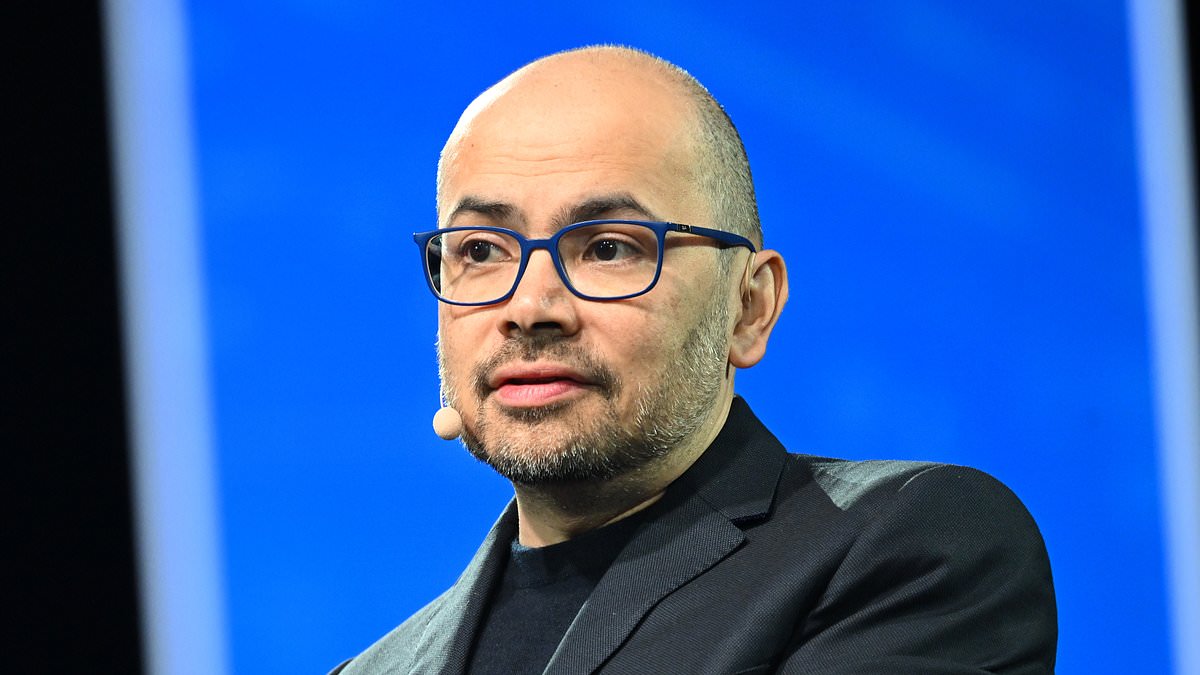
A leading AI researcher who won the Nobel Prize for his historic work has confessed that the technology is much closer to surpassing human intelligence than he previously believed. Demis Hassabis, founder and CEO of Google DeepMind, one of the world's leading AI research groups, won the Nobel Prize in Chemistry two years ago for his breakthrough work on proteins. He is a leading figurehead in artificial intelligence and modern science. Hassabis is developing artificial general intelligence (AGI), a hypothetical technology that matches human cognitive ability. In an interview with the Wall Street Journal, Hassabis said he expects Artificial General Intelligence (AGI) - the point at which computers surpass human cognitive ability across any task - within two to three years. 'It’s soon,' he said, adding, 'I’m updating nearer and nearer.' Earlier this year, Hassabis said AGI was three to five years away. In a 2025 interview with 60 Minutes, the scientist predicted AGI would not be embedded into our daily lives until 2035. The chilling prediction comes amid a growing fear around AI and AGI. In a recent poll by ABC News and the Washington Post, 52 per cent of Americans said AI was bad for society, 42 per cent said it was good, 17 per cent said it was extremely bad and just two per cent said it was extremely good. Protests against the growing technology and calls for regulation have erupted worldwide. Americans have also pushed back against building data centers to develop AI in their communities. Demis Hassabis, Co-Founder and Chair of Google DeepMind, said in a recent interview that he expects AGI to be just years away Hassabis won the Nobel Prize in 2024 for AlphaFold, an AI technology that can predict protein structure. He is pictured above at a meeting in September with King Charles III and Nvidia chief executive Jensen Huang Hassabis' chilling prediction comes amid worldwide fears around AI and calls to slow down advancement. Pictured above is a protest in New York City during the Nationwide Walkouts To Freeze AIHassabis defended the technology to the Wall Street Journal, explaining that once innovation leaders prioritize curing diseases like cancer, people will begin to feel the benefits of AI. When asked whether curing cancer with AI technology was even possible, Hassabis replied: 'I don’t see any insurmountable obstacles currently.''I see hard things, but not impossible things.'Hassabis added that his team at Isomorphic Labs, part of Google, is focused on creating AGI models that can 'revolutionize the drug discovery process' and solve multiple diseases. 'It’s slow, slow, slow—then suddenly all at once,' he said. Hassabis's breakthrough discovery led to a new technology called AlphaFold that can predict protein structure.The scientist said that since his 2024 Nobel Prize win for AlphaFold, AGI is coming sooner than anticipated. Several former researchers at AI development companies have sounded the alarm on the innovation race, prompting industry leaders to vow to slow advancement. Hassabis defended AI and AGI for their potential to cure diseases. He is pictured above with Princess Madeleine at the Nobel banquet in the City Hall in Stockholm, Sweden in 2024 Hassabis was featured alongside his fellow tech leaders for Time magazine's 2025 Person of the Year issue. He said in a recent interview that he regularly speaks to all of the AI CEOs Anthropic CEO Dario Amodei published an essay in September calling for slower AI development and stronger coordination among leading AI companies. OpenAI CEO Sam Altman and SpaceX CEO Elon Musk posted on X that they agreed with Amodei on pacing AI advancement. Hassabis has proposed an industry-funded body, under federal oversight, to monitor AI technology before releasing it to the public. He argued that federal regulation would never keep pace with how fast AI develops, but noted that AI leaders regularly discuss monitoring technology. When asked if all of the AI CEOs have a group chat, Hassabis coyly replied: 'No. I mean, I speak to everybody. But some of them don’t get on with each other.'
Nobel Prize-winning chief scientist at Google issues chilling new forecast for when AI will be smarter than humans in every area
Full Article
Original Source
Read the full article at Dailymail →KhanList aggregates and links to publicly available news content. We do not host full articles from third-party sources. Always verify important information with original sources.