
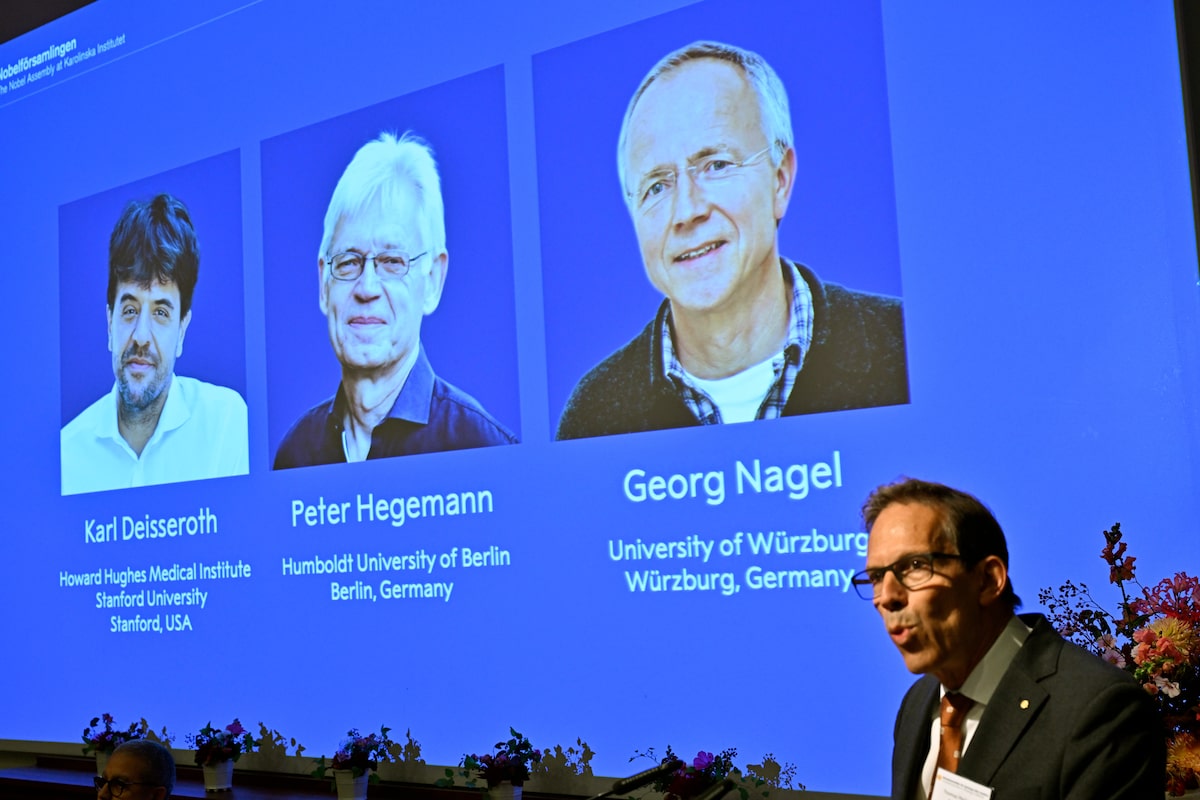
Open this photo in gallery:Karl Deisseroth, Peter Hegemann and Georg Nagel are shown on the screen as they are awarded the 2026 Nobel Prize in Physiology or Medicine.Pontus Lundahl/The Associated PressA discovery that began with algae and turned into a powerful method for investigating the brain is the subject of this year’s Nobel Prize in Physiology or Medicine.On Monday, the Nobel Assembly at the Karolinska Institute in Sweden announced this year’s prize has been has awarded to three scientists, one in the United States and two in Germany, for work leading to the development of the field known as optogenetics.Karl Deisseroth of Stanford University, Peter Hegemann of Humboldt University of Berlin and Georg Nagel of the University of Würzburg will share equally in the prize, worth approximately $1.74 million Canadian dollars.The story of this year’s medical Nobel begins with Dr. Hegemann, a biophysicist who in the 1980s became fascinated with the ability of pond algae to sense and respond to sunlight. Algae rise or sink depending on the amount of light, and in doing so can regulate photosynthesis.The phenomenon led to the discovery of a class of proteins called channelrhodopsins, which the algae use to turn light into electrical signals. Dr. Hegemann found the underlying gene associated with the protein in algae, which Dr. Nagel was then able to reproduce in frog eggs to study the protein’s function.In 2005, Dr. Deisseroth and a colleague in the U.S. showed how a channelrhodopsin gene could be inserted into the DNA of a mammal neuron. This created a brain cell that could be turned on or off with a pulse of light. With that innovation, optogenetics was born.Researchers have now used the technique to understand how the brain is wired, opening a new window into a range of complex neural functions including perception, memory and emotion.The breakthrough technique has since been widely celebrated. In 2018, Dr. Hegemann and Dr. Deisseroth were among the winners of the Canada Gairdner International Award for their contributions.Monday’s announcement kicks off a week of Nobel prize reveals, with the recipient or recipients of the physics prize to be named on Tuesday, chemistry on Wednesday, literature on Thursday and the Nobel Peace Prize on Friday. The prizes were first awarded in 1901, with categories stipulated in the will of Swedish businessman and inventor, Alfred Nobel.A sixth prize for economics, added in 1969, is set to be announced on Oct. 12. All the prizes are bestowed annually at a special ceremony held in Stockholm on Dec. 10, the anniversary of Alfred Nobel’s death in 1896.
Nobel prize in Physiology or Medicine awarded to researchers who learned how to light up the brain
Full Article
Original Source
Read the full article at Theglobeandmail →KhanList aggregates and links to publicly available news content. We do not host full articles from third-party sources. Always verify important information with original sources.