
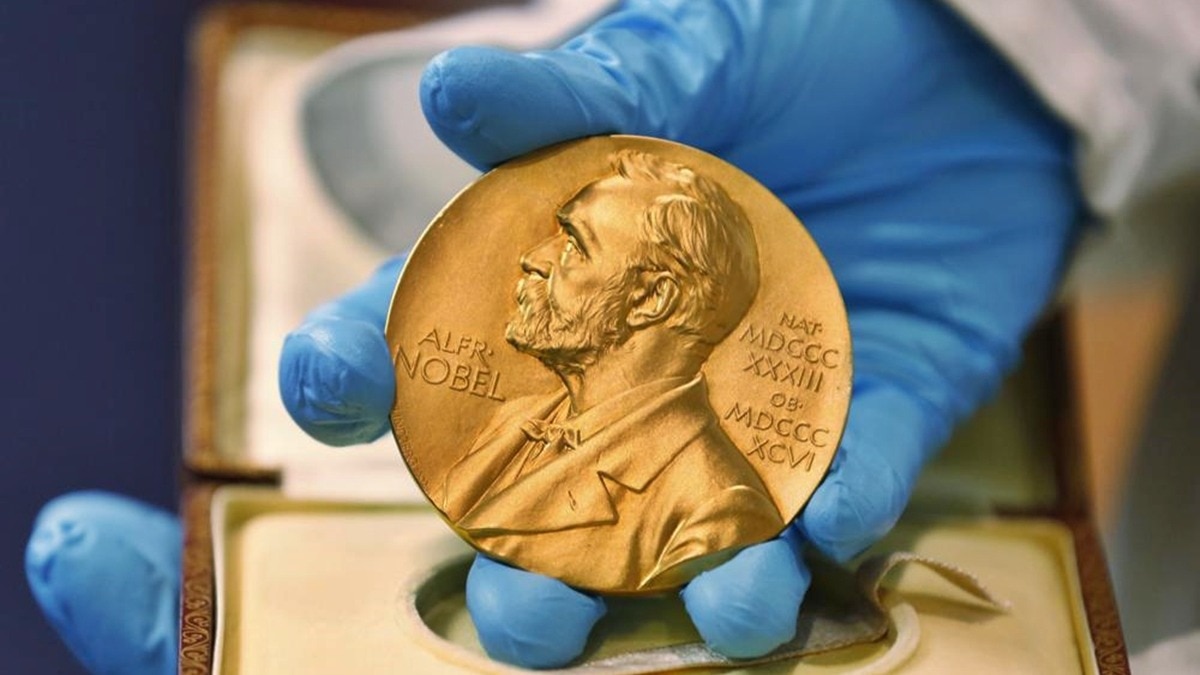
The world's most prestigious prizes for scientific achievement are set to return soon, with the 2026 Nobel Prize announcements beginning on October 5.The story behind the famed prize goes back to Alfred Nobel, the Swedish inventor, engineer and entrepreneur best known for inventing dynamite. Nobel laureate in Physiology or Medicine Fred Ramsdell receives his award in 2025. (Photo: AP) HOW DID THE NOBEL PRIZE BEGIN?In his will, signed in 1895, Nobel directed that most of his fortune be used to reward people who had conferred the "greatest benefit to humankind". He named five fields, including Physics, Chemistry, Physiology or Medicine, Literature and Peace.After his death in 1896, it took several years to put his wishes into practice, resulting in the first Nobel Prizes to be finally awarded in 1901. A sixth prize, the Sveriges Riksbank Prize in Economic Sciences in Memory of Alfred Nobel, was established in 1968 and first awarded in 1969.The Nobel Prizes in Physics and Chemistry are awarded by the Royal Swedish Academy of Sciences, while the Nobel Prize in Physiology or Medicine is awarded by the Nobel Assembly at Karolinska Institutet in Stockholm. Nobel Prize laureate in Chemistry Omar M Yaghi delivers a public lecture.(Photo: Reuters) WHEN WILL NOBEL PRIZE ANNOUNCEMENTS BE MADE?The Nobel Prize in Physiology or Medicine will be announced first on October 5, followed by Physics on October 6 and Chemistry on October 7.Literature will be announced on October 8, the Peace Prize on October 9, and the Economics prize on October 12.For those in India, the science announcements will come at 3 pm IST for Medicine on October 5, and 3:15 pm IST for Physics and Chemistry on October 6 and 7, respectively.The announcements will be streamed live by the Nobel Prize organisation. An image of the Nobel Prize medal featuring a photo of Alfred Nobel. (Photo: Nobel Prize) WHAT DOES NOBEL PRIZE MEAN TO SCIENCE?The science prizes are not simply awards for a clever discovery.They recognise research that has fundamentally changed how scientists understand the world or opened new possibilities for medicine and technology.That can be seen in recent winners. An image of Albert Einstein who won the Nobel Prize in 1921. (Photo: X) In 2025, the prize for Physics went to John Clarke, Michel H Devoret and John M Martinis for discovering macroscopic quantum mechanical tunnelling and energy quantisation in an electric circuit.Chemistry recognised Susumu Kitagawa, Richard Robson and Omar M Yaghi for developing metal-organic frameworks.Medicine went to Mary E. Brunkow, Fred Ramsdell and Shimon Sakaguchi for discoveries concerning peripheral immune tolerance.The previous year offered equally prominent examples.The 2024 Medicine prize recognised Victor Ambros and Gary Ruvkun for discovering microRNA and its role in gene regulation, while the Physics prize recognised John Hopfield and Geoffrey Hinton for foundational discoveries and inventions enabling machine learning with artificial neural networks. Nobel Prize laureate James A Robinson addresses a gathering.(Photo: PTI) These awards show why the Nobel remains important to science, and how it takes complex research that may have taken decades to develop and places it before the world, drawing attention to discoveries that can change the world in the most realistic way.Between 1901 and 2025, the Nobel Prizes and Economics prize were awarded 633 times to 1,026 people and organisations, with each laureate receiving a medal, diploma and prize money.The fresh set of names to be etched in history are set to be announced soon.- EndsPublished On: Sep 3, 2026 11:50 IST
Nobel Prize 2026 announcements coming: What it means for science and why
Full Article
Original Source
Read the full article at Indiatoday →KhanList aggregates and links to publicly available news content. We do not host full articles from third-party sources. Always verify important information with original sources.