
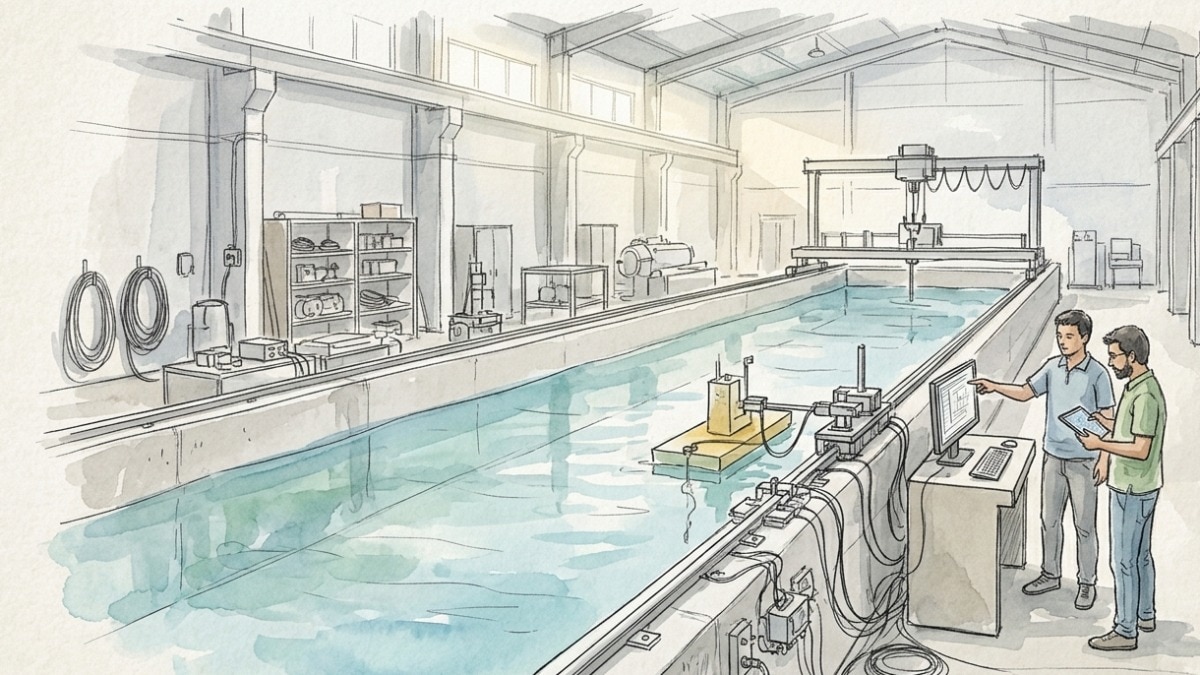
IIT Madras has developed SEANAV, a real-time digital twin platform that creates virtual maritime environments to train autonomous ships, test AI-powered collision avoidance systems, and improve navigation safety under challenging sea conditions.IIT Madras develops AI-powered platform to train autonomous ships and prevent collisions (AI-generated image)Imagine a ship navigating through rough seas, approaching a crowded harbour or steering clear of another vessel in thick fog. What if researchers could test how it responds to these situations without putting an actual ship or its crew at risk?Researchers at the Indian Institute of Technology (IIT) Madras have developed a technology that could make this possible. Called SEANAV (Sea Navigation), the platform creates a real-time virtual replica of maritime environments to test and train autonomous ships.A VIRTUAL OCEAN TO TEST SHIPSAccording to IIT Madras's official website, SEANAV is a digital twin platform that recreates ocean conditions, vessel movements, sensors, and surrounding ship traffic in a virtual environment.Developed by the institute's Department of Ocean Engineering, it allows researchers to test autonomous navigation systems before they are deployed in real-world waters. The platform has already demonstrated autonomous path-following and AI-driven collision avoidance under simulated wave and sensing conditions.The idea addresses a practical challenge for the shipping industry. Testing navigation systems at sea can be expensive, complicated, and potentially hazardous. A virtual environment allows researchers to conduct extensive trials without relying entirely on physical sea tests.SHIPS LEARN TO NAVIGATE TOGETHER One of SEANAV's notable features is its ability to simulate multiple autonomous vessels operating together.In busy shipping lanes and harbours, ships must navigate around one another while following international collision-prevention regulations. The platform allows multiple AI-powered vessels to learn navigation strategies while responding to surrounding traffic.Built using the Unity3D engine, the system also incorporates inputs from LiDAR, marine radar, and stereo vision cameras. It simulates sensor limitations such as noise and delays, helping researchers test how navigation systems respond to challenging conditions, including fog and rain.FROM VIRTUAL TRAINING TO SAFER PORTSThe technology could also have applications beyond autonomous shipping. IIT Madras says SEANAV could support maritime training, coastal surveillance, search-and-rescue operations and maritime defence.The platform also features a virtual reality interface powered by Meta Quest headsets, allowing trainees and maritime professionals to experience simulated situations from a ship's bridge.The research was led by Dr Suresh Rajendran of IIT Madras, along with Dr Athira M Nambiar of SRM Institute of Science and Technology and researchers and students from IIT Madras.The findings were published in the peer-reviewed Journal of Offshore Mechanics and Arctic Engineering. Future work will focus on developing digital twins of major Indian ports and validating the technology using physical scale models.- Ends
No waves, no storms, no real ships: IIT Madras builds a virtual ocean
Full Article
Original Source
Read the full article at Indiatoday →KhanList aggregates and links to publicly available news content. We do not host full articles from third-party sources. Always verify important information with original sources.