
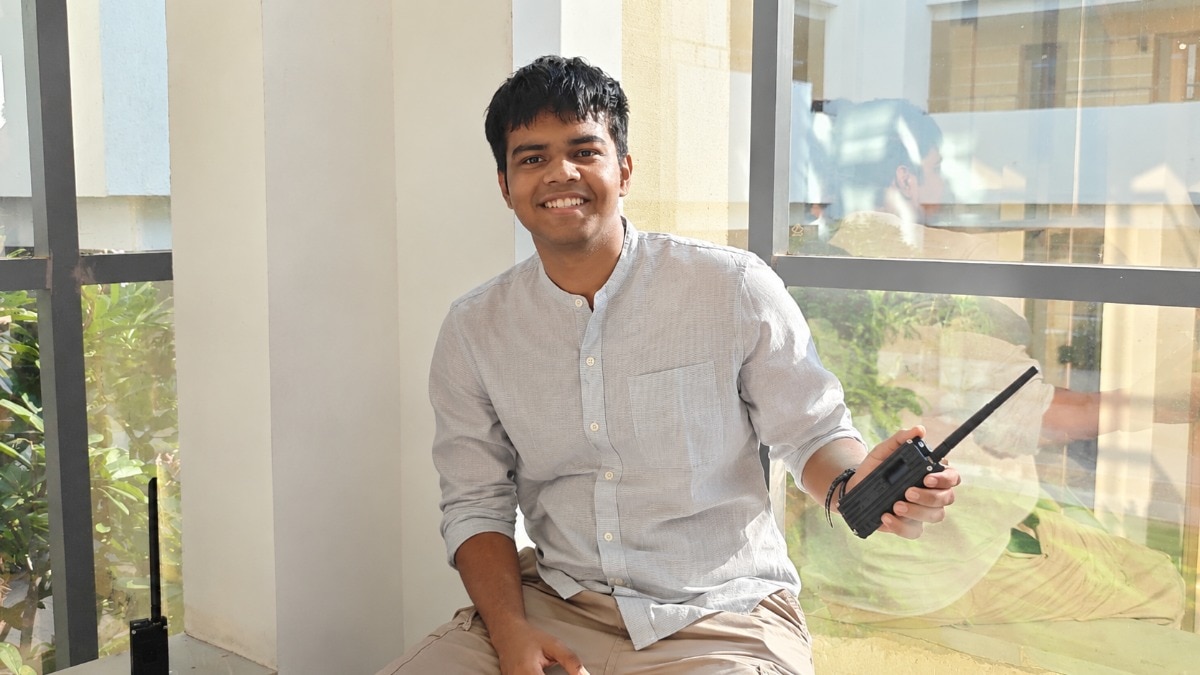
For Samarth Alok Srivastava, a third-year student at BITS Pilani's Hyderabad campus, the idea of building a defence startup did not begin with a business plan. It began with a problem he noticed while working with another startup.The 20-year-old, who is pursuing a dual degree in MSc Physics and BE Mechanical Engineering, was among the early members of Apollyon Dynamics, a defence-drone startup that emerged from the BITS Hyderabad campus. He worked across technology and business, including building and testing unmanned aerial vehicles.While exploring communication systems for drones, he began looking at a larger problem: how soldiers communicate on the ground, particularly in areas where conventional infrastructure is unavailable.“The communication part of drones. I came across this idea of actually communicating on the ground is also a bit broken in the Indian Armed Forces,” he said. He began speaking to people in the military to understand the problem better. Those conversations convinced him that it was something he could work on.“I was like, there's something that is an actual problem that I need to solve, and I can solve this,” he said. He left Apollyon Dynamics in April 2026 and began developing the idea that would become Krathveil Private Limited, incorporated the following month.The startup was initially his effort alone. His batchmate Shresth Prakash Singh later joined as co-founder, bringing experience in communication systems and related projects. Two other BITS Hyderabad students, Darshan Bhandari and Sarika Revitsar, also help the team. (Photo: (l) Shresth Prakash Singh, (r) Samarth Alok Srivastava) “Initially when I started out it was just me. So I had this idea. I was working on the prototype,” Srivastava said. “And then Shresth also joined, as he has been working on the communication part a lot in the last two years. He has done multiple projects about communication.”All four are in their third year at BITS Hyderabad, and much of the work happens from their hostel rooms.NOT A WALKIE-TALKIE, BUT A NETWORK IN YOUR POCKETKrathveil's first product, Krath Control, is a pocket-sized radio weighing less than 180 grams. It pairs with a soldier's smartphone and connects with other devices to create an encrypted mesh network.In simple terms, the devices communicate directly with one another instead of depending on mobile towers, satellites or SIM cards. They can carry voice and data, while also helping soldiers share their locations and information during operations.“A lot of people confuse this product as a walkie-talkie. It's not a walkie-talkie. It's a mesh router,” he said.The system is designed to give soldiers more than voice communication. Through their phones, they can access a map showing where other members of their team are, share attachments and send markers or pointers. The radio, Krath Control, that Samarth and his team have built “The enemy is here, the enemy is there, that takes time, that takes understanding, that takes training,” he said, explaining the limitations of relying only on verbal instructions. “But all of these are in front of your eyes, like where is the enemy, where we are heading, where each and every person is.”He describes this as situational awareness on the battlefield.The network is also designed to keep working if one device stops functioning. Srivastava said that when several radios are connected, they create a stronger mesh.“If there are 10, 15, 20, 25 of these radios on the ground, that creates a very strong mesh,” he said. “This network is a self-healing network.”If one device is switched off or destroyed, the network can find other routes to carry information between the remaining devices. A single connection between two hilltops could potentially cover more than 100 km, although field-testing is still required to establish the range.BUILDING AN INDIAN ALTERNATIVE AT A LOWER COSTOne of the biggest challenges was developing a solution that could meet military requirements without becoming too expensive.Srivastava said similar imported systems can cost around Rs 2 lakh per unit. Krathveil is aiming to bring the cost down to approximately Rs 40,000–50,000 once testing, compliance and product development are factored in.He said the team relied on existing research and open-source technologies rather than trying to build everything from scratch.“You don't really invent the wheel. You have to take a few things that are already out there and make changes to them,” he said. “And you have to present a solution in a way that it solves their problem, but in the budget.”The prototype itself was developed for around Rs 25,000–35,000. Srivastava said the final cost would rise as the team works on improvements and compliance.“We will be able to price it much lower than our competitors,” he said. “We own the stack, we know the software, we know the hardware, so we can make it compatible with their technology.”The initial funding came from his savings from Apollyon Dynamics, equipment provided by friends and financial support from his parents. The team built four nodes, including three handheld units and one that can be mounted on a drone to work as a relay. The radios weigh less than 180 grams TWO ARMY UNITS HAVE ASSESSED THE PROTOTYPEKrathveil has demonstrated its technology to two Indian Army units and the Army Defence College. Srivastava said the feedback was encouraging, but the device is still at the prototype stage and has not received formal certification or been inducted into service.“They said it's an excellent product. They have said they have never seen something like this built in India,” he said, recalling the response to the demonstrations.The assessments also brought specific suggestions. The Army asked the team to increase the device's output power to 1 watt and improve its antennas. Krathveil is working on an upgraded version incorporating these changes over the next two to three months, after which it plans to seek another assessment.The startup is DPIIT-recognised and is seeking incubation at PIEDS to support its next stage of development. Samarth's teammates (Photo: (l) Samarth (m) Darshan Bhandari and (r) Sarika Revitsar) COLLEGE, STARTUP AND A LOT OF LATE NIGHTSBuilding a defence technology company while pursuing two degrees has meant juggling coursework with demonstrations, meetings and product development.Srivastava has seven to eight courses each semester, spanning physics and mechanical engineering. Asked how he manages both commitments, he gave a candid answer: “Mostly barely surviving, honestly.”He said his workload varies considerably. Demonstration days can stretch to 12–16 hours, while quieter periods give him time to focus on college.“Those days I am working 12 to 16 hours straight, not sleeping at night at all,” he said.For now, the team's immediate goal is to turn the prototype into a product that can undergo further testing. The longer-term ambition is to build a resilient communication and intelligence layer for the armed forces.“In the next 10 years, I would love to see all these radios, all these communication layers in the hands of the military, them operating with it and we becoming somewhat a backbone to the military communication layer,” he said.- Ends
No towers, no SIM: 20-year-old Hyderabad student is building a radio for the Army
Full Article
Original Source
Read the full article at Indiatoday →KhanList aggregates and links to publicly available news content. We do not host full articles from third-party sources. Always verify important information with original sources.