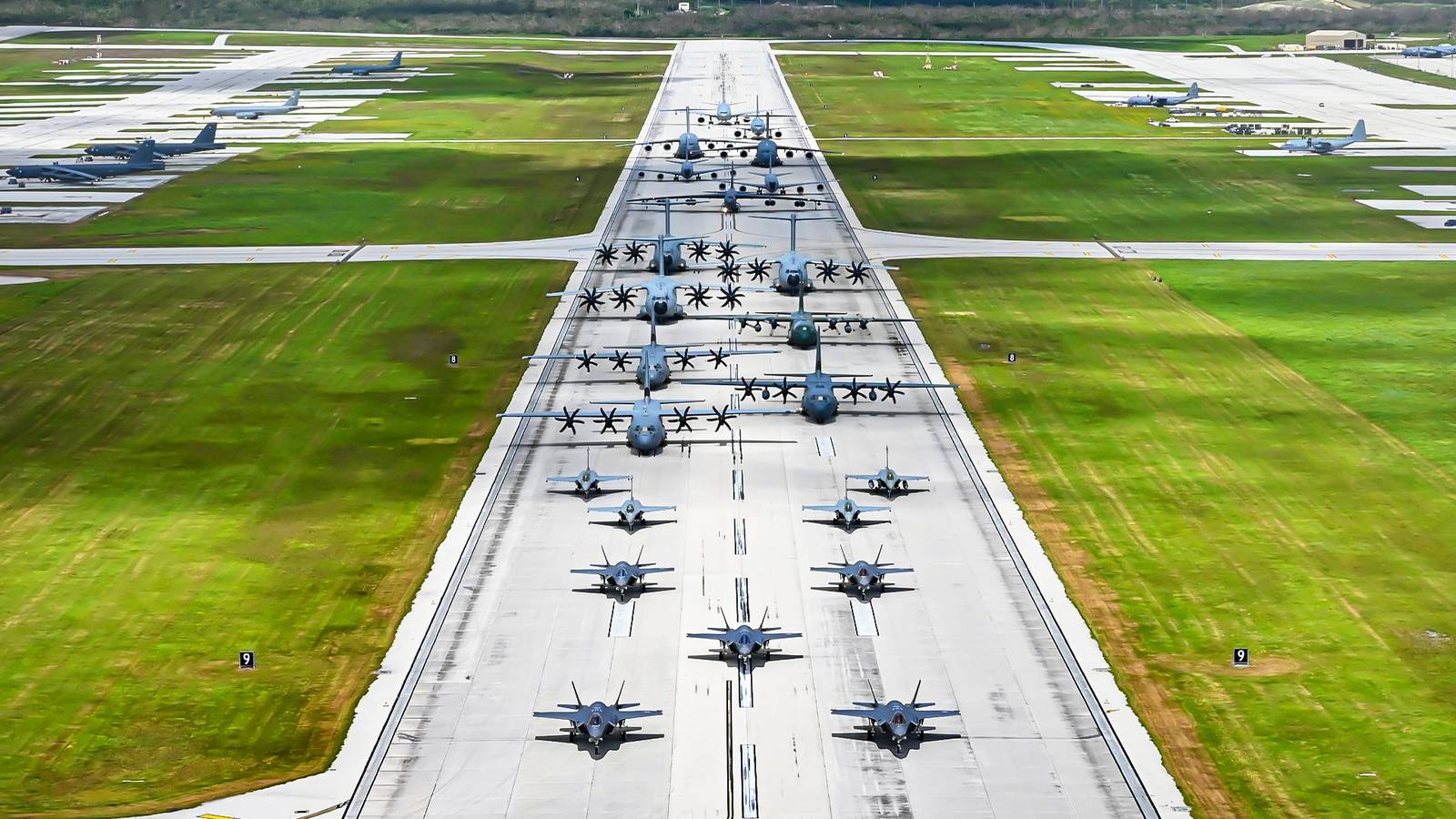
Published Aug 11, 2026, 8:00 PM EDT Aaron is an aviation enthusiast and world traveler with a deep interest in aerospace history and technology. He has traveled around the world numerous times, often incorporating visits to aviation museums and historic aircraft collections into his journeys. A native of New Zealand, he is an expert in aviation and maintains a broad interest in a variety of other subjects. The United States Air Force plans to expand and develop its facilities on Guam. This includes more aircraft parking apron space at Andersen Air Force Base's North Ramp area. The expansion includes taxiways, large parking areas, and more and is part of a larger developed area. It is designed for capacity expansion, allowing Andersen to handle more bombers, tankers, fighters, and other aircraft. Some have pointed out that the expansion plans lack hardened shelters and that this is foolhardy given the threats posed by China and the number of Russian aircraft Ukraine has destroyed on the ground. But there is logical reasoning behind the move to not concentrate on building set, fixed shelters. The logic reflects the dynamic position air forces now find themselves in and that no forward air base can be fully protected against a peer adversary in a high-end conflict. Guam's Andersen Air Force Base Credit: US Air Force Andersen Air Force Base is one of the most important bases the US has in the Eastern Pacific. It is sovereign and so not reliant on the continued goodwill of allies like Japan and South Korea. It is also far enough from China to be hard to hit while also being close enough to be relevant. It is located on the northern plateau of Guam and covers around 20,000 acres. According to the Air Force, rotational aircraft operating from Andersen routinely include B-1B, B-52H, B-2s, KC-135, and various fighter, mobility, and support aircraft. It is the home base of the 36th Wing (36 WG), which provides continuous forward presence, contingency response capabilities, and theater support across the Indo-Pacific area of responsibility. It is central to the US's Island Chain strategy and is a critical node in any large-scale conflict in the Eastern Pacific. The US DoD is pouring tens of billions into upgrading Andersen and other military installations on the island. These range from new communication centers to new barracks to better air defenses, and more. But one criticism is that the efforts appear to be lacking new hardened shelters for aircraft. The reasoning behind this is complicated. While this article focuses on Guam, it is worth noting that Chinese planners have to grapple with the same or similar problems and dilemmas to protect their own aircraft. Why Advocates Say Hardened Shelters Are Important Credit: Department of Defense During the early stages of the Ukraine-Russia conflict, most Russian aviation losses were in the air. As time has gone on, Russia has failed to establish air superiority over Ukraine. At the same time, Ukraine's deep strikes, enabled by a growing list of one-way attack drones, cruise missiles, and soon, ballistic missiles, have brought more and more of Russia's air bases into range. Over time, the balance of Russian losses has shifted from in the air to on the ground. 2025's Operation Spiderweb was a major event that the Financial Times estimated Russia lost as much as 20% of its operational strategic bomber fleet on the ground in a single day. While that was the most dramatic event, there has been a continual drip of Russian losses on the ground throughout the course of the conflict. In July 2026, Russia lost another rare Tu-95MS strategic bomber on the ground to a Ukrainian strike. Lessons from 2025's Operation Rising Lion and 2026's Operation Epic Fury also demonstrated how aircraft are vulnerable on the ground. From patchy open-source intelligence, it appears practically all of Iran's military aircraft that were not stored away in tunnels dug into the mountains were lost on the ground. A Yak-130 and two Su-24s were also lost in air-to-air engagements. Additionally, many of the US's losses were (and continue to be) on the ground. This includes multiple MQ-9 Reapers (one Italian), KC-135 tankers, a rare E-3 AEW&C, and others. It seems Italy and Kuwait had Eurofighters destroyed or damaged on the ground. Counterpoints, Hardened Shelters Don't Stop Missiles Credit: The U.S. National Archives One issue with hardened shelters is that they provide fixed, known targets that are easy to hit. Hardened aircraft shelters can not realistically protect aircraft from direct missile impacts. On Google Maps, the hardened shelters at Ali Al Salem Air Base and Ahmed Al Jaber Air Base have been visible, bearing the direct Coalition strikes from Operation Desert Storm that destroyed any Iraqi aircraft parked in them. Until the Iran conflict of 2026, these impacts were clearly visible on Google Maps satellite view and sat unrepaired for decades. However, as of mid-2026, the air bases have been blurred. Following the collapse of Assad in Syria in late 2024, Israel launched Operation Bashan Arrow, which destroyed any remaining Syrian aircraft parked in their shelters. Iran has also struck Israel's Nevatim Air Base (home to F-35s) and various US bases in the Middle East. Where satellite imagery is available, and on the occasion Iran hit the hangar with a ballistic missile, it appears the hangars did not withstand the impact. Any aircraft in them would likely have been destroyed, although in many cases there is reason to believe they were empty. The Israeli and US operations against Iran also targeted Iranian aircraft parked in hardened shelters. It is not feasible to build hardened shelters able to protect aircraft from direct Tomahawk or GBU-24 2,000 lb bomb strikes. What Hangars Actually Do Credit: The U.S. National Archives Hardened hangars offer a range of benefits. While they can't withstand a direct hit from a large warhead, they do protect against near misses, blast overpressure, fragmentation (shrapnel), small submunitions, some limited penetration by unguided munitions, and smaller drones. That said, some of these benefits (e.g., fragmentation) can be gained by building revetments. In the context of Russia wanting to protect its aircraft from Ukraine, hardened shelters (with closed gates) would likely protect against FPV and other small drone strikes. But in the context of Guam, its chief threat is China. The range alone makes it unlikely the threat would be FPV drones (unless a sneak attack from a cargo ship, etc.). Instead, China would likely attack with more capable cruise and ballistic missiles. Andersen Air Force Base (per USAF) Established 1944 (as North Field) Host unit 36th Wing Total personnel 8,000+ (incl military personnel, civilians, and contractors) Area (approx.) 15,000 acres Runway 06L/24R 12,000 feet (3,660 meters) Runway 06R/24L 11,000 feet (3,350 meters) But where hangars can help is by creating a targeting dilemma. The adversary may not know which hangars are empty, which have decoys, and which have real aircraft. Aircraft can be effectively hidden with a proverbial tarp. So even basic, non-reinforced shelters may be enough to achieve targeting dilemmas. US planners may also think that, realistically, China would have the magazine depth to systematically target all the shelters, regardless of how many they build. The US's Agile Combat Employment Credit: US Air Force Over the last few years, US planners have emphasized Agile Combat Employment (ACE) to disperse aircraft operations across multiple bases to keep the aircraft moving. Central to this doctrine is keeping aircraft mobile. For example, a fighter jet squadron deployed to Andersen will be constantly towed to new parking spots on the tarmac and rotated through other airfields. If a Chinese satellite sees an aircraft parked on the tarmac, it could be a number of hours before a munition arrives to target it. The plan is to tow it a few hundred feet (meters) so that it isn't there when the munition arrives. Part of the criticism for the loss of the E-3 Sentry in Saudi Arabia to an Iranian strike was that it was left sitting at the same location for too long. While this plan works in theory, it is unclear to what degree it will survive the emerging age of AI-assisted targeting. Ukrainian one-way attack drones have a human in the loop to reach the target area. However, increasingly, as electronic jamming cuts communication, the drones are able to autonomously identify the target and attack. It is possible future long-range attack drones/cruise missiles will not just be programmed to fly to a set of coordinates, but to fly to the airfield, and then autonomously identify the target on arrival. Various Deception Tactics Credit: Ukraine Ministry Of Defense It is not possible to list all the methods being used to protect military aircraft on the ground in Iran, the US, Ukraine, Israel, and Russia. However, it does appear that surviving Iranian aircraft were deep underground, not in shelters. One common tactic in Ukraine and Russia is the use of decoys. These can be anything from plywood mock-ups to old derelict aircraft towed onto the flightway and around the base. Russia and Ukraine have many of their retired aircraft rotting on their active airbases. These can be towed to resemble legitimate targets and absorb strikes. This is how Russia used a pair of Tupolev Tu-142 turboprop patrol aircraft (derived from Tu-95) to soak up Ukrainian strikes at Taganrog-South Airfield in May. Both Russian and Ukrainian fighter jets have become incredibly mobile, with Ukraine's Come Back Alive organization developing mobile maintenance facilities to service its F-16s that are often unable to land at established maintenance bases. One issue here is that for the US almost all of its retired aircraft are based at the Davis-Monthan boneyard in Arizona. But the solution for Guam may be a combination of measures that include dispersal, some hardened and unhardened shelters, decoys, counter-ISR measures, mobility, air defense, and other measures. The bottom line is that by themselves, hardened hangars may help somewhat, but would not be enough to save the aircraft on Guam.
No Shelters, No Problem: The Logic Behind Andersen AFB's 20-Acre Concrete Expansion
Full Article
Original Source
Read the full article at Simpleflying →KhanList aggregates and links to publicly available news content. We do not host full articles from third-party sources. Always verify important information with original sources.