
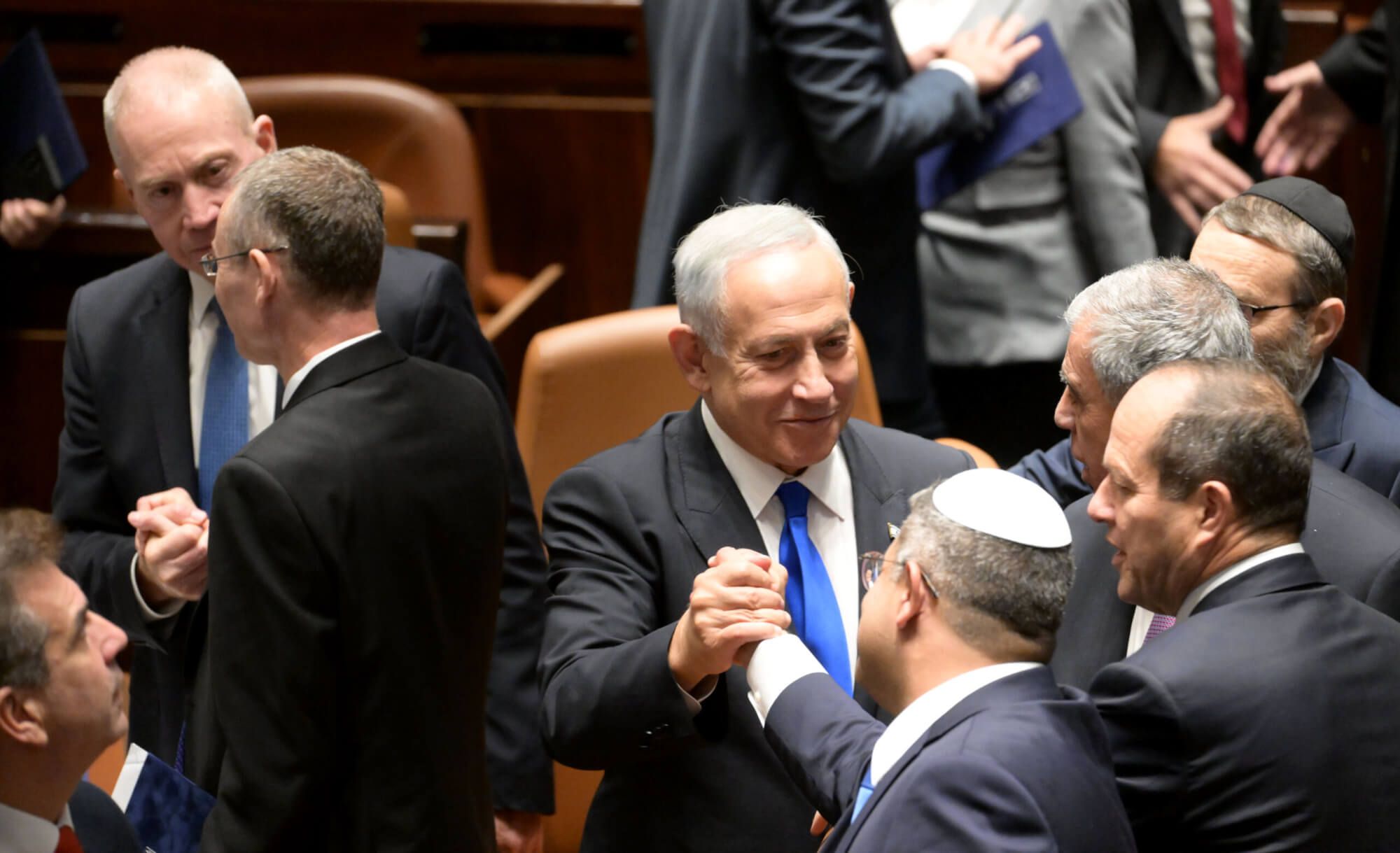
Israel’s dilemma over its identity as a state couldn’t be clearer, and its leaders have set their priorities straight after the long-awaited election day on Tuesday. According to the Israeli Central Elections Committee, some four million Israeli citizens cast their vote, representing around 77.7% of voters, the highest turnout in over 20 years. Described as the most heated in Israel’s history, the 2026 elections centered around one question: Should Prime Minister Benjamin Netanyahu stay in power? As of Thursday morning, after counting nearly 90% of votes, the Netanyahu camp takes the prize, with 55 out of the 120 seats in the Knesset, followed by the opposition camp with 49 seats, and the Arab Palestinian parties with 19 seats, the most seats won by Palestinian citizens of Israel in the state’s history. Neither the Netanyahu camp nor the Eisenkot camp has reached the 61-seat majority required to form a government, and the Arab camp seems to be the key to solving the deadlock. However, the majority of the Eizenkot camp refuse to ally themselves with Palestinians, despite fiercely wanting to oust Netanyahu. This makes the achievement of the Palestinian vote essentially irrelevant, despite representing 20% of Israel’s population, and leaves the central question of forming a new government unresolved. There are multiple possible scenarios ahead, and somebody will have to make some strategic concessions with deep political implications for the identity of Israel. The coming weeks may be the most politically significant since Israel’s establishment in 1948 — for Israel as a state, for its Palestinian citizens, and for Palestinians in the West Bank and Gaza, who remain subject to Israel’s rule, despite not having citizenship. In order to understand the significance of this political moment, and the possible scenarios to come, we need to look back at the elections process within a larger context. Voting on what? Israelis voted on Tuesday for the first time since the October 7 attacks in 2023, widely considered as the largest security failure in Israel’s history, for which Netanyahu, under whose watch it happened, hasn’t taken any responsibility. But it is also the first vote since Israel unleashed a genocidal military campaign on Gaza, which has earned a worldwide consensus for the crime of genocide, including a charge from a UN special investigation commission, all major international human rights organizations, the International Association of Genocide Scholars, and Israel’s leading human rights group, B’Tselem. The Gaza genocide has turned global opinion against Israel, pushing it into an unprecedented political isolation. Meanwhile, neither its official stated goal of destroying Hamas nor its unofficial goal of expelling Palestinians from Gaza has been achieved. Under Netanyahu’s government, Israeli settlers in the West Bank have launched their largest ever offensive, ethnically cleansing more than 100 rural Palestinian communities and attacking the heart of Palestinian towns, which invited international condemnation and even sanctions, albeit limited, on Israeli settlers in the West Bank. It is also the first Israeli election since Israel’s two-round war with Iran, which has seen Israel receiving missile strikes like never before, wear out the U.S. deterrence in the region, giving Iran full control over the strategic Strait of Hormuz, boosting its position in the region, and deepening the U.S. opposition to Israel’s influence in American politics, including amongst the Republican party. Meanwhile, Netanyahu’s own promise of “regime change” in Iran has become a distant dream. This election also arrives with a backdrop of Netanyahu’s campaign to change the decades-old established state institutions in Israel, giving the extreme ideologically-driven para-state pro-settler movements a way into controlling state institutions, and concentrating power in the executive branch, polarizing Israeli society along ideological and social identity lines. The peak of this crisis culminated in 2023, with the mass protests in Israel against Netanyahu’s attempt to diminish the power of the Israeli Supreme Court, shortly before the October 7 attacks. Moreover, the Tuesday vote comes in the midst of the unresolved Haredi drafting crisis, as the religious ultra-orthodox Jewish community demands to put its exemption from military drafting into law, while more Israelis demand that Haredis serve in the army like the rest, especially with the exhaustion of reservist forces, and the Israeli army’s crisis of manpower. In an attempt to maintain support from both sides of the crisis, Netanyahu dragged it on until the very end of his term. By opening multiple fronts of war, deepening Israel’s military presence in Lebanon, and escalating campaigns against Palestinians in the West Bank, Netanyahu succeeded in keeping Israel in a constant state of emergency, fostering a ruthless nationalistic wartime atmosphere. Last week, media reports revealed that Israeli warplanes were sent to the edge of Iran’s borders, in an attempt to provoke a new round of fighting, which would have forced the postponement of the elections. According to reports, the Israeli army’s Chief of Staff Eyal Zamir refused to go through with an attack on Iran at Netanyahu’s demand, setting a new precedent in the dynamic between the army’s chief and the Prime Minister. If he stays in power, Netanyahu has promised new military offensives in Gaza, in the West Bank, and against Iran. Netanyahu’s setback Two main camps are confronted. On the one hand, the Netanyahu camp includes his Likud party and other smaller right-wing, nationalist, religious, and anti-Arab parties, such as the far-right Jewish Power party led by Itamar Gvir and the far-right Religious Zionism party led by Bezalel Smotrich. On the other hand, the opposition anti-Netanyahu camp is led by former chief of the Israeli army staff, Gadi Eizenkot, and his Yashar party. Eizenkot himself is considered to be center-right, institutionalist, and pragmatic, joined by other key figures of the Israeli opposition: Avigdor Liberman, leading the Israel Beitenu far-right party, representing Russian-origin Jewish Israelis, Neftali Bennet, former Prime Minister, leading the B’Yachad far-right pro-settlers party, Yair Lapid, running the Yesh Atid center-right secular party, and Yair Golan, running The Democrats party, described as the left of the Zionist spectrum, secular, institutionalist, and pragmatic. Shortly after voting posts closed at 10:00pm local time, media estimations showed that the opposition camp, led by Gadi Eizenkot, had won a majority of votes, making up between 52 to 54 seats out of the 120 seats in the Knesset, followed closely by the camp of the Prime Minister Benjamin Netanyahu with 49 to 52 seats. Netanyahu’s Likud party, the main force in his camp, was estimated to have won 24 to 25 seats, becoming the largest single party, followed by the Yashar party, led by the main opposition leader, Eizenkot, with 21 to 24 seats. Netanyahu’s main allies in his now-expired cabinet, Itamar Ben-Gvir’s Jewish Power party and Bezalel Smotrich’s Religious Zionism party, were estimated to have won seven and six seats respectively. However, without the required majority, Netanyahu appeared to be far from forming a cabinet and staying in power. Although Eizenkot’s camp, with less ideological common ground, appeared to have come on top, it didn’t reach the required majority either. The surprise of the night came from the two Arab lists, representing the Palestinian minority, who, according to initial estimates, won 17 to 18 seats, far more than their goal of 15 to 16 seats prior to the voting day. These seats were won by two forces. First, the Joint Arab list, including the Palestinian nationalist, liberal, pro-citizenship Balad party, whose leader, Sami Abu Shehadeh, quit the race in early October to avoid being disqualified by the Israeli Supreme Court, the Ta’al nationalist pro-citizenship Palestinian party led by Ahmad Tibi, and the Hadash anti-Zionist Arab-Jewish leftist party. This alliance was estimated to get 11 seats. Second, Ra’am, representing a branch of the conservative Islamic movement led by Mansour Abbas, which was estimated to have won six to seven seats. The voting rate in the Palestinian community in Israel reached 78% according to the Joint Arab List’s numbers, a historical voting rate unseen since the mid-1990s, securing the highest number of seats for Arab parties in the history of Arab representation in Israel. The high Palestinian turnout affected how the vote-to-seat ratio is calculated, making it impossible for either of the two main camps to reach the 61-seat majority and positioning Palestinian representation in the Knesset as a key player capable of determining who forms the next Israeli government. However, in the hours that followed, this numerical victory proved not to be a guarantee of Palestinian citizens of Israel’s capacity to influence Israeli politics. In the early hours of Tuesday night, Palestinians celebrated in the headquarters of the Joint Arab List in Nazareth, where the head of the list, Yousef Jabarin, said in a speech that “our people sent Ben-Gvir home.” Jabarin later told the media that the Arab parties’ priority was to oust Netanyahu’s government and ensure that “there will be a change in policies, not only in faces.” In Tel Aviv, Israeli opposition supporters also celebrated at the headquarters of Eizenkot’s campaign. The opposition leader offered what was described as a victory speech, saying that Israelis “had demonstrated that they lost trust in Netanyahu.” Eizenkot called upon the Israeli security forces to “remember that Netanyahu is now the head of an interim cabinet, and no longer the Prime Minister,” in a clear call to refuse any attempt by Netanyahu to start a war with Iran in the remaining transition weeks of his term. Netanyahu, for his part, remained silent until 3:00 am, when he declared, from the Likud party’s headquarters in Jerusalem that his party was the largest, and called for a “right-wing, strong, government,” and that Israel must “not form a government with anti-Zionist Arab parties.” Meanwhile, Netanyahu’s allies, including foreign minister Gideon Saar and finance minister Bezalel Smotrich, dismissed the opposition celebrations as premature. In 2022, Netanyahu formed the government which ended its term on Tuesday, the 6th that he has led so far, with a 68-seat coalition in the Knesset. For years, Netanyahu has been seen as the sole leader of the overwhelmingly growing Israeli right and far-right camp. For him, falling short of securing a stable majority and forming a government is a clear setback. Despite this, his chances of staying in power proved to be far from over, after the official vote count began to be published on Wednesday morning. The first announcements indicated a comeback of Netanyahu’s camp on top, with 54 seats, with Eizenkot’s camp falling to 49, and later 47 seats. By Wednesday night, 77% of votes had been counted, confirming Netanyahu’s camp as the largest block in the new Knesset, although still short of the 61-seat majority required to form a government. Arab lists, for their part, were announced to have won up to 19 seats, making them the determining factor. The final result is yet to be announced on Thursday night, after counting the votes of Israeli serving soldiers and foreign diplomatic missions, which take longer to register due to a special procedure. These make up more than 600,000 votes, representing 10 to 12 seats, which could change the entire equation. Given that these votes do not include Palestinian citizens, they are expected to go to both Netanyahu’s and Eizenkot’s camps, probably along the same lines as the other votes. The Arab dilemma The Arab lists, representing the Palestinian national minority in Israel, have established themselves as the determining factor, sharing the same goal as Eizenkot to put an end to Netanyahu’s 18 years in power. All of Eizenkot’s allies have expressed their willingness to oust the current Prime Minister, and they have the chance of doing that by building an alliance with the Arab lists. However, Eizenkot’s allies, except for Yair Golan, have pledged not to form a government with Arab support. The Joint Arab List’s leaders have stated that although they wouldn’t join a government coalition, they are ready to provide an Eizenkot-led government with a “safety net” by supporting it with their vote of trust, without joining the coalition or subscribing to all its decisions. The Ra’am Palestinian party, led by Mansour Abbas, on the contrary, is ready to join an Israeli government. It even has a Jewish candidate on its list, Yoav Segalovitz, a former Knesset member for Lapid’s Yesh Atid party, now occupying the second slot of Ra’am’s list, under Abbas himself, just to make it easier for the Israeli opposition to make an alliance with Ra’am, without having to put an Arab face in the cabinet. By all measures, the Israeli opposition has the possibility of ousting Netanyahu and ending his political career. It is only a difficult choice because it requires some form of alliance with the Palestinian component. This is a difficult choice, because of the overwhelming anti-Arab sentiment in Israel, growing since before October 7, 2023. Since 2015, Netanyahu has referred to the Arab vote as a “danger” and a “threat to the essence of the state.” In 2015, on election day, Netanyahu addressed his supporters in a video, warning that “Arab voters are coming out in droves to the polls,” and repeated the same threat last Tuesday. To the exception of Yair Golan and non-Zionist Jewish leaders who are part of the Arab lists, Israeli opposition leaders never pushed back against Netanyahu’s logic. None of them attacked him for discriminative or inflammatory language, nor did any of them take the opportunity to come out as more moderate or morally higher. Opinion polls and Tuesday’s voting results have shown that bigotry against “the Arabs” is the most unifying political message in Israel. Accepting an alliance with Arab lists would mean a loss of public support and, therefore, instability for the incoming government. Eizenkot, Lapid, and Bennet have stressed that they want to form a Zionist government, which means the exclusion of both Arab and Haredi parties, the latter of which are considered non-Zionist for religious reasons. However, without the support of Arab lists or Haredis, Eizenkot’s camp remains unable to form a government, as is Netanyahu. What’s next? There is no possible scenario ahead in which the solution to the current political deadlock in Israel comes from Netanyahu’s camp. It is monolithic, fanatic, and laser-focused on an extremist agenda on domestic issues, Palestinians, and surrounding countries that Netanyahu refers to as “Greater Israel.” For this camp, any cooperation with Arab lists is not only a political taboo, but also an accusation that it throws at its opponents to discredit them. At the same time, there is no possible scenario without any concessions. The opposition camp, at least, has obvious concessions to choose from: accepting Netanyahu’s continuity in power, or accepting cooperation with the Arab lists. If Eizenkot and his allies lean towards Netanyahu, the current Prime Minister might have to drop his alliance with the Haredis and begin drafting them into the Israeli army. These concessions might come in the form of one of four scenarios. The first of these scenarios is the ousting of Netanyahu, if Eizenkot, with the support of at least one of his allies, Yair Golan, decides to cooperate with Arab lists, especially the Joint List, by accepting their offer of a safety net. This would allow Palestinian candidates to discuss the terms. Among these are, according to statements made by the head of the Balad party, Ahmad Tibi, changing the speaker of the Knesset for a more moderate one, drafting legislation to improve the conditions of Palestinian citizens of Israel, especially in terms of house demolitions and fighting organized crime, and de-escalating tensions in the West Bank and Gaza. The second possibility is a unified government between Netanyahu and Eizenkot’s camp, making Palestinian citizens and the seats that they won completely irrelevant. The Haredi community might find itself sidelined as well. This scenario is the one favored by the Trump administration, according to Israeli media reports, which said that Trump is planning to mediate between both Israeli camps to form a stable government that can participate in a possible upcoming round of war on Iran. In this scenario, Palestinians’ hopes of de-escalating the situation in Gaza and the West Bank, and improving conditions for Palestinian citizens of Israel, would all fade away. The third scenario is the continuity of the political deadlock, and setting a new date for elections, which would be in March. This would give Netanyahu at least five more months n power, during which he can start a new war with Iran to boost his popularity and force a war-time atmosphere on his opponents, and go further in the escalation in the West Bank. The Israeli president Yitzhak Herzog, who is tasked with choosing who receives the delegation to form a government, said that he wants to prevent this scenario. The fourth and final scenario is that Netanyahu would use the remaining time he has as interim Prime Minister to start a war with Iran, possibly after the US midterm elections, when such a war would be more favorable for the US president. This would impose a war-time state of emergency in Israel, in which Eizenkot and other opposition leaders would find themselves forced to join a national unity war government under Netanyahu. As it stands today, one thing has been made clear: Despite the fact that the anti-Netanyahu camp has won an overwhelming majority, a feat that should make the path to a post-Netanyahu government clear, this is not the case, and the only reason is that this camp includes a major Arab, Palestinian component. The incapacity of the Israeli opposition to form a government with Arab lists immediately stems only from the anti-Arab sentiment in the Israeli political scene and society. This is despite Palestinian citizens of Israel showing every possible flexibility, asking for nothing more than recognition of their status as a national minority as equal citizens. In the case of Mansour Abbas, leader of the Ra’am party, he even stated his disposition to recognize the Jewish character of Israel. But it is for their Palestinian, Arab identity that Netanyahu has delegitimized any political cooperation with them, without any significant pushback from his opponents. In practice, Israel is clearly defining itself as a democracy only when its Palestinian citizens are made absent, and that despite being the original, indigenous people of their own country, they are still not allowed a seat at the table.
No seat at the table: Israel’s post-election message to its Palestinian citizens
Full Article
Original Source
Read the full article at Mondoweiss →KhanList aggregates and links to publicly available news content. We do not host full articles from third-party sources. Always verify important information with original sources.