
South Africa and New Zealand players were not subjected to a single post-match drugs test by anti-doping authorities when they contested this year's Rugby's Greatest Rivalry series.The four-Test series, played in August and September, is a new biennial initiative between the two southern hemisphere powerhouses aimed at boosted revenues and profiles.An agreement over how the series operates refers to World Rugby anti-doping rules; but, in practice, post-match tests, which are standard practice at most elite-level matches, were not carried out.Players in the series could have been tested by either of two official bodies.All players involved in the series are part of World Rugby's testing pool. The global governing body conducts on-the-spot tests on top players around the world throughout the year.The South African Institute for Drug-Free Sport (Saids) runs its own domestic anti-doping programme, covering sporting events and athletes in the country.With all matches, bar the fourth and final Test in the American city of Baltimore, taking place in South Africa, Saids could have demanded samples from players after games.World Rugby would not confirm the lack of post-match testing in the Rugby's Greatest Rivalry series, but it stressed that all players are subject to the "always-on" testing regime."World Rugby operates a risk-based no-notice anti-doping programme in line with the World Anti-Doping Agency code," said a spokesperson."All qualified men's and women's Rugby World Cup team players are included within a dedicated out-of-competition testing pool which is not competition specific."This means that all these players are subject to testing on a no-notice, any location basis throughout the calendar year, including within international competition windows."This means that over the course of the year, both teams are tested in and out of competition in line with World Rugby's programme and are also subject to testing undertaken by the respective national anti-doping agencies at both the international and domestic/cross border club levels."Saids referred queries about testing in Rugby's Greatest Rivalry back to World Rugby, saying the global body had "jurisdiction" over the matches.The latest figures from the World Anti-Doping Agency show there were 9,583 accredited doping tests in rugby union globally in 2024, with 0.6% coming back positive.That number of tests is fewer than those conducted in athletics (44,044), cycling (26,156), aquatics (17,447), but more than in wrestling (7,620), triathlon, (4,478) and gymnastics (4,190).The number of rugby players tested by Saids has fallen significantly in recent years.The most recent Saids annual report, covering the 12 months to 31 March, records 225 tests in the sport.A decade before, the equivalent number was 753.UK Anti-Doping, which covers England, Scotland and Wales, carried out 1,086 tests in rugby union in 2025. New Zealand's Sport Integrity Commission conducted 249 tests in rugby over the same period.Currently two rugby union players in New Zealand – both well below elite level – are serving suspensions for doping.The cost of testing has dramatically increased for Saids after the World Anti-Doping Agency revoked its accreditation for a sample-testing laboratory in Bloemfontein in May 2025., externalWith no other such facilities in Africa, Saids has to send samples long distances for testing. It says its budget has been hit by foreign currency costs from overseas laboratories, courier costs and import charges.While elsewhere violations have mainly been restricted to players outside the elite, the Springboks have been hit by several doping cases in recent years.Aphiwe Dyantyi, who made 13 appearances for the team and was named as World Rugby's breakthrough player of 2018, was banned for four years after he tested positive for a cocktail of steroids.Sbu Nkosi and Elton Jantjies, both members of the 2019 Rugby World Cup winning squad, have also been banned for doping offences.Three-cap prop Asenathi Ntlabakanye is the latest international to fall foul of the authorities, with the 27-year-old getting an 18-month suspension in May.Incidents of doping on the country's highly competitive schoolboy circuit are also common.Eighteen-year-old Deon Botes, a former SA Schools prop, was banned for four years after returning a positive test for steroids at the showpiece Craven Week event in 2025., externalWhile Dyanti, Jantjies and Ntlabakanye's positive tests were picked up by Saids, many of the Springbok squad play their club rugby overseas and will be subject to anti-doping tests there.World Rugby's anti-doping programme, which includes biological markers and DNA as well as urine and blood analysis, stores samples after immediate testing to allow for further investigation as new techniques and technology are developed.South Africa play France in the Nations Championship final on Sunday evening in the last match of their Test season.
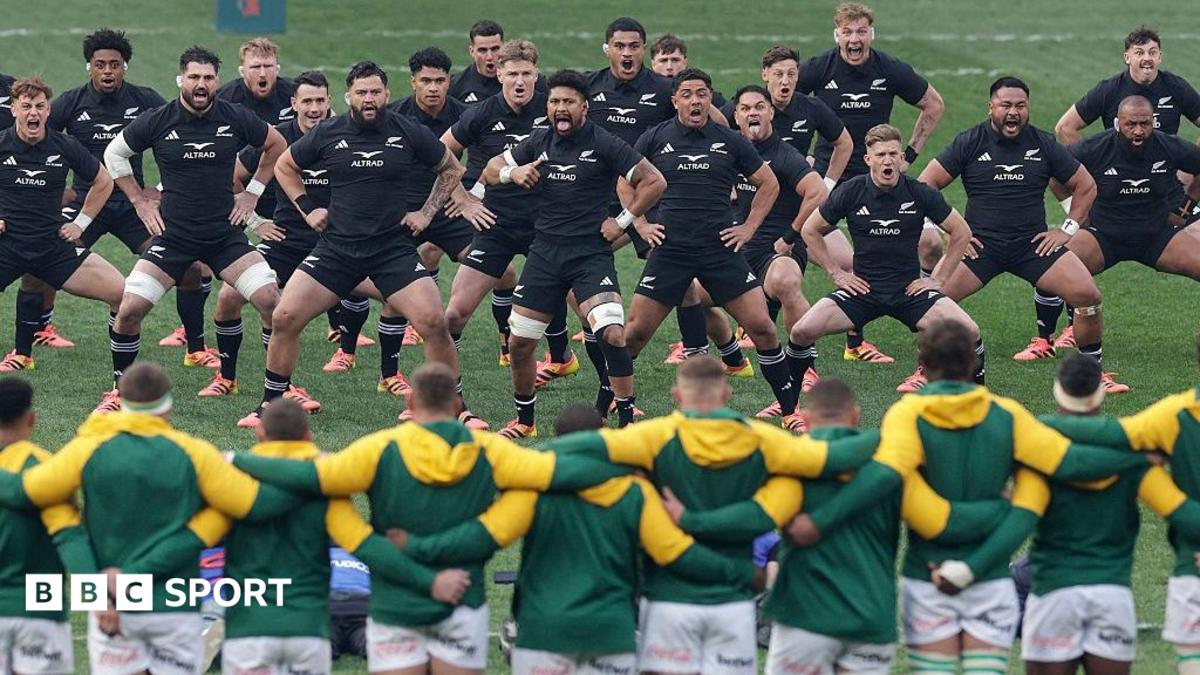
No post-match drug testing in South Africa v New Zealand series
Full Article
Original Source
Read the full article at Bbc →KhanList aggregates and links to publicly available news content. We do not host full articles from third-party sources. Always verify important information with original sources.